Saudi Arabia’s Voluntary Carbon Market Fuels the Shift to a Low-Carbon

Under UAE President’s directives, UAE launches urgent relief response for Ghana flood victims

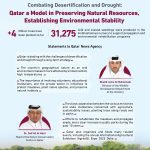
Combating Desertification and Drought: Qatar a Model in Preserving Natural Resources, Establishing Environmental Stability
UAE allocates US$30 million for emergency humanitarian response in El Obeid, calls for civilian protection, safe humanitarian aid access in Sudan


Amman, Jan. 29 (Petra)– Jordan’s seasonal rainfall has reached approximately 72 percent of the long-term annual average since the start of the current rainy season, following the impact of the seventh and final weather depression of the 40-day core of winter, according to the Jordan Meteorological Department.
Director of the department, Raed Al-Khattab, said that rainfall from the latest depression contributed an additional 1 to 5 percent to the seasonal total, particularly in the central and northern regions of the Kingdom.
Al-Khattab explained that Jordan was affected on Wednesday by the last weather system of the 40-day core of winter, accompanied by a cold and moist air mass, resulting in cold and cloudy conditions across most regions.
Rainfall began in the northern areas, then gradually extended to the central regions and parts of the eastern desert, where showers were at times heavy and short-lived, especially in the north and center.
The precipitation was accompanied by thunderstorms and occasional hail, leading to rising water levels in valleys and low-lying areas. Limited rainfall also reached parts of the southwestern regions, while moderate westerly winds, occasionally active, prevailed.
Al-Khattab added that the accumulated rainfall recorded from the onset of the depression through Thursday morning has helped improve the overall performance of the current rainy season, with increases ranging between 1 and 5 percent of the seasonal average.
According to the department’s data, Ras Munif station recorded the highest rainfall in the northern regions at 25.4 millimeters, equivalent to 4 percent of its seasonal average. It was followed by Hussein Gardens station in the central region with 20.0 millimeters (4 percent), and Samma station with 17.8 millimeters (4 percent).
In the eastern regions, Mafraq station recorded the highest rainfall at 6.8 millimeters, representing 5 percent of its seasonal average, while Rabba station in Karak Governorate registered the highest rainfall in the southwestern regions at 4.6 millimeters, equivalent to 1 percent of its seasonal average.
//Petra// MF
29/01/2026 21:18:38