Saudi Arabia’s Voluntary Carbon Market Fuels the Shift to a Low-Carbon

Under UAE President’s directives, UAE launches urgent relief response for Ghana flood victims
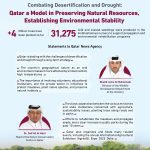
Combating Desertification and Drought: Qatar a Model in Preserving Natural Resources, Establishing Environmental Stability
UAE allocates US$30 million for emergency humanitarian response in El Obeid, calls for civilian protection, safe humanitarian aid access in Sudan

Amman, Jan. 29 (Petra)– Deputizing for Her Royal Highness Princess Rym Ali, Government Communication Minister and official government spokesperson, Mohammad Al-Momani, patronized the annual conference of the Model United Nations (MUN) Club at the Orthodox National School, underscoring that engaging young people in public affairs and policy making is a cornerstone for strengthening political and social stability, improving the quality of public decision-making, and building more sustainable policies.
Al-Momani said Jordan is demographically a young country, whose youth today are distinguished by a high level of awareness, global connectivity, and the ability to understand public decision-making frameworks and the nature of politics as the management of interests and priorities not slogans or momentary positions. This reality, he added, calls for a shift from viewing youth as mere policy beneficiaries to recognizing them as active partners in shaping and developing policies.
He stressed that involving qualified youth in public life not only broadens participation but also elevates the level of public discourse through understanding, accountability, and the presentation of alternatives. Such engagement, he noted, strengthens trust in institutions, promotes constructive, reform-oriented criticism, and reinforces a national dialogue grounded in knowledge and responsibility.
Al-Momani emphasized that student participation in Model United Nations conferences is far more than a symbolic school activity; it constitutes early training in public service by fostering an understanding of balancing interests, managing differences, and navigating the complexities of political realities. This experience, he said, offers young people deeper insight into the nature of politics and its tools.
He explained that states safeguard their interests and stability through an integrated set of tools, including diplomatic, political, and media instruments, while military options remain a last resort employed within specific frameworks and under precise considerations. Such experiences, he added, help build a politically conscious mindset that recognizes state strength not by slogans, but by the responsible and effective use of diverse tools within an institutional system governed by law and national interest.
Al-Momani noted that youth involved in these models acquire essential skills in official, political, and diplomatic language, as well as legal discourse and the language of action and achievement rather than rhetoric. This, he said, positively influences the nature and quality of public debate and contributes to a rational, fact-based discourse.
On digital media, Al-Momani affirmed that state sovereignty in the digital sphere has become a national necessity and a collective responsibility, requiring awareness of media’s role as a tool of influence and public opinion formation.
He stressed the importance of framing youth engagement on digital platforms within a responsible understanding of public policies and discourse boundaries to strengthen the national narrative and transform these platforms into spaces for constructive dialogue.
He also highlighted the vital role of the Jordanian family in building youth awareness and responsibility, as the primary incubator for instilling values of belonging, dialogue, and discipline. Political empowerment of youth, he said, cannot be complete without a supportive family and educational environment that complements the role of institutions and the public sphere.
Concluding his remarks, Al-Momani said Jordan’s stability and resilience are the result of wise leadership, strong institutions, and long-term investment in its people not chance. He underscored that involving youth in policy thinking and formulation is a strategic choice for the state and one of the most important tools for preserving political and social stability.
For her part, Principal of the Orthodox National School Mai Al-Qassous outlined the objectives of the school’s Model United Nations Club, which aims to build youth capacities and empower students with cognitive and analytical skills, conflict-resolution methods, and optimal approaches to addressing challenges.
The closing ceremony featured presentations by participants showcasing their experiences and the knowledge gained from the issues discussed, as well as opportunities for students to propose solutions to challenges in line with the Model United Nations framework for addressing global and regional issues.
//Petra// MF
29/01/2026 23:07:08