
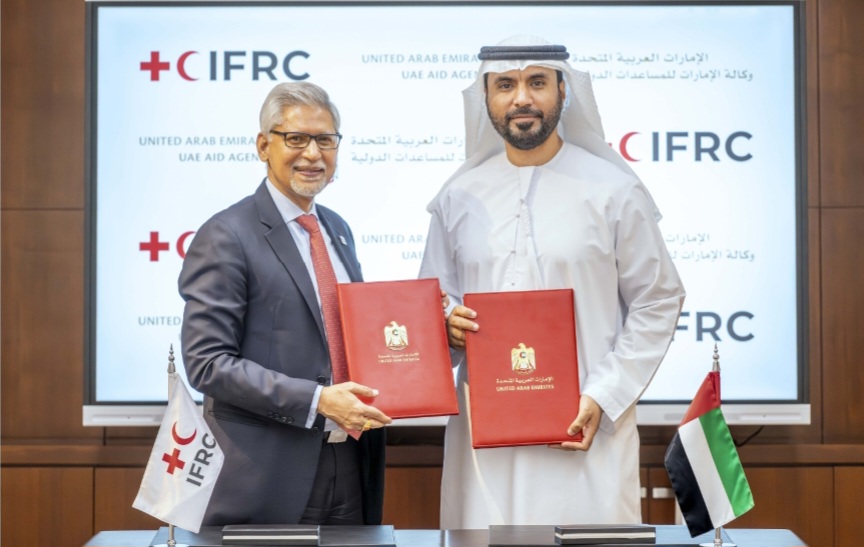
UAE signs cooperation agreement with IFRC to support humanitarian efforts in Sudan
Following directives of UAE President, UAE announces $550 million for UN’s 2026 Global Humanitarian OverviewABU DHABI
Arab-China Cooperation Forum to hold seventh edition on radio and television2 November 2025

Kuwait environmental sustainability constitutes developmental strategic pillar,


Irbid, Jan. 20 (Petra) – The opening of the new Princess Basma Hospital building marks a qualitative leap for the health sector in Irbid and across the northern region’s governorates, thanks to its advanced medical infrastructure and comprehensive specialized services, which contribute to raising the level of healthcare delivered to citizens.
The hospital, whose opening was held under royal patronage on Tuesday, is responding to a growing need for more efficient therapeutic services closer to patients, easing the burden on them and their families and improving access to diagnosis and therapeutic intervention, within a modern health environment that adheres to the highest standards of quality and safety.
This modern medical edifice embodies a national direction toward developing government health services and enhancing their readiness through investment in infrastructure and advanced medical equipment, ensuring the sustainability and efficiency of service provision.
The new Princess Basma Hospital, considered the second-largest government hospital in the Kingdom, is distinguished by integrated construction and medical specifications, large capacity, and modern specialized departments, reflecting the scale of development in the health sector in the northern region and laying the foundation for a new phase of comprehensive healthcare that meets the needs of various age groups.
The hospital was built on a plot of land measuring approximately 33 dunums, with a total built-up area of about 85,000 square meters. It consists of nine floors, with a capacity of 504 beds, expandable, in addition to 53 beds in the emergency department and 10 beds allocated for day surgeries, which improve emergency response efficiency, reduce waiting times, and enhance the ability to meet citizens’ growing health needs.
The total cost of constructing and equipping the hospital reached approximately JD100 million. The government contributed JD51 million from the public treasury, while JD49 million was provided through a grant from the Kingdom of Saudi Arabia. The project cost was distributed as JD75 million for construction and execution works and JD25 million for furnishing and equipment.
Minister of Health Ibrahim Al Bdour said in statements following the opening that the new hospital will create a qualitative leap in the health sector in the north of the Kingdom, noting that the number of beds will double compared with the old hospital, whose capacity did not exceed 227 beds, and that it will provide integrated medical and surgical services covering various specialties.
He added that the new hospital features modern construction and advanced infrastructure, in addition to high-quality medical services and the provision of the best advanced medical equipment across many specialties, noting that patient reception will be gradual and in phases at specified percentages of capacity until full operation, ensuring departmental readiness and smooth service delivery.
Al Bdour affirmed that medical staff at the hospital are integrated and will be reinforced as needed through direct recruitment, service procurement, or cooperation agreements with the Royal Medical Services and other health institutions, stressing the commitment to providing equal, fair, and high-quality medical services to all citizens.
He pointed out that the cancer treatment center, whose construction will begin at Princess Basma Hospital under directives from His Majesty King Abdullah II, will work in direct coordination with the King Hussein Cancer Center through unified therapeutic and administrative protocols, ensuring the provision of specialized medical services in accordance with the highest approved standards and at a quality comparable to advanced centers in this field, thereby alleviating the suffering of patients and visitors.
The health minister explained that a comprehensive assessment will be conducted of the old Princess Basma Hospital buildings to determine how they can be utilized in the next phase, noting the ministry’s orientation toward converting it into a comprehensive health center that would serve as a gateway to the new hospital, contributing to easing pressure on it and enhancing the concept of primary healthcare, whereby comprehensive health centers constitute the primary entry point for patients before referral to hospitals.
For his part, Princess Basma Hospital Director Ibrahim Al-Shhabat said during a tour of the hospital’s facilities that the opening of the hospital by His Majesty the King represents a pivotal milestone in developing health services in the north, noting that the hospital will provide advanced and sophisticated medical services supported by the latest medical equipment.
He indicated that the hospital has been supplied with a magnetic resonance imaging device that is among the most advanced in the region and the first of its kind within the Ministry of Health, in addition to the device available at the old hospital, as well as three CT scanners, seven radiology rooms, a bone density examination room, two mammography rooms, and a cardiac catheterization and interventional radiology unit.
He affirmed that citizens will feel a significant health leap across all levels given the hospital’s modern and advanced equipment and qualified staff, which enhances the level of services provided and elevates healthcare in Irbid governorate and the northern governorates in general.
The hospital includes integrated surgical departments with a capacity of 272 beds, covering precise specialties including neurosurgery, thoracic surgery, vascular surgery, burns and plastic surgery, orthopedics, ophthalmology, ear, nose and throat, and urology, in addition to 13 operating rooms, including 11 main rooms and two dedicated to day surgeries.
It also includes internal medicine and interventional departments with a capacity of 232 beds, covering nephrology, cardiology, gastroenterology and pulmonary diseases, in addition to procedure rooms, two cardiac and peripheral catheterization rooms, a dialysis unit with a capacity of 37 beds, and a gastrointestinal endoscopy unit.
The hospital features a fully integrated specialized emergency department with a capacity of 53 beds, equipped with an operating room, medical laboratory, radiology services, pharmacy, and specialized monitoring rooms for cardiac and cerebral strokes, in addition to a cardiac care unit and advanced monitoring areas for cardiac cases in accordance with advanced cardiac life support protocols.
The hospital includes advanced intensive care units, including a general intensive care unit, a cardiac care unit, and a cardiac intensive care unit (CICU), ensuring precise care for critical cases.
In diagnostics, the hospital includes a radiology department with 18 rooms equipped with the latest digital devices at the Ministry of Health level, including a 3-tesla magnetic resonance imaging (MRI) device supported by artificial intelligence, the first of its kind in ministry hospitals and the northern region, in addition to an advanced computed tomography scanner, an interventional radiology unit, and a mammography unit.
The hospital has also been equipped with advanced cardiac catheterization laboratories (biplane and single-plane), a modern lithotripsy system, and advanced patient monitoring systems, enhancing diagnostic accuracy and the speed of therapeutic intervention.
The hospital was designed according to an integrated engineering system ensuring interconnection and harmonious operation between firefighting, electrical and air-conditioning systems, achieving the highest standards of safety, operational continuity and emergency management efficiency.
The hospital enjoys a strategic location adjacent to Princess Badea Teaching Hospital for Obstetrics and Gynecology and Princess Rahma Pediatric Hospital, enabling effective integration in providing healthcare services for women, children and adults, and reinforcing the concept of integrated healthcare and continuity of services across different age groups and specialties.
//Petra// AF
20/01/2026 21:21:40