Saudi Arabia’s Voluntary Carbon Market Fuels the Shift to a Low-Carbon
Under UAE President’s directives, UAE launches urgent relief response for Ghana flood victims

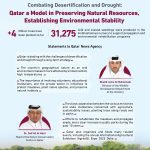
Combating Desertification and Drought: Qatar a Model in Preserving Natural Resources, Establishing Environmental Stability
UAE allocates US$30 million for emergency humanitarian response in El Obeid, calls for civilian protection, safe humanitarian aid access in Sudan


Amman, July 21 (Petra) – Secretary-General of the Ministry of Agriculture Mohammad Hayari said Sunday that the Cabinet’s decision to begin purchasing wheat and barley from the 2024/2025 agricultural season underscores the state’s commitment to supporting the agricultural sector.
In a press statement, Hayari noted that specialized committees under the Central Committee for Local Grain Purchasing began receiving wheat and barley from various regions of the Kingdom last Friday, with the process continuing until August 7.
He said the expected volume of wheat and barley to be received is around 36,000 tons. Additionally, about 424 certificates of origin are projected to be issued to farmers via a dedicated electronic platform designed to streamline procedures and accelerate workflow under the digital transformation plan.
The committees overseeing the receipt and inspection processes include representatives from the Ministries of Agriculture, Industry, Trade and Supply, and Finance, as well as the Audit Bureau, the Cooperative Corporation, and the National Agricultural Research Center. These bodies manage inspection, certificate auditing, and field verification of production.
Hayari stressed the importance of farmers complying with approved production certificates and adhering to quantity limits based on cultivated areas. A margin of up to 15 percent over the specified quantity is permitted, according to field inspection reports.
Farmers in the northern region are supplying grain to Irbid silos, while those in the central region are using the Juwaida silos in Amman. In the southern region, a receiving center has been set up in Rabbah, Karak Governorate, with the government covering transport costs to Juwaida silos.
Hayari emphasized that these efforts are part of a comprehensive government policy to support local production, boost food security, and encourage the cultivation of strategic crops, contributing to market stability and ensuring fair returns for farmers.
The Cabinet has set the subsidized purchase price at JD420 per ton of wheat and JD370 per ton of barley. The public treasury will cover screening and sterilization costs amounting to JD75 per ton, while the Cooperative Corporation will cover JD25 per ton for screening and seed packaging.
Additionally, the Cabinet approved a JD50 per ton reduction in seed prices for the 2025/2026 agricultural season. Wheat seeds, previously priced at JD500 per ton, will now be sold to farmers for JD450, while barley seeds will be sold for JD370 per ton, down from JD420.
//Petra// AJ
21/07/2025 14:39:15