Saudi Arabia’s Voluntary Carbon Market Fuels the Shift to a Low-Carbon

Under UAE President’s directives, UAE launches urgent relief response for Ghana flood victims

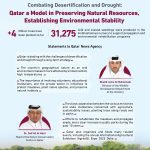
Combating Desertification and Drought: Qatar a Model in Preserving Natural Resources, Establishing Environmental Stability
UAE allocates US$30 million for emergency humanitarian response in El Obeid, calls for civilian protection, safe humanitarian aid access in Sudan

Royal
Directives Issued on Legislative Amendments to Social Protection System
Muscat,
11 Jan 2026 (ONA) — The Royal directives of His Majesty Sultan Haitham bin
Tarik to amend the provisions of certain social protection schemes reaffirm the
government’s established approach to developing the social protection system,
enhancing the fairness of entitlement, and improving the efficiency of
directing benefits to the most eligible. This aligns with economic and social
changes and places the individual and the family at the forefront of national
priorities.
The
Royal directives aim to regulate support for societal groups, particularly the
most vulnerable, ensuring that support is directed equitably to those entitled
to it. They take into account the circumstances of low-income families, women,
widows, and divorcees, guarantee no harm to beneficiaries, and enhance
procedural control. They ensure the continuity of disbursements according to
approved regulations and the integration of verification mechanisms and data
exchange. This framework safeguards rights, ensures proper implementation, and
solidifies principles of transparency and justice, thereby enhancing confidence
in the system and reassuring beneficiaries.
The
Royal blessings included amendments to the provisions of certain social
protection schemes. The monthly Senior Citizens Scheme (for those aged 60 and
above) of RO 115 will continue to be disbursed to beneficiaries whose monthly
income is RO 1,020 or less. For beneficiaries whose monthly incomes exceed RO
1,020 but are less than RO 1,250, their entitlement will be progressively
reduced. Furthermore, individuals whose income reaches RO 1,250 or higher will
no longer be eligible for the benefit.
The
Royal blessings also stipulated that child support payments and children’s
shares from pensions shall not be counted as part of the family income of a
widow or divorcee when calculating the Household Income Support Scheme.
Additionally, the calculation of equivalent income based on work capability for
determining the Household Income Support Benefit has been abolished for a
number of cases. These cases include: unmarried women who are 40 years of age
or older; divorced women with children who are 40 years of age or older;
divorced women with children not in their custody; and widows without children.
The maximum benefit for these cases will be set at RO 115 per month instead of
RO 80.
The
Royal blessings further included adding daughters and divorced women who lost
their fathers, aged between 31 and 39 years, to the cases considered as
independent families for the purpose of eligibility for the Household Income
Support Scheme.
Additionally,
the Royal blessings included adding parents as eligible beneficiaries for the
death pension, provided the deceased insured person has no other eligible
dependents from the categories of spouse or children. In the absence of
parents, grandparents shall be considered in their stead.
These
Royal directives contribute to achieving the objectives of the social
protection system, which serves as a cornerstone of societal stability and
comprehensive national development, fulfilling the purpose for which this
national system was established.
—
Ends/AH