Saudi Arabia’s Voluntary Carbon Market Fuels the Shift to a Low-Carbon
Under UAE President’s directives, UAE launches urgent relief response for Ghana flood victims
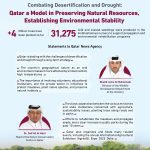
Combating Desertification and Drought: Qatar a Model in Preserving Natural Resources, Establishing Environmental Stability
UAE allocates US$30 million for emergency humanitarian response in El Obeid, calls for civilian protection, safe humanitarian aid access in Sudan

Amman
Exhibition Celebrates Arabic Calligraphy as Living Art Bridging Heritage,
Contemporary Expression
Amman,
9 Mar 2026 (ONA) — The Ruaa Gallery in the Jordanian capital, Amman, is
currently presenting a distinguished art exhibition titled “The Aesthetics
of Arabic Calligraphy,” featuring a carefully curated collection of visual
works that illuminate the richness of this venerable artistic tradition and its
dynamic evolution across diverse schools and creative expressions.
Organized
in celebration of the blessed month of Ramadan, the exhibition brings together
a distinguished ensemble of Arab artists whose works masterfully bridge
authenticity and innovation. The displayed pieces traverse a spectrum from
classical compositions inspired by time-honoured calligraphic traditions to
contemporary explorations that deploy the Arabic letter within experimental
visual formations, where plastic art and design converge in striking dialogue.
Many
of the artworks showcase the disciplined elegance of authentic Arabic
scripts—Thuluth, Naskh, and Diwani—while others liberate the letter from its
conventional constraints, transforming it into an autonomous visual element
integrated within abstract and geometric compositions that frequently intersect
with the vocabulary of Islamic ornamentation.
The
exhibited works engage with diverse textual sources encompassing Quranic verses
and literary passages, rendered through innovative artistic treatments and
surrounded by intricate Islamic decorations and nuanced chromatic gradations.
Certain compositions deliberately emancipate the Arabic letter from its
traditional structural confines, allowing it to emerge as a visual element
moving with freedom and intention within varied chromatic landscapes.
The
exhibition aspires to honour Arabic calligraphy as one of the most profound
expressions of Arab cultural identity, affirming its transcendence beyond mere
written communication to become a visual art form capable of communicating both
aesthetic pleasure and spiritual resonance.
According
to the exhibition organizers, the inherent flexibility of the Arabic letter and
its remarkable capacity to assume multiple configurations have rendered it an
enduring source of inspiration for contemporary artists, who deploy it within
modern artistic visions that seamlessly fuse experimental creativity with the
depth of visual heritage.
—
Ends/Khalid