35th Doha Book Fair, Cultural Salon Highlights Religion’s Role in Fostering Tight-Knit Families in Times of Crisis
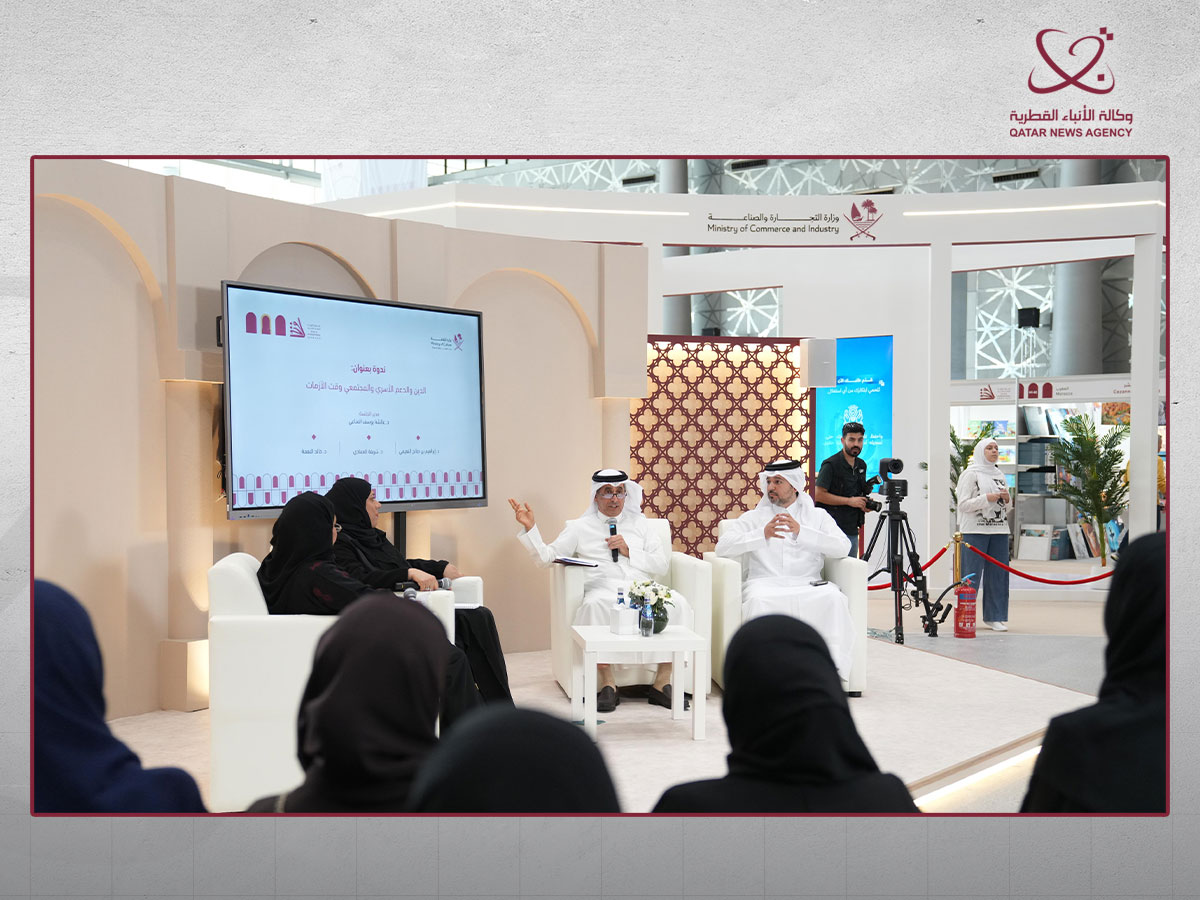
Doha, May 16 (QNA) – The cultural salon at the 35th Doha International Book Fair, held at the Doha Exhibition and Convention Center, hosted a symposium on religion and family support in times of crisis, as part of the cultural events of the fair.
Held in collaboration with Doha International Center for Interfaith Dialogue (DICID) and Doha International Family Institute (DIFI), the event saw the participation of HE Chairman of DICID’s Board of Directors Dr. Ibrahim bin Saleh Al Nuaimi, Executive Director of DIFI Dr. Sharifa Noaman Al Emadi, alongside Director of Advocacy and Outreach at DIFI Dr. Khalid Al Naama.
Moderated by Director of Muhammad bin Hamad Al-Thani Center for Muslim Contribution to Civilization (CMCC) Dr. Aisha Yousef Al Mannai, the symposium tackled the importance of religion and sound religious discourse in enhancing tight-knit families and society in times of crisis, as well as the role of this discourse in strengthening the tenets of mercy, interdependence, dialogue, and social cohesion.
Presenting a paper on the role of proper religious discourse in fostering tight-knit families and society in times of crisis, Dr. Al Nuaimi emphasized that wars, conflicts, epidemics, and rapid socioeconomic transformations have revealed that humans always need a value system that gives them the ability to coexist, remain resilient, and adapt in the face of anxiety and perturbation.
The Abrahamic religions recognized the importance of values of mercy, solidarity, and shared moral responsibility in preserving the cohesion of the individual and society during crises, he underlined.
Dr. Al Nuaimi opined that the Islamic perception considers religion a civilizational and ethical system that regulates the nexus between humans and their families and societies, thereby placing the family at the heart of this structure as “the prime nucleus” for humanitarian stability.
Christianity and Judaism likewise emphasize the importance of the family and shared responsibility in the moral reform of society, Al Nuaimi noted, reemphasizing that sound religious discourse contributes to building awareness, strengthening hope and values, as well as shielding the family from disintegration.
Dr. Al Nuaimi further indicated that balanced discourse is imperative to confront fear, hatred, division, and loss of confidence in times of crisis.
He stressed the critical importance of interfaith and cultural dialogue as a civilizational imperative that bolsters understanding and societal peace.
Dr. Al Nuaimi noted that DICID has always been interested in this topic, having organized the 15th Doha Conference on Interfaith Dialogue in May 2024 under the theme “Integration of Families, Faith, Values, and Education”.
The 18th issue of Adyan magazine dedicated its focus to family issues amid contemporary changes, Dr. Al Nuaimi highlighted, before concluding that the strength of societies is not measured by their material and technological capabilities alone, but rather by their ability to safeguard their humanity and maintain family and social cohesion in times of adversity.
Dr. Sharifa Al Emadi, for her part, asserted that upholding religious tenets fosters family cohesion and amplifies families’ ability to confront crises.
DIFI-prepared studies have demonstrated that societies- closely interconnected through religion and family-have been more stable during crises compared to other societies where rates of violence, suicide, and family disintegration have been on the ascent, Al Emadi pointed out.
She underscored that the Arab family, by nature, becomes more interconnected in times of crisis, something that helps enhance dialogue and psychological support among its members.
It is highly important to uphold emotional and psychological support within the family, which gives children a sense of security and reassurance, while parental tension is directly reflected in children, Dr. Al Emadi underlined. She implored parents to serve as a practical model for their children in behavior and dealing with crises.
Dr. Al Emadi further revealed that DIFI is poised to organize its 6th international conference next October to discuss family welfare and gauge family cohesion in Islamic nations, with a particular focus on the role of religious tenets in strengthening family stability.
For his part, Dr. Al Naama underscored the importance of promoting dialogue within families and forging bridges of understanding among parents and their sons and daughters.
He noted that the biggest challenge facing families today is the metastasizing intellectual and emotional gap between the two generations.
Dr. Al Naama highlighted that differences in ideas between parents and children have begun creating a state of “implicit disagreement” as parents strive to protect and guide their sons and daughters, who sometimes interpret that as a restriction on freedom or a lack of understanding.
He added that those sons and daughters, in turn, carry a “silent outcry” embodied in their feeling that their parents don’t understand them quite well, underscoring the need to reconsider the nature of family relations and methods of communication within the household.
Dr. Al Naama indicated that what matters most is instilling a culture of accepting differences and gratitude within the family, and teaching sons and daughters to respect diversity in opinions and ideas, while preserving family bonds built on appreciation and mutual support. (QNA)