Saudi Arabia’s Voluntary Carbon Market Fuels the Shift to a Low-Carbon

Under UAE President’s directives, UAE launches urgent relief response for Ghana flood victims
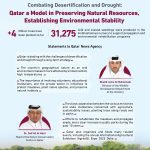
Combating Desertification and Drought: Qatar a Model in Preserving Natural Resources, Establishing Environmental Stability
UAE allocates US$30 million for emergency humanitarian response in El Obeid, calls for civilian protection, safe humanitarian aid access in Sudan

New York, (SUNA) — Sudan’s Permanent Representative to the United Nations, Ambassador Al-Harith Idris, renewed the Government of Sudan’s commitment to achieving peace, affirming its acceptance of regional and international initiatives aimed at ending the war, while stressing that any sustainable settlement must stem from a purely Sudanese national will. Addressing the UN Security Council, Idris said the government “has spared no effort in seeking peace and engaging with initiatives aimed at ending the war and addressing the humanitarian situation,” noting the signing of the Jeddah Declaration of Principles in May 2023. He added that “the Rapid Support Forces (RSF) militia’s intransigence and its insistence on positioning itself inside state institutions, public facilities, civilian homes, and hospitals led to flagrant violations that undermined the effectiveness of the agreement.” He welcomed the efforts of the UN Secretary-General’s Special Envoy, affirming Sudan’s “full cooperation with efforts aimed at ending the war,” and also commended briefings delivered by the Under-Secretary-General for Political and Peacebuilding Affairs and the Deputy Executive Director of UNICEF. Sudan’s Permanent Representative to the United Nations explained that the multiplicity of negotiating forums and tracks has contributed to complicating settlement efforts, stating that the fragmentation of efforts and lack of coordination, together with the failure of some initiatives to include all parties, has prevented addressing the root causes of the crisis and reaching a coherent peace strategy. He stressed that the government’s vision is based on the protection of civilians through an approved national plan, which includes the withdrawal of militias from cities in Darfur and Kordofan, adding that “any ceasefire that is not accompanied by such withdrawal would effectively entrench a reality that threatens the unity of the country.” Ambassador Al-Harith Idris noted that Sudan has submitted clear proposals to mediators regarding withdrawal from those areas, describing it as a key guarantee for successful negotiations and for preserving Sudan’s unity, while reaffirming the government’s commitment to facilitating humanitarian access through all routes, airports, and ports without obstacles. He underscored that the political process is “a purely national ownership process managed inside Sudan and by the will of Sudanese people,” noting that the population is “tired of the multiplicity of external initiatives and conflicting agendas of some states.” On the issue of ceasefire, he said Sudan does not oppose it in principle, but rejects any arrangement that would allow the militia to regroup militarily. Ambassador Idris also called for reliance on evidence and testimonies regarding violations, stating that the militia’s record “warrants its designation as a terrorist organization, similar to ISIS, Boko Haram, and the Lord’s Resistance Army.” Idris stressed that achieving peace requires broad participation, including political and social forces, women, youth, civil society organizations, as well as the armed forces and regular institutions as “key guarantors of security.” He revealed plans by the government to organize a national conference on social peace and reconciliation aimed at “rebuilding trust, strengthening peaceful coexistence, addressing the root causes of conflicts, and linking this process to transitional justice mechanisms,” with the participation of various societal actors to ensure that peace becomes an inclusive process not limited to the government.BH/BH