Saudi Arabia’s Voluntary Carbon Market Fuels the Shift to a Low-Carbon

Under UAE President’s directives, UAE launches urgent relief response for Ghana flood victims
Combating Desertification and Drought: Qatar a Model in Preserving Natural Resources, Establishing Environmental Stability
UAE allocates US$30 million for emergency humanitarian response in El Obeid, calls for civilian protection, safe humanitarian aid access in Sudan

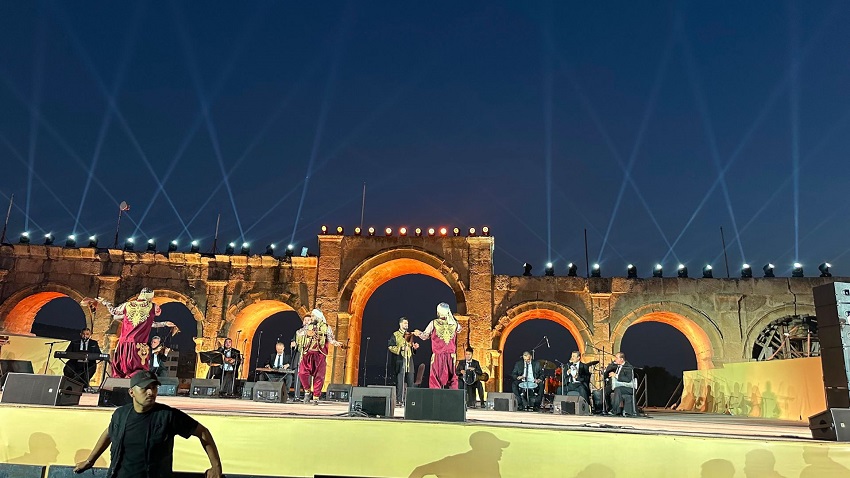
Jerash, Aug. 2 (Petra) — Continuing its mission of celebrating
shared cultural heritage, the Hippodrome stage at the **Jerash
Festival for Culture and Arts** hosted an evening of performances
showcasing the richness and diversity of Arab music, folklore and
traditional singing.
The event was attended by Minister of Culture and Chairman of the
Festival’s Higher Committee Mustafa Rawashdeh, Minister of Tourism
and Antiquities Imad Hijazin, Culture Ministry Secretary-General
Nidal Al-Ahmad, Festival Executive Director Yazan Khudair, Director
of the Jerash Antiquities Directorate Mohammad Al-Shalabi and
Director of the Jerash Tourism Directorate Thaer Al-Ayasrah.
The Hippodrome continued its role as a platform for Arab cultural
expression, presenting performances that highlighted traditional arts
as a bridge for cultural exchange and dialogue among peoples.
The Syrian Heritage Masterpieces Ensemble presented a performance
celebrating Syria’s artistic legacy through traditional folk dances,
heritage music and Aleppine music, one of the oldest and most
distinguished schools of Arab singing originating from the city of
Aleppo.
The ensemble showcased scenes inspired by Syrian folklore, reflecting
customs and traditions passed down through generations while
highlighting the distinctive melodic richness and artistic depth of
Aleppine musical traditions. The performance offered audiences a
vivid glimpse into Syria’s rich cultural heritage and was warmly
received by festival-goers.
The Kan Choir, affiliated with the Jordanian Kan Culture Association,
followed with a choral performance featuring a selection of
patriotic, traditional and humanitarian songs. The concert
highlighted the expressive power of choral singing through harmonious
vocal arrangements that reflected Jordan’s cultural identity.
The evening concluded with a performance by the Iraqi Maqam Ensemble,
which brought one of the Arab world’s oldest musical traditions to
the Jerash audience. Led by renowned maqam singer Hussein Al-Aadhami
and featuring ten musicians, the ensemble performed a selection of
maqamat associated with Baghdad, Mosul, Erbil and Basra, illustrating
the diversity of Iraq’s musical heritage.
Iraqi maqam is regarded as a comprehensive musical tradition built on
artistic principles refined over centuries, blending Arabic poetry,
vocal performance and instrumental accompaniment into a sophisticated
musical form. Each maqam is distinguished by its own melodic and
rhythmic structure, expressing a wide range of emotional and human
experiences, making it one of the most profound forms of Arab
traditional music.
The performance also featured the traditional instruments that define
the maqam tradition, including the jawza, santur, naqqara and oud,
whose distinctive sounds have helped preserve the authenticity and
continuity of the art form across generations.
Widely regarded as a cornerstone of Iraq’s cultural identity, Iraqi
maqam has long been performed at social, cultural and religious
occasions and remains an important part of the country’s musical
heritage. Its artistic richness continues to attract the attention of
scholars and enthusiasts of traditional music throughout the Arab
world and beyond.
Blending the sounds of Iraqi maqam, Syrian folklore and Jordanian
choral music, the Hippodrome stage offered audiences a vibrant
celebration of Arab cultural heritage, reaffirming the Jerash
Festival’s role as a platform for cultural dialogue and artistic
creativity that bridges tradition and contemporary expression.
//Petra// AF