Saudi Arabia’s Voluntary Carbon Market Fuels the Shift to a Low-Carbon

Under UAE President’s directives, UAE launches urgent relief response for Ghana flood victims

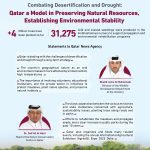
Combating Desertification and Drought: Qatar a Model in Preserving Natural Resources, Establishing Environmental Stability
UAE allocates US$30 million for emergency humanitarian response in El Obeid, calls for civilian protection, safe humanitarian aid access in Sudan


Amman, Aug. 21 (Petra)– Amman will host the second Conference on
Climate Change and Health in the Arab Region (CCHAR-II 2026) from
August 24 to 26, bringing together leading researchers, policymakers,
and representatives of ministries, universities, scientific
institutions, and regional and international organizations.
The conference is organized by the University of Jordan in
cooperation with a network of scientific institutions, including
Jordan University of Science and Technology, the Royal Scientific
Society, The Hashemite University, the University of California San
Diego, the University of California, Berkeley, the University of
California, San Francisco, Harvard T.H. Chan School of Public Health,
Texas A&M University, the University of Balamand, and Mohammed VI
University of Health Sciences, as well as researchers, experts and
partner institutions from Arab and international countries.
Held at the Le Royal Hotel under the theme “Policy Translation and
Implementation,” the conference aims to strengthen the transition
from generating scientific evidence on the health impacts of climate
change to using that evidence to develop policies, programs and
practical interventions that protect community health and strengthen
the capacity of health systems across the Arab region to address
growing climate-related risks.
Chairman of the conference’s organizing committee, Professor Ahmad
Al-Salameh, told the Jordan News Agency (Petra) that the conference
is being held amid rising temperatures across the Arab region,
increasingly frequent heatwaves and dust storms, and growing
challenges related to water scarcity, air pollution and
climate-sensitive diseases.
He said these challenges require stronger cooperation among
researchers, decision-makers and implementing bodies, as well as the
development of evidence-based responses that take into account the
needs and specific circumstances of Arab communities.
Al-Salameh added that the opening session will feature a keynote
lecture by Dr. Wael Al-Dulaimi, a faculty member at the University of
California San Diego, on the need for a qualitative shift in
translating climate and health research into policy.
He stressed that hosting the event reflects the advanced role played
by Jordanian academic and scientific institutions in leading the
regional dialogue on climate change and health.
The conference, he explained, has been designed as a platform for
joint action and solution development rather than merely a venue for
presenting research and knowledge. It will focus on building
effective partnerships among scientific, policy and implementation
sectors and producing recommendations and tools that institutions can
use in health and climate planning.
The aim is to translate research findings into applicable policies
and interventions while enhancing the preparedness of communities and
institutions to address the health impacts of climate change.
Al-Salameh said the conference will feature an extensive scientific
program comprising 12 specialized sessions and around 68 scientific
and research presentations addressing some of the most pressing
climate and health challenges facing Jordan and the Arab region.
The research will cover the use of artificial intelligence and data
science to predict climate-related diseases, the relationship between
climate variables and disease incidence, and the use of digital
technologies to improve the reliability of renewable energy and
promote public health.
Researchers will also examine the health impacts of air pollution and
dust storms, including respiratory, eye and nasal symptoms associated
with Khamsin storms, as well as the relationship between fine
particulate matter, climate variability and mortality rates in
Jordan.
Other studies will address the impact of environmental exposures on
the health of children and mothers, as well as chronic and
climate-sensitive diseases.
The conference will also explore the effects of heatwaves and
nighttime temperatures on health and mortality, the development of
indicators to measure heat vulnerability in cities, and the
feasibility of establishing safe cooling spaces in densely populated
areas of Amman.
Research will further examine schools’ preparedness and teachers’
knowledge of the health risks associated with heatwaves, as well as
the effectiveness of climate adaptation strategies in improving
asthma control among refugees during periods of extreme heat and dust
storms.
The conference will also feature dialogue sessions bringing together
scientific and policy perspectives to discuss ways to strengthen
climate and health preparedness in the Arab region, with the
participation of researchers, experts, parliamentarians, health
ministry officials, and representatives of national and regional
institutions.
The event is being organized as part of a scientific cooperation
network that includes the Royal Scientific Society, the University of
Jordan, Jordan University of Science and Technology, the University
of California San Diego, the University of California, Berkeley, the
University of California, San Francisco, Harvard T.H. Chan School of
Public Health, Texas A&M University, the University of Balamand, and
Mohammed VI University of Health Sciences, alongside researchers,
experts and partner institutions from Arab and international
countries.
CCHAR-II 2026 builds on the success of the conference’s first edition
and represents one of the key platforms for regional cooperation on
climate change and health. It seeks to facilitate the exchange of
expertise, build capacity, and develop research and institutional
partnerships that support the translation of scientific evidence into
applicable policies and practices across the Arab region.
The conference is scheduled to conclude with a set of recommendations
aimed at strengthening cooperation between scientific institutions
and policymakers, promoting the integration of health considerations
into climate and adaptation policies, and identifying research and
joint action priorities for the next phase.
//Petra// MF