Saudi Arabia’s Voluntary Carbon Market Fuels the Shift to a Low-Carbon

Under UAE President’s directives, UAE launches urgent relief response for Ghana flood victims
Combating Desertification and Drought: Qatar a Model in Preserving Natural Resources, Establishing Environmental Stability
UAE allocates US$30 million for emergency humanitarian response in El Obeid, calls for civilian protection, safe humanitarian aid access in Sudan

Oman Presides over Working Committee for Middle East
Nuclear-Weapon-Free Zone
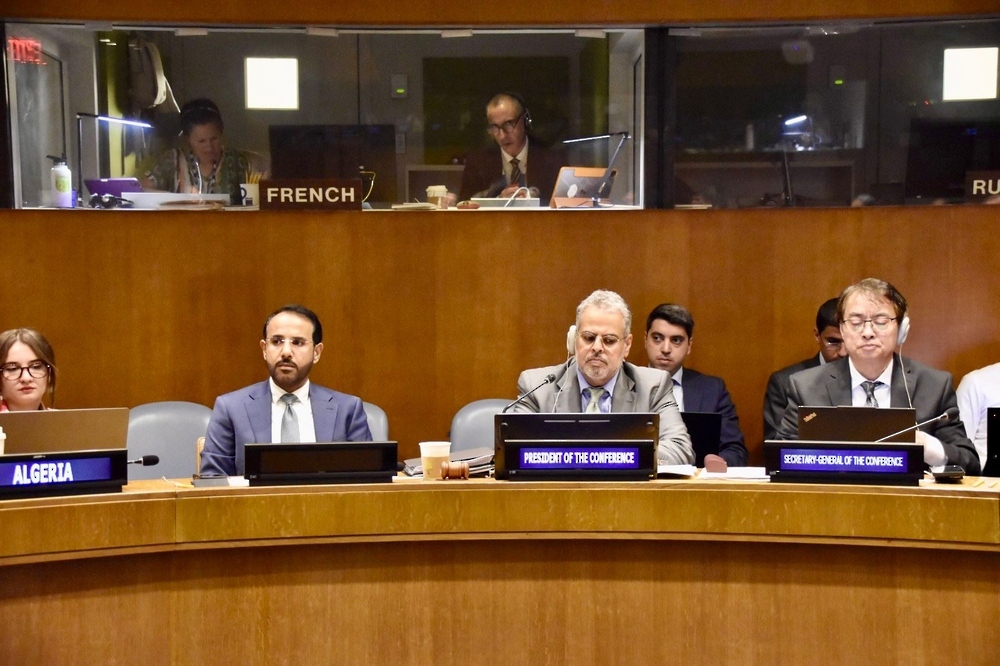
New York, 2 Sep 2026 (ONA) — The Sultanate of Oman today
chaired the proceedings of the third meeting of the Working Committee of the
Seventh Session of the Conference on the Establishment of a Middle East Zone
Free of Nuclear Weapons and Other Weapons of Mass Destruction, held at United
Nations Headquarters in New York. The meeting will continue its deliberations
until 3 September 2026.
The session is presided over by Ambassador Omar Said Al Kathiri,
Permanent Representative of the Sultanate of Oman to the United Nations and
President of the Seventh Session of the Conference. This meeting forms part of
the preparatory process led by the Sultanate of Oman for the upcoming session
of the Conference, scheduled to convene in New York from 16 to 20 November
2026.
The Conference constitutes a negotiating track that brings
together States of the region under the auspices of the United Nations, with
the objective of concluding a treaty establishing a Middle East zone free of
nuclear weapons and other weapons of mass destruction, thereby contributing to
the strengthening of regional and international peace and security.
The current meeting addresses a number of pivotal issues
pertaining to the prospective form of the future treaty and its implementation
mechanisms. Deliberations focus on the institutional arrangements the treaty
may require to oversee compliance with its provisions and to facilitate
cooperation among States Parties, as well as on the relationship between the
future treaty and existing international agreements in the fields of
disarmament and non-proliferation, with a view to ensuring complementarity and
avoiding duplication of obligations.
Participants are drawing upon the experiences of other regions
worldwide that have already established nuclear-weapon-free zones, as well as
the legal and technical expertise of specialists participating in the meeting.
This is intended to enable regional states to familiarize themselves with the
options and best practices that may be leveraged during negotiations on a
treaty specific to the Middle East.
In its national statement delivered before the meeting, the
Sultanate of Oman emphasized the importance of continuing to work in a spirit
of cooperation and consensus among Member States, noting that the meetings held
throughout the current year have contributed to deepening shared understanding
of a number of issues pertaining to the future treaty, and to benefiting from
relevant international experiences and expertise.
This meeting forms part of a series of preparatory sessions
convened by the Working Committee under the presidency of the Sultanate of Oman
for the Seventh Session, with the aim of providing a space for technical and
substantive dialogue among Member States in advance of the conference in
November, and building a common ground that can facilitate progress in
negotiations.
Through its presidency of the Seventh Session of the Conference,
the Sultanate of Oman continues its efforts, in collaboration with Member
States and the United Nations, to bridge perspectives and foster dialogue and
consensus, thereby supporting endeavors to realize the shared objective of
establishing a Middle East zone free of nuclear weapons and other weapons of
mass destruction.
— Ends/AH