Saudi Arabia’s Voluntary Carbon Market Fuels the Shift to a Low-Carbon
Under UAE President’s directives, UAE launches urgent relief response for Ghana flood victims
Combating Desertification and Drought: Qatar a Model in Preserving Natural Resources, Establishing Environmental Stability
UAE allocates US$30 million for emergency humanitarian response in El Obeid, calls for civilian protection, safe humanitarian aid access in Sudan

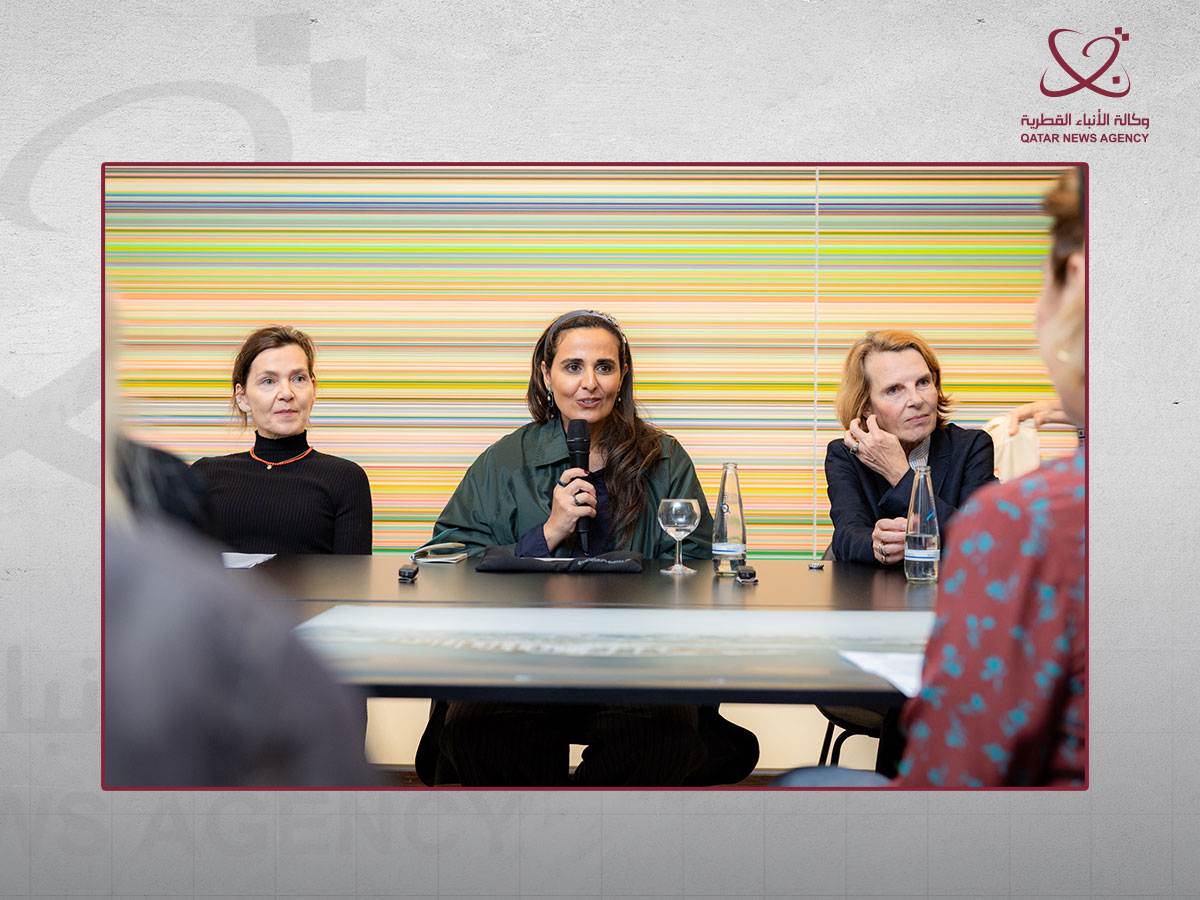
Berlin, September 10 (QNA) – At a special event held Thursday at the Neue Nationalgalerie in Berlin, HE Chairperson of Qatar Museums Sheikha Al Mayassa bint Hamad Al-Thani announced the creation of Doha Pavilion: Gerhard Richter, a new permanent, site-specific structure conceived by the world-renowned artist.
Doha Pavilion has been designed by Gerhard Richter as a free-standing work of art and architecture housing a distinct body of his paintings and sculpture. Selldorf Architects worked with the artist to realise his vision for the project, which will be located in Doha’s MIA Park. Doha Pavilion will be unveiled on Nov. 20 on the eve of the opening of Rubaiya Qatar, the nation’s new contemporary art quadrennial.
Her Excellency made the announcement as part of a roundtable discussion with Annabelle Selldorf, Principal of Selldorf Architects, and Tom Eccles, Advisor, Public Art, for Qatar Museums and Co-Curator of Rubaiya Qatar.
Her Excellency also spoke at a public presentation at the Neue Nationalgalerie, appearing in a conversation with the Icelandic-Danish artist Olafur Eliasson on the topic of “Art, Patronage and Cultural Stewardship.”
Her Excellency discussed with the artist his long relationship with Qatar Museums, which has included creation of the permanent site-specific installation Shadows Traveling on the Sea of the Day and the major exhibition The Curious Desert at the National Museum of Qatar.
Her Excellency Sheikha Al Mayassa bint Hamad Al-Thani said “Qatar’s ambitious program of public art installations continues to grow from our belief that art is part of everyday life, a source of knowledge and dialogue, and that its presence in public space allows everyone to engage with new ideas and experiences. Our longstanding relationships with outstanding figures in contemporary art have helped us build a program that brings together creativity, research and knowledge, making culture an open space for exchange and learning.”
“It is an extraordinary pleasure to add to this journey our collaboration with Gerhard Richter through his exceptional Doha Pavilion, which holds particular significance for us as part of the continuing legacy of the Qatar–Germany 2017 Year of Culture. It demonstrates the ability of the Years of Culture initiative to build lasting relationships and partnerships whose impact extends far beyond the year of celebration. Doha Pavilion will be an important addition to Qatar’s cultural landscape, offering a new space for reflection and engagement with the work of one of the greatest artists of his generation,” Her Excellency added.
It is also a great pleasure to rejoin Olafur Eliasson, a close friend of Qatar Museums, to share with an audience in Berlin some of what has emerged from our longstanding collaboration. I am grateful to Klaus Biesenbach, Director of the Neue Nationalgalerie, for graciously hosting these events.”
Gerhard Richter said, “My trip to Doha in 2013 came two years into developing my Strip paintings, and the city’s architecture and history sparked an idea for a pavilion that could unite the thematic threads of that body of work. The Pavilion’s exterior features decorative tiles based on the Patterns that first led me to the Strips. Inside, Strip paintings hang alongside Mirrors, and the Strip Tower is installed centrally within. Doha is the right place and the only place for my Pavilion.”
With a career spanning from the 1960s to the present, Gerhard Richter has pursued a diverse and influential practice that has explored and expanded the formal and conceptual possibilities of art and the ways in which we relate to images. His vast body of work, which includes paintings, objects, installations, works on paper, editions, and photographic documentation, is grounded in deeply nuanced investigations of history, memory, and perception.
Richter’s Doha Pavilion is a hexagonal structure that unites several of the most significant threads of his longstanding inquiry into the nature of visual representation. The pavilion’s six exterior walls are clad in repeating patterns composed on printed panels. These patterns relate to Richter’s 2011 artist’s book Patterns, which documented the creative process behind his well-known series of Strip paintings, which he began the same year. Together, the walls translate these digitally derived compositions into a new architectural format, expanding Richter’s uniquely analytical and experimental approach to painting-and to perception-into three dimensions.
Rubaiya Qatar, the nation’s new international visual arts quadrennial, will take place from No. 21 through April 30, 2027. Centered on overarching themes of global ecology, water’s political and geographic importance, and the maritime heritage that links Qatar to the world, the inaugural edition brings together exhibitions and public art installations featuring more than 50 regional and international artists with particular attention to artists from outside the Western Hemisphere, 25 new commissions and 6 public art installations.
The multidisciplinary quadrennial aims to inspire and empower new generations of artists and thinkers, with the dynamic cultural hub of Qatar as their platform.
It will unfold across multiple sites in Doha, including the newly renovated ALRIWAQ Arts + Architecture building, the Museum of Islamic Art (MIA), Katara QM Gallery, and Mathaf: Arab Museum of Modern Art, and in public sites across the country. (QNA)