Saudi Arabia’s Voluntary Carbon Market Fuels the Shift to a Low-Carbon

Under UAE President’s directives, UAE launches urgent relief response for Ghana flood victims
Combating Desertification and Drought: Qatar a Model in Preserving Natural Resources, Establishing Environmental Stability

UAE allocates US$30 million for emergency humanitarian response in El Obeid, calls for civilian protection, safe humanitarian aid access in Sudan

National
Museum Inaugurates “Book Culture of Belarusian Tatars” Exhibition
Muscat,
Sep 9 (ONA) — The National Museum, in cooperation with the National Library of
Belarus, inaugurated today the “Book Culture of Belarusian Tatars”
Exhibition.
The
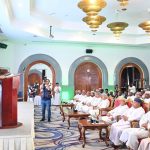
opening ceremony was held under the auspices of Dr. Mohammed Said Al Maamari,
Minister of Endowments and Religious Affairs.
The
exhibition, which continues through 6 November 2026, presents unique examples
of the manuscript heritage of the Tatars of Belarus from the holdings of the
National Library of Belarus, highlighting the most prominent written legacy
produced by Muslims that reflects their cultural and religious identity.
The
exhibition comes within the framework of introducing the cultural diversity
enjoyed by Belarus and highlighting examples of the contributions of Islamic
communities in preserving and inheriting knowledge across generations.
Vadim
Gigin, General Director of the National Library of Belarus, said: “The
written heritage of the Tatars of Belarus represents one of the most precious
and important parts of Belarusian history, offering a window into a unique
cultural phenomenon that reflects the exceptional legacy of the Tatars of
Belarus, who preserved their identity and became an authentic part of national
life in Belarus. The exhibition is not limited to displaying these heritage
treasures, but also represents a symbol of the growing ties between the
Republic of Belarus and the Sultanate of Oman, embodying our mutual respect for
history and our keenness to preserve cultural heritage.”
He
added: “Our cooperation is not limited to this exhibition; as we express
our deep gratitude to the National Records and Archives Authority and the
National Museum in the Sultanate of Oman for their pioneering initiative to
launch a specialized training program for restorers from the National Library
of Belarus, allowing for the exchange of expertise and the enhancement of
preservation and restoration skills to safeguard these heritage treasures for
future generations. This cooperation serves as a bridge connecting our two
countries, linking the past to the future, and contributing to the protection
and study of rich Islamic book culture.”
The
exhibition features a number of Holy Qurans dating from the first quarter of
the 19th century to the early 20th century AD, bearing the names of their
copyists and owners. These Qurans are distinguished by the multiplicity of
languages used, as Arabic texts were recorded alongside Turkish, Belarusian,
and Polish using the Arabic script.
It
also includes exegeses of the Holy Qur’an dating back to the late 18th century
and early 20th century AD, alongside manuscript writings known as
“Kitab”—diverse collections of topics from the second half of the
19th century and the early 20th century AD, which record the places of their
transcription and the names of their copyists.
The
exhibition dedicates another section to displaying examples of the most widely
distributed books among the Tatars of Belarus, which are small prayer booklets
known as “Hamail”, prepared in the late 19th century and early 20th
century AD in cities such as Slonim, Minsk, and other areas of Belarus.
The
exhibits are not limited to religious works, as the exhibition includes part of
a medical book dating back to the late 19th century AD, written in Belarusian
and Polish using the Arabic script, along with examples associated with
teaching reading, writing, and literacy, highlighting the broad function of
manuscript books among the Tatars of Belarus beyond the religious realm into
the fields of knowledge, education, and daily life.
These
manuscripts were written in Arabic, Turkish, Belarusian, and Polish, all using
the Arabic alphabet. Muslims in Belarus created a special alphabet based on
Arabic script that enabled them to record the sounds of the Belarusian language
with high accuracy, making it considered one of the writing systems most
capable of representing these sounds compared to other alphabets.
It
is worth noting that the National Library in Minsk is the largest library in
the Republic of Belarus, founded in 1922 and housing millions of books and
documents. Its modern building features a unique polyhedral architectural
design, housing reading halls, a conference center, and an observation deck
overlooking the city, making it a prominent cultural and architectural
landmark.
The
exhibition was accompanied by a lecture on the book culture of the Tatars of
Belarus delivered by Krystsina Yermak, Head of Department in the Cultural
Heritage Directorate of the Republic of Belarus. The lecture addressed the
manuscript legacy of the Tatars of Belarus, highlighting the uniqueness of this
heritage that combines Arabic script with Belarusian, Turkish, and Polish
languages, and what it reflects of centuries-long cultural and religious
interaction in Eastern Europe.
—Ends/AG