Jordan’s Q2 2026 GDP Expands 3.0%, Outperforming Regional Headwinds, International Forecasts

ENV-KUWAIT-SUSTAINABLITYKuwait strengthens environmental sustainability through strategic initiativesBy Zahra Al-Kadhmi

HLT-KUWAIT-SURGERYKuwait advances health sector with robotic, remote surgeryBy Mohammad Al-Moseb

Saudi Arabia’s Voluntary Carbon Market Fuels the Shift to a Low-Carbon

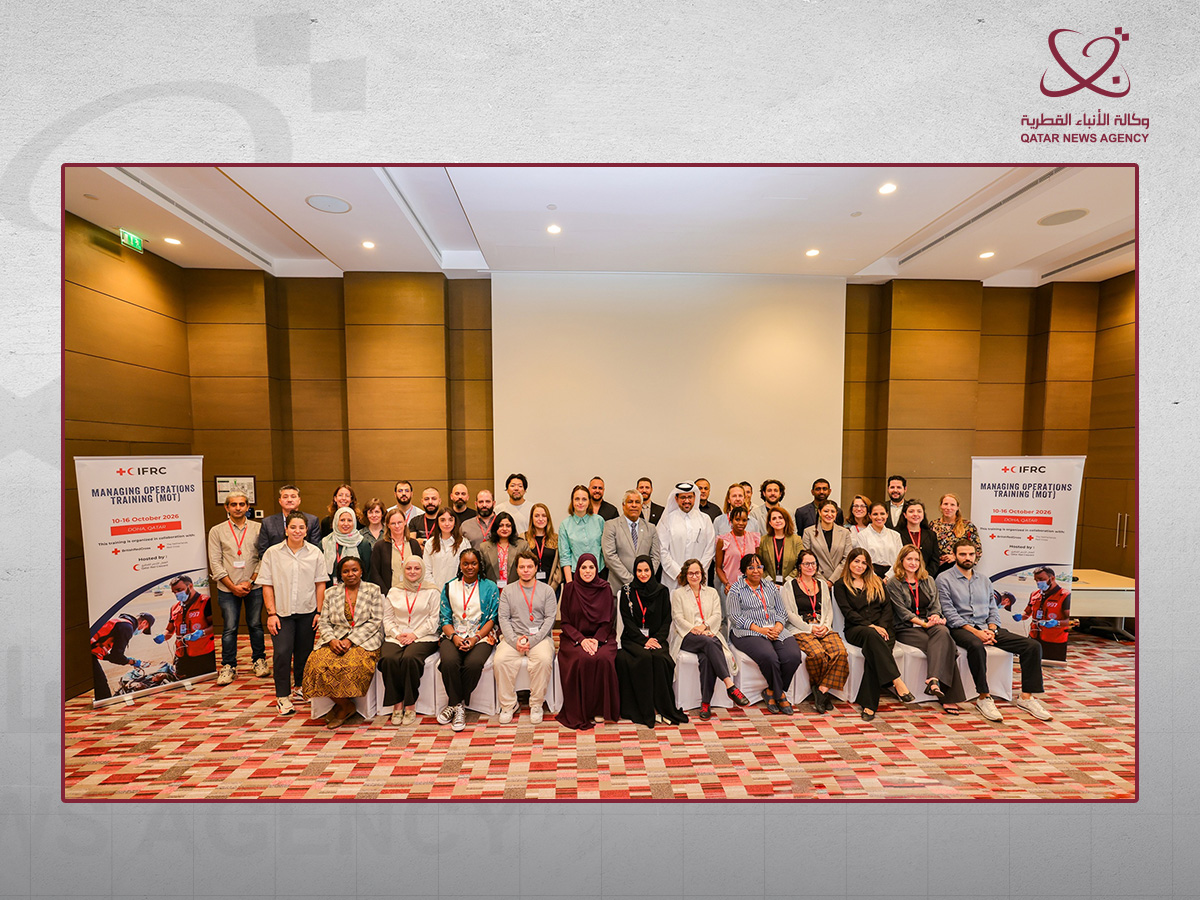
Doha, October 18 (QNA) – Qatar Red Crescent Society (QRCS) has hosted the Managing Operations Training (MOT) workshop, organized by the International Federation of Red Cross and Red Crescent Societies (IFRC) to enhance the professional and operational capacity of disaster response personnel, as well as to facilitate experience sharing between National Societies and the Federation.
The one-week event was attended by 44 specialists who had already completed the mandatory virtual pre-courses from IFRC and 17 National Societies (Qatar, UK, Tanzania, Syria, Norway, Bangladesh, the Netherlands, Japan, Lebanon, Spain, Canada, France, Sweden, Switzerland, Tajikistan, Austria, and Germany).
In his remarks, Assistant Secretary-General for Relief and International Development at QRCS Mohamed Bader Al Sada stated, “Crises and disasters have become increasingly complex. Besides technical expertise and resources, this situation requires capable leaders and personnel to manage operations, coordinate effectively, and make the right and timely decisions. That is why this MOT workshop is so important, as it focuses on humanitarian operations management capacity-building, coordination enhancement, support for National Societies, resource management, safety and security, and transition from response to recovery”.
He revealed capacity-building plans for QRCS’s Emergency Response Units (ERUs), mainly in field hospitals, WASH, and psychosocial support. “We believe that upgrading such capacity goes beyond securing personnel and equipment; it also requires investment in human talent, as well as leadership and operational skills,” added Al Sada. “This would enable our teams to work efficiently within the International Red Cross and Red Crescent Movement and respond to humanitarian needs in different contexts”.
IFRC MENA Deputy Regional Director Cristhian Cortez said, “The responsibility of operations managers and operational leaders is not simply to manage an operation, a budget, or a response plan; it is to ensure that our collective support reinforces National Society leadership, builds sustainable capacity, and delivers meaningful results for people affected by crises. Successful operational management should leave behind not only assistance delivered, but also stronger National Societies, better preparedness, and greater resilience for future emergencies”.
By the end of the MOT Learning Program, participants should be able to identify and apply appropriate IFRC resources, tools, policies, systems, and procedures in providing strategic and operational management to operations. These include, but are not limited to: Movement and Membership Coordination; Humanitarian diplomacy and stakeholder engagement; Duty of Care, including human resources in emergencies and safety and security; Supply chain management, procurement, and surge exit planning; Resource mobilization, financial management, and funding modalities; Risk management, safeguarding, and legal considerations; Transitioning to recovery; and National Society capacity strengthening. (QNA)