Jordan’s Q2 2026 GDP Expands 3.0%, Outperforming Regional Headwinds, International Forecasts

ENV-KUWAIT-SUSTAINABLITYKuwait strengthens environmental sustainability through strategic initiativesBy Zahra Al-Kadhmi

HLT-KUWAIT-SURGERYKuwait advances health sector with robotic, remote surgeryBy Mohammad Al-Moseb

Saudi Arabia’s Voluntary Carbon Market Fuels the Shift to a Low-Carbon

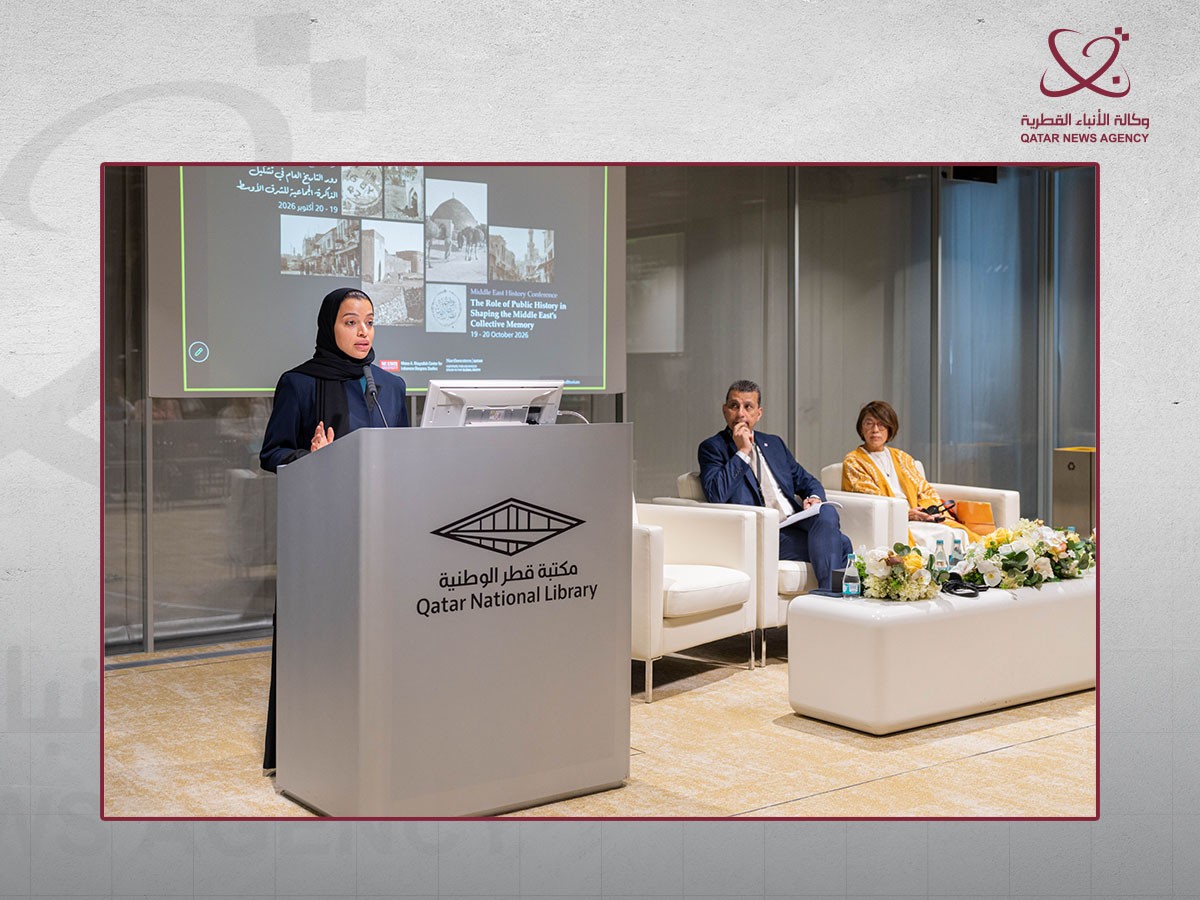
Doha, October 21 (QNA) – Qatar National Library and North Carolina State University explored the stories, voices, and histories that shape the region’s collective memory during a two-day conference held on Oct. 19-20, 2026.
Bringing together academics, researchers, and cultural practitioners from across the globe, the event mapped the current state and future trajectory of public history in the Middle East.
Central to the conference was a focus on the shifting paradigms of historical documentation. While traditional historical research has relied heavily on official and organizational records, public history places the “human subject” at its core. By turning to individual records, family archives, and community narratives, the discipline engages the public through museums, cultural institutions, and media to construct a more inclusive historical record.
“At Qatar National Library, we recognize that history extends far beyond official state records; it lives within the personal archives, oral traditions, and shared experiences of our communities,” said Maryam A. Al Mutawa, Head of Collection Access at Qatar National Library. “This conference is a vital step toward ensuring the diverse voices of our region are preserved, studied, and amplified for generations to come.”
Commenting on the significance of the conference, Dr. Akram Khater, Director of the Khayrallah Center for Lebanese Diaspora Studies at North Carolina State University, said: “This first-of-its-kind conference marks an important moment for public history in the Middle East. Qatar National Library, through its pioneering work in preserving cultural heritage and creating an intellectual space where scholars, communities, and the public can engage with the past, is an ideal partner for this gathering. Its mission resonates deeply with the Khayrallah Center’s work in building archives, digital projects, exhibitions, and community partnerships around the histories of Arab migration and diaspora.”
He added: “I am deeply grateful to Qatar National Library for its vision, space, and resources that have made this conference possible. Together, we hope to foster lasting collaborations and help build the networks, training, and infrastructure needed for public history to flourish across the region.”
To explore these themes, scholars presented research across five comprehensive panels. The first day focused on foundational frameworks, navigating the complexities of digital public history, archives, and digital networks. Participants examined the transition in museum practices from state-led narratives to private and community collections and joined panels on community and oral traditions that elevated historically overlooked voices.
Building on this foundation, the second day shifted its focus to “People, Spaces, and Living Heritage.” Scholars examined urban memory and the history of marginalized communities within changing landscapes, offering insights into post-conflict zones. The conversations then addressed the integration of cultural heritage and historical landscapes into modern education.
On the day following the conclusion of the conference, interactive workshops were held to explore topics related to public history, historical documentation, and community heritage. The workshops were sponsored by the Institute for Advanced Study in the Global South at Northwestern University in Qatar, in collaboration with the Luxembourg Centre for Contemporary and Digital History and the Khayrallah Center for Lebanese Diaspora Studies at North Carolina State University.
Beyond the academic panels, attendees connected directly with local heritage through curated tours of the Heritage Library and the National Museum of Qatar.
By mapping the intersections of personal memory and public record, the conference laid the foundational groundwork for the future of Middle Eastern public history and the development of a dedicated regional network, an objective deeply rooted in Qatar National Library’s mission to safeguard the region’s heritage. (QNA)