Jordan’s Q2 2026 GDP Expands 3.0%, Outperforming Regional Headwinds, International Forecasts
ENV-KUWAIT-SUSTAINABLITYKuwait strengthens environmental sustainability through strategic initiativesBy Zahra Al-Kadhmi

HLT-KUWAIT-SURGERYKuwait advances health sector with robotic, remote surgeryBy Mohammad Al-Moseb

Saudi Arabia’s Voluntary Carbon Market Fuels the Shift to a Low-Carbon

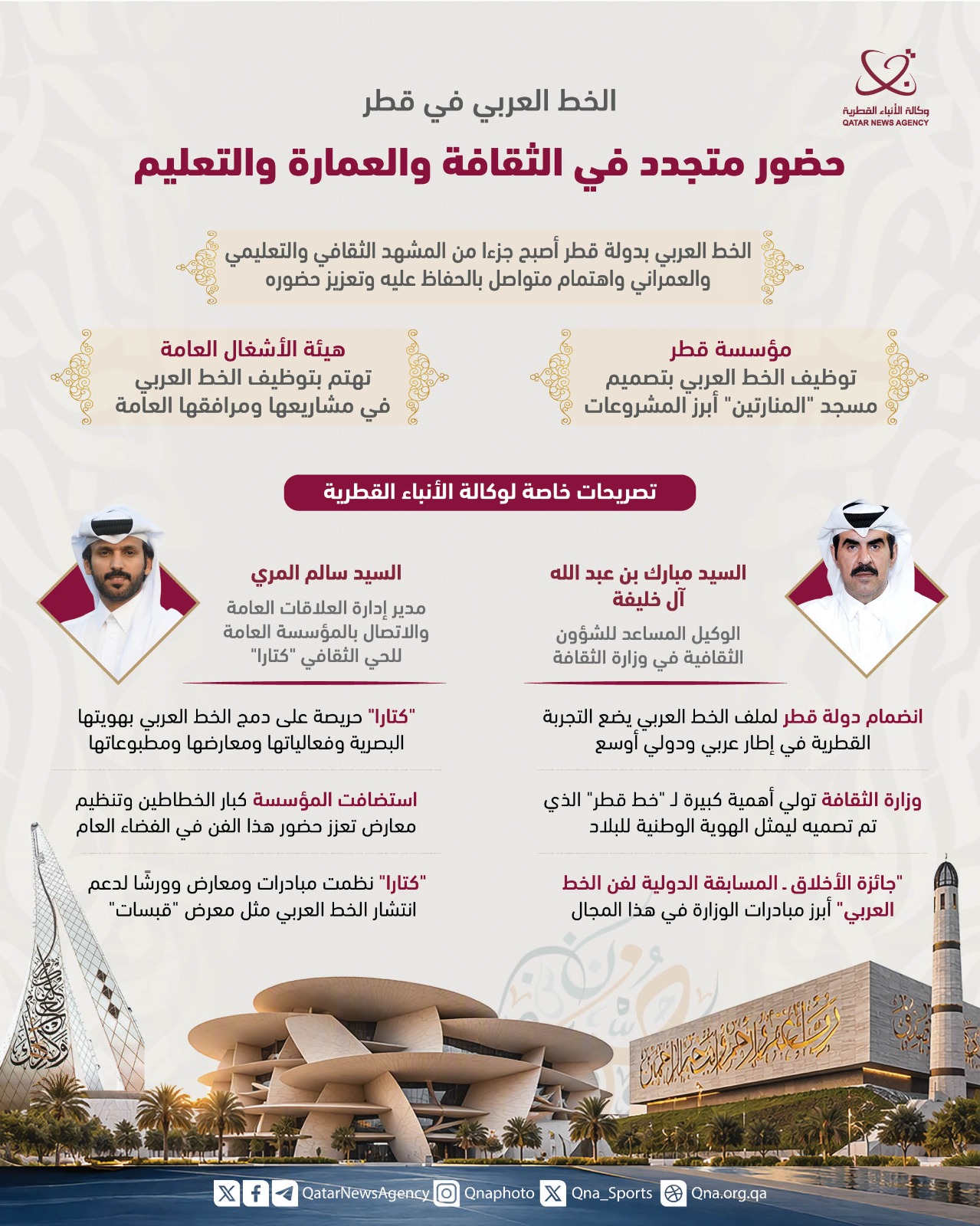
Arabic Calligraphy in Qatar: A Living Heritage Across Culture, Architecture, and EducationDoha, October 24, 2026 (QNA) – (FANA) Arabic calligraphy in Qatar is no longer confined to art galleries, exhibitions, or calligraphic competitions. It has become an integral part of the nation’s cultural, educational, and architectural landscape through coordinated institutional efforts to preserve it as a core element of Qatar’s national and cultural identity.These efforts are visible across public spaces, museums, cultural centers, architectural projects, schools, and universities through specialized educational programs, training workshops, and initiatives to identify emerging talent. Entities such as the Ministry of Culture, the Ministry of Education and Higher Education, the Ministry of Endowments and Islamic Affairs, Qatar Museums, Qatar Foundation, the Cultural Village Foundation (Katara), Qatar University, and the Public Works Authority (Ashghal) have expanded the reach of Arabic calligraphy into modern design, public art, architecture, and daily life.This institutional push reflects a coordinated strategy that treats Arabic calligraphy as a living, evolving heritage. While historical manuscripts are preserved, calligraphic aesthetics are actively integrated into walls, tunnels, parks, mosques, and architectural facades, ensuring that skills and appreciation are passed down across generations.The report explores Qatar’s efforts to support Arabic calligraphy and strengthen its presence locally and internationally, including the country’s participation in the multinational nomination of Arabic calligraphy for inscription on UNESCO’s Representative List of the Intangible Cultural Heritage of Humanity. The report also highlights key cultural, architectural and educational initiatives and examines how institutions are transforming calligraphy from a traditional art form into a vibrant visual language across Qatar.Recognizing the importance of Arabic calligraphy, the Ministry of Culture supported Qatar’s participation in the multinational effort to inscribe the art on UNESCO’s Representative List of the Intangible Cultural Heritage of Humanity, alongside 15 other Arab countries, on December 14, 2022.Assistant Undersecretary for Cultural Affairs at the Ministry of Culture Mubarak bin Abdullah Al Khalifa stated to Qatar News Agency (QNA) that the State of Qatar’s joining of the Arabic calligraphy file reflects the participation of Gulf and Arab countries in promoting the importance of this element as a shared bond in Qatari and Arab cultural identity, while placing the Qatari experience within a broader Arab and international framework to present its authentic practices and expertise.He explained that the UNESCO file views Arabic calligraphy as an integrated system of knowledge, skills, and script types, including Naskh, Thuluth, Ruq’ah, and Kufic, alongside traditional tools like reed pens, inkwells, and specialized surfaces, as well as its presence in architecture and contemporary arts.Al Khalifa emphasized that the inscription of Arabic calligraphy on the UNESCO list offers multiple cultural and cognitive benefits for Qatar, most notably reinforcing national, Arab, and Islamic identity linked to language and memory, ensuring the continued transmission of knowledge and skills to new generations, and turning heritage into a living resource for creativity in the arts and contemporary design.He noted that sustaining this element requires documenting active calligraphers, updating national intangible cultural heritage inventories, supporting artists, hosting workshops and competitions, and employing modern technologies while maintaining traditional standards.Sustaining Arabic calligraphy, he added, requires transforming its inscription into a cultural and educational project by expanding programs for children and youth, integrating it into schools and universities, and enhancing its international presence through exhibitions, forums, research, and digital documentation.He stressed the Ministry’s commitment to building a comprehensive documentation and educational system, including a database of calligraphers, documenting works and inscriptions, conducting studies and interviews with master calligraphers, and advancing digital transformation.Al Khalifa highlighted the international Arabic calligraphy competition “Akhlaq Award”, stating that the goal of the award is to revive the art of Arabic calligraphy in accordance with its traditional rules, while highlighting high moral values as a central idea and primary theme for the competition.It aims to achieve an integrated artistic and value-based vision, he stressed, by establishing several targets, including reinforcing values, elevating ethics in culture and arts, emphasizing the close link between noble ethics and calligraphic refinement, preserving classical heritage, enhancing community awareness and artistic taste, and supporting creators by attracting calligraphers worldwide to exchange expertise and develop individual skills.He said the Akhlaq Award supports the calligraphic movement in Qatar by embracing Qatari creators and providing opportunities to engage with international master calligraphers, alongside intensive courses organized periodically by the Ministry so that Qatar becomes an incubator for all Arab creators in this field.Regarding local developments, Al Khalifa noted that the Ministry of Culture attaches utmost importance to a locally developed script, ‘Qatar Font,’ designed to reflect the country’s identity. Used in official Ministry correspondence and Doha Magazine, it is inspired by historical Qatari writings, most notably those of the founder, Sheikh Jassim bin Mohammed bin Thani, and manuscripts of Sheikh Ahmed Al Muraikhi, scribe of the oldest Qatari manuscript Quran. The font uniquely merges rigid, geometric lines with smooth, fluid strokes.One of the primary international competitions sponsored by Qatar in Arabic calligraphy is the “Al Raqeem” Qatar International Arabic Calligraphy Competition, organized by the Ministry of Endowments and Islamic Affairs in cooperation with the Museum of Islamic Art (MIA).Director of the Sheikh Abdulla Bin Zaid Al Mahmoud Islamic Cultural Center and Chairman of the Organizing Committee for the competition Dr. Saleh bin Ali Al Akhn Al Marri stated to QNA that “Al Raqeem” served as a renewed cultural project aimed at utilizing Arabic calligraphy as a civilized medium combining letter aesthetics with Islamic values, thereby enhancing its presence globally and highlighting Qatar’s role in supporting Islamic arts and elevating the Arabic language.He noted that the competition operated on a vision balanced between preserving authentic traditional rules and embracing contemporary creative approaches, providing a professional space for artistic expression while maintaining the art form’s identity.Dr. Al Marri emphasized that the prize pool, exceeding one million Qatari riyals, reflected Qatar’s commitment to supporting calligraphy and attracting international talent, turning the competition into a global platform for advancing the art’s future.He added that “Al Raqeem” was part of a broader cultural framework dedicated to serving the Arabic language as the vessel of the Holy Quran and a pillar of Islamic identity, while fostering intercultural dialogue through art. Furthermore, he highlighted that the prize supported qualitative initiatives combining creativity with Quranic and Prophetic values to present a contemporary cultural discourse.Dr. Al Marri pointed out that this year’s edition featured updated categories and procedures to raise the level of competition, expand cultural partnerships, and reinforce Qatar’s standing as a hub for Islamic arts and intellectual creativity.Manuscripts and Historical CollectionsThe presence of Arabic calligraphy in Qatar’s cultural scene is no longer confined to historical manuscripts and artifacts. Instead, it has become part of a broader vision that treats the Arabic letter as a living element in visual culture, capable of transitioning from pages of Quranic manuscripts into museums, exhibitions, contemporary artworks, and public spaces. In this context, Qatar Museums integrates efforts to preserve, study, anddisplay this heritage while facilitating its active practice and reinterpreting its aesthetics in modern artistic works.In statements to Qatar News Agency (QNA), Director of the Museum of Islamic Art (MIA) Sheikha Nasser Al Nasr explained that the museum’s collections allowed visitors to trace the development of script and its various schools across different eras and regions.She highlighted key pieces, including a Hijazi Quran leaf dating to 650–733 AD, a Kufic Quran from 900–925 AD, and a Zubarah Quran from 1806 written in Naskh script by Sheikh Ahmed bin Rashid bin Jumaa bin Khamis bin Hilal Al-Marriqi, directly linking calligraphic history to Qatari cultural memory.She noted that Qatar Museums’ interest in Arabic calligraphy also extends to programs and workshops, such as the “Arabic Calligraphy Artwork” workshop, which transformed museum collection models into creative pieces. She also mentioned the biennial “Al Raqeem” International Arabic Calligraphy Competition, organized by the Sheikh Abdulla Bin Zaid Al Mahmoud Islamic Cultural Center in cooperation with MIA, which in its second edition featured categories including Jaly Thuluth, Naskh, Nasta’liq, Jaly Diwani, and Muhaqqaq.In a parallel direction, Arabic calligraphy has moved from museum galleries into public spaces under a vision by Qatar Museums that treats the script as an adaptable artistic medium.Addressing this aspect, HE Qatar Museums Deputy Deputy CEO of AL RIWAQ, Public Art, and Rubaiya Qatar at Qatar Museums (QM) Sheikha Reem Al-Thani stated that the Public Art program had contributed to moving Arabic calligraphy from its traditional framework into murals, sculptures, and art installations.Her Excellency cited key examples, including Ali Hassan Al Jaber’s “Wisdom of a Nation” outside the National Museum of Qatar (NMAQ), inspired by a poem by Sheikh Jassim bin Mohammed bin Thani; Bashayer Al Badr’s “Infinity Love”; and eL Seed’s “Calligraffiti,” featuring 52 murals along Salwa Road inspired by Qatari daily life.She added that another major example was Jean-Michel Othoniel’s “Alfa,” a sculptural installation comprising 114 fountain sculptures outside the National Museum of Qatar (NMoQ), created in collaboration with Kuwaiti calligrapher Jassem Al Nasrallah.HE Sheikha Reem emphasized that these experiences demonstrate the broad presence of Arabic calligraphy in Qatar—from manuscripts and museums to workshops, murals, sculptures, and open spaces—reinforcing its status as a living, renewed art and a key component of visual and cultural identity. She noted that displaying these works in open environments enabled children, youth, and visitors to interact with them directly without visiting a specialized exhibition. She further pointed out that Arabic calligraphy uniquely combined word, meaning, and form, allowing artists to reshape letters into visual compositions that audiences could engage with even before reading the underlying text.Calligraphy and Aesthetic SpaceArabic calligraphy also occupies a prominent place in public infrastructure projects through initiatives by the Public Works Authority (Ashghal), which incorporates calligraphic art into public facilities to enhance Qatar’s visual identity and blend art into urban spaces.Key projects executed by Ashghal include Fatima Al Sharshani’s mural in Al Tadamon Tunnel, Ibrahim Al Muhareb’s mural in Post Office Park, and the “Watan” mural near the Shura Council, a triptych combining stone carving with contemporary calligraphy to link letters with Qatari architectural and historical landmarks.In the MIA-Corniche pedestrian tunnel, artist Saleh Al Obaidly presented “Garden of Letters,” combining limestone with metallic Arabic lettering, as well as his mural in Rawdat Al Hamama Park using Somboli script in compositions that harmonize with surrounding greenery.Calligraphy also features prominently in “Iqra” Plaza near the Qatar National Library, where the word “Iqra” is embedded in the pavement design for interactive visual engagement. Additionally, decorative murals on water towers feature letters wrapped around structures, while decorative fencing uses Square Kufic script to add a refined cultural character to public infrastructure.Minaretein Mosque, An Icon of Calligraphic CreativityQatar Foundation for Education, Science and Community Development places particular emphasis to Arabic calligraphy as a key component of the state’s visual and cultural identity. The Foundation has actively integrated calligraphy into public spaces, architecture, and fine arts, treating it not merely as a decorative element, but as a creative force that elevates the Arabic language.A prime example is the Education City Mosque (“Minaretein”), where calligraphy is seamlessly woven into the architectural design, enhancing its presence in the urban landscape and bridging heritage with contemporary identity. Qatar Foundation explained that one of its flagship projects in this field was incorporating calligraphy into the Minaretein Mosque using Thuluth and Ijaza scripts. The Foundation also hosts exhibitions and works by specialized calligraphers and organizes interactive workshops for community and national events. Qatar Foundation affirmed that its approach stemmed from viewing Arabic calligraphy as a living, evolving art capable of shaping public spaces, reinforcing national identity, and inspiring new generations to innovate based on their heritage.Among the leading supporting institutions in Qatar is the Cultural Village Foundation (Katara), which has embedded calligraphy into its visual identity, public spaces, events, exhibitions, and publications.In this context, Director of Public Relations and Communications at Katara Salem Al Marri explained that Katara helped transform Arabic calligraphy from a decorative motif into a core element of its visual and cultural identity through architecture, murals, artworks, exhibitions, and publications, while hosting master calligraphers and organizing specialized exhibitions.Al Marri noted that Katara had organized various initiatives, exhibitions, and workshops over recent years, including the “On the Shoulder of the Letter” exhibition by Iraqi calligrapher Dhiya Al Jazairi in February 2026, featuring 28 paintings inspired by the classical Mu’allaqat poems, alongside the “Qabasat” exhibition by Syrian artist Dr. Waseem Al Hamdou, and the “The Absolute Just” exhibition co-organized with the Turkish Embassy and the Yunus Emre Institute.He added that these initiatives included a calligraphy exhibition featuring Syrian artists, as well as the “Dialogue of Letters Between Qatar and China” exhibition held in April 2025 in cooperation with the Chinese Calligraphers Association, featuring 37 calligraphers from Qatar and China, including nine Qatari artists.Al Marri emphasized that Katara continues to support Arabic calligraphy through exhibitions, workshops, and cultural partnerships to establish it as a living art that served as a bridge for intercultural dialogue.Calligraphy and EducationEducational and cultural institutions in Qatar work together to strengthen the presence of Arabic calligraphy among students and ensure its sustainability across generations, prominent among these is the Ministry of Education and Higher Education (MOEHE).MOEHE’s Arabic Language Educational Specialist Fayez Abdul Latif Al Khatib stated to QNA that the Ministry believed Arabic calligraphy was a fundamental component of Arab and Islamic identity that reinforced students’ connection to their language and heritage.He explained that this commitment starts in primary and preparatory classrooms with practical handwriting instruction, supported by curricular and extracurricular activities.Al Khatib highlighted specialized initiatives and competitions launched by the Ministry, including student participation in the “Al Raqeem” competition in cooperation with the Ministry of Endowments and Islamic Affairs, whose second edition attracted 479 male and female students participate from 24 public and private schools.He also noted school participation in Arabic Language Month activities alongside the Qatari National Commission for Education, Culture and Science, which included calligraphy contests and art exhibitions.Regarding higher education, Director of Student Activities at Qatar University Abdullah Hamid Al Mulla affirmed that the university prioritized Arab cultural identity and calligraphy to deepen students’ connection to their heritage.He noted that the administration provided an environment for students to practice calligraphy across university events, workshops, exhibitions, and competitions.Al Mulla highlighted the establishment of the “Medad” Arabic Calligraphy Club at Qatar University, one of 120 student clubs under the Student Activities Department, serving as a hub for students to develop basic and advanced skills across various script styles.In addition, Qatar Foundation offers calligraphy workshops and classes through the Minaretein Center at Hamad Bin Khalifa University’s College of Islamic Studies, alongside interactive educational platforms like “Rasekh” and “Siraj.”At Virginia Commonwealth University School of the Arts in Qatar (VCUarts Qatar) Professor of Graphic Design and Founder/Director of the “TypeAraby” research lab Basma Hamdy stated that the university approached Arabic calligraphy as part of a broader, evolving visual language.She pointed to student engagement through typography, image-making, digital media, fabrication, and experimental design.Hamdy noted that the university encourages students to study letter structure, rhythm, proportions, and cultural meanings through contemporary practices, citing the “Typographic Archaeology” course where students explored the history and form of Arabic typography.She highlighted the “TypeAraby” lab as a research initiative enabling emerging designers to push beyond traditional typography by combining historical manuscripts with digital font design, CNC fabrication, and modern technology.Creativity, Training, and Nurturing New CalligraphersSpecialized art centers play a critical role in discovering and training calligraphic talent. Director of the Visual Arts Center under the Ministry of Culture Huda Al Yafai stated to QNA that the center maintained a specialized department offering continuous training programs in various script styles alongside community workshops and exhibitions.Al Yafai explained that the training pathway began with foundational rules and tools, progressing to practical application and complete artistic production. She noted that these programs have introduced several artists into the Qatari art scene and international exhibitions.She added that these programs attracted participants across age groups, with notable involvement from women. The center has hosted major showcases, including the “Sutoor” (LINES) exhibition at the Fereej Art and Design Festival 2025, the Calligraphy and Ornamentation exhibition at the Doha International Book Fair 2024, and two editions of the “Arabic Letters” exhibition featuring Arab and Turkish calligraphers.Similarly, Director of Souq Waqif Art Center Rawda Al Mansouri stated to QNA that the center played a pivotal role in spreading calligraphic culture from its central location in Souq Waqif.She noted that the center features a dedicated calligraphy section offering instruction in styles such as Andalusian and Ruq’ah, led by internationally certified experts.Al Mansouri explained that the center’s progressive training levels (beginner, intermediate, and advanced) had successfully graduated a new generation of calligraphers, including Qatari artists who now actively contributed to the national cultural landscape.She emphasized that the workshops attract young people throughout the year, developing writing skills and aesthetic appreciation while providing a supportive artistic environment with specialized academic supervision and periodic student exhibitions to ensure the long-term sustainability of the art form. (QNA)