Jordan’s Q2 2026 GDP Expands 3.0%, Outperforming Regional Headwinds, International Forecasts
ENV-KUWAIT-SUSTAINABLITYKuwait strengthens environmental sustainability through strategic initiativesBy Zahra Al-Kadhmi

HLT-KUWAIT-SURGERYKuwait advances health sector with robotic, remote surgeryBy Mohammad Al-Moseb

Saudi Arabia’s Voluntary Carbon Market Fuels the Shift to a Low-Carbon

Amman, June 20 (Petra) – Local and international statistical data
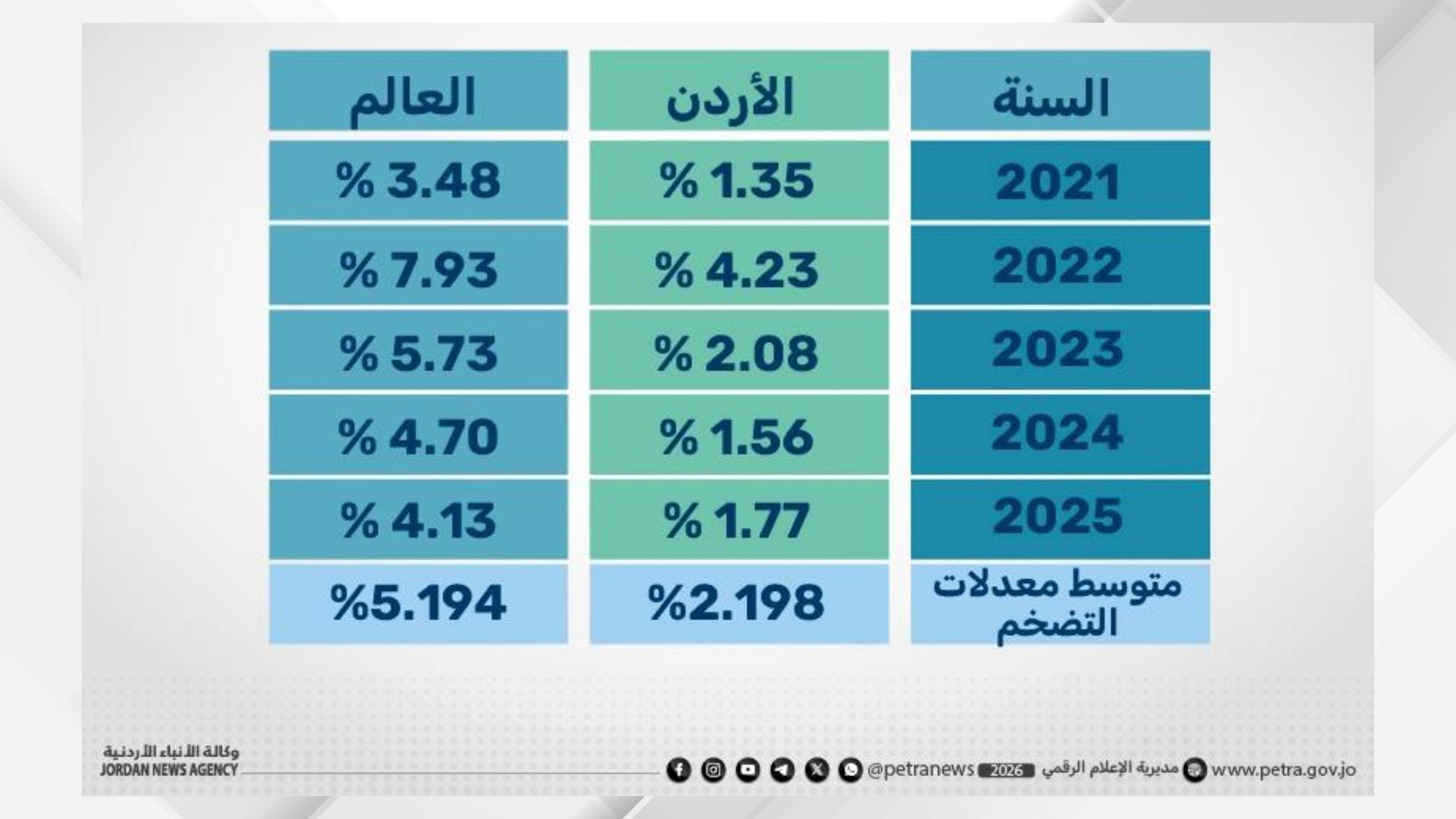
show that inflation rates in the Kingdom over the past 5 years have
been “lower than global averages,” reaching 2.198% in Jordan,
compared to 5.194% globally.
According to the data, Jordan has “clearly managed to control” the
wave of inflation that swept the world in recent years, from 2021
until the end of 2025.
The global inflation crisis began in 2021 with the return to normalcy
following the decline of the COVID-19 pandemic and the increased
demand for goods.
The global inflation rate rose to 3.48%, while in Jordan it remained
at a low level of only 1.35%.
In 2022, the world faced the true peak of the crisis due to problems
with maritime shipping and rising global energy prices, which pushed
global inflation to its highest level, recording 7.93%.
Despite this situation, Jordan demonstrated “remarkable resilience,”
as inflation reached 4.23%, thanks to the measures taken by the
Kingdom and the support provided for some basic commodities and
petroleum products, in addition to the decisions of the Central Bank
of Jordan (CBJ).
During the pandemic, the largest health crisis facing the world, the
local market did not experience shortages of goods and commodities,
despite disruptions to supply and transportation chains and the rise
in shipping costs across all modes.
As 2023 began, central banks around the world started raising
interest rates to calm markets, leading to a decline in global
inflation to 5.73%. Inflation in Jordan, however, declined at a
faster pace, settling at 2.08%, thanks to the CBJ’s prudent policies.
This stability continued into 2024, as Jordan recorded a further
decrease in inflation to 1.56%, benefiting from improved global
shipping and supply chains, whose overall inflation rate reached
4.70%.
At the end of 2025, while global inflation was nearing 4.1% due to
continued price increases in the services sector in developed
countries, Jordan recorded a “slight” increase of 1.77% for the
entire year, driven by price fluctuations in non-essential goods.
Over the past five years, trajectory of inflation rates in the
Kingdom indicates that the “proactive measures and CBJ’s flexible
monetary policies have successfully” kept prices within safe and
acceptable limits for citizens and businesses, which provided a
stable economic environment despite all the challenges and the
region’s tumultous conditions.
According to the Central Bank of Jordan, the Kingdom’s inflation rate
last year was in line with its estimates at a level below 2%, as
expectations of stabilizing around this rate in 2026, which would
maintain purchasing power and strengthen the investment climate.
As for the latest report issued by Department of Statistics (DoS),
the local inflation rate declined during the first five months of
this year, reaching 1.88%, compared to 1.97% for the same period last
year.
//Petra// AG