Saudi Arabia’s Voluntary Carbon Market Fuels the Shift to a Low-Carbon

Under UAE President’s directives, UAE launches urgent relief response for Ghana flood victims

Combating Desertification and Drought: Qatar a Model in Preserving Natural Resources, Establishing Environmental Stability

UAE allocates US$30 million for emergency humanitarian response in El Obeid, calls for civilian protection, safe humanitarian aid access in Sudan

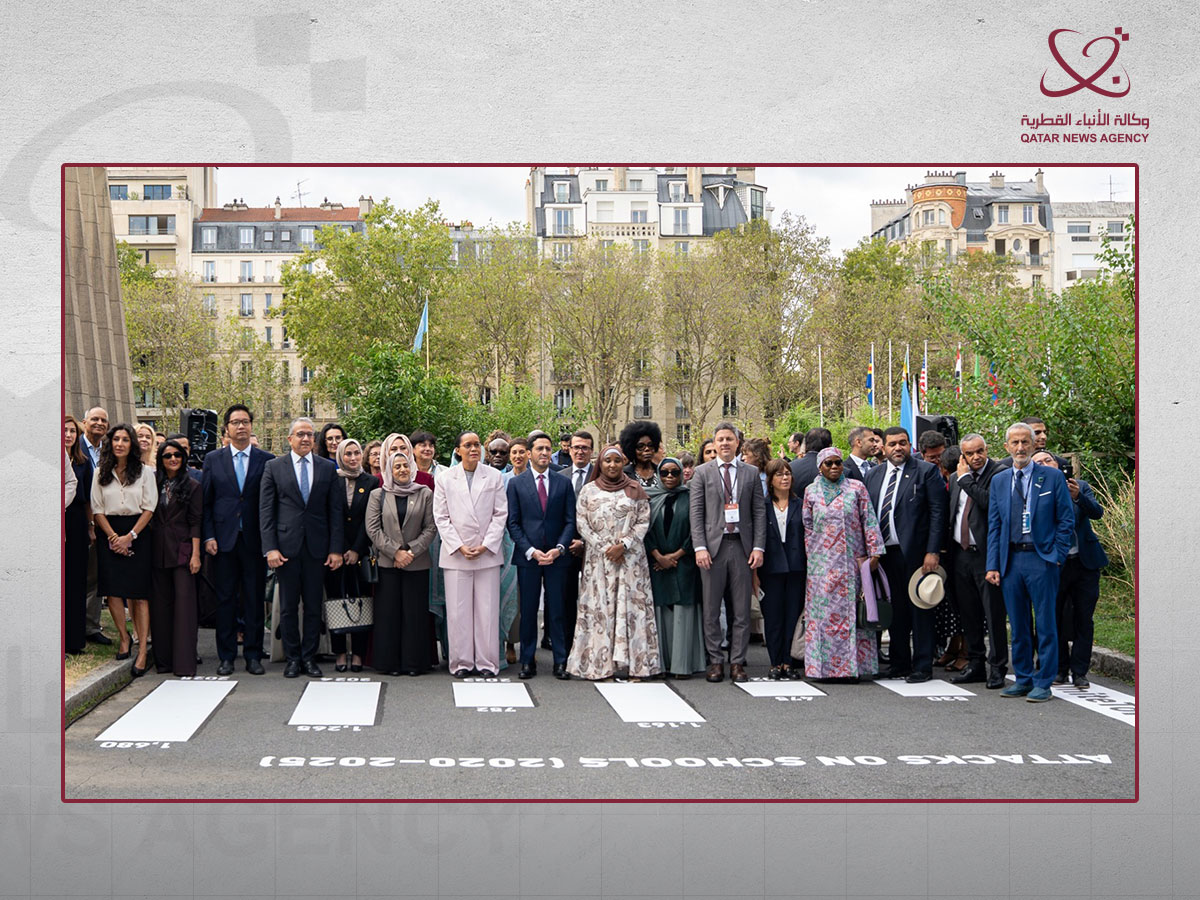
Doha, September 09 (QNA) – The Education Above All (EAA) Foundation, in collaboration with its international partners, launched a global visual activation entitled “The Crosswalk” in both Paris and Geneva, marking the occasion of the International Day to Protect Education from Attack, which falls on Sep. 9 of each year, with the aim of transforming data related to attacks on education into an interactive visual experience that reflects the alarming escalation of these violations around the world.
In a statement on Wednesday, EAA indicated that the installation uses pedestrian-crossing stripes as a visual timeline of verified attacks on schools, with each stripe representing a year and the corresponding number of recorded attacks.
In Paris,EAA, UNESCO and the Permanent Delegation of the State of Qatar to UNESCO will jointly present The Crosswalk at UNESCO Headquarters from Sep. 9-13. The installation will be accompanied by a digital display featuring key facts, campaign messages, a QR code linking to UNESCO’s Preventative Plan of Action to Protect Education from Attack, and an interactive prompt asking: “Can Education Survive Attack?” Bringing the campaign into a diplomatic and policy setting, the activation reinforces awareness of the growing threats facing education and the importance of international cooperation to protect it.
In Geneva, the Permanent Mission of the State of Qatar to the United Nations Office in Geneva, in coordination with the Global Coalition to Protect Education from Attack, will hold a high-level event at the Palais des Nations, bringing together representatives of governments, United Nations agencies and international organizations. The Crosswalk will form part of the event, alongside photographs and digital content highlighting the experiences, determination and resilience of learners and communities affected by conflict and insecurity, and their efforts to sustain education in the most challenging circumstances.
Through the global UniteToProtect campaign, this year’s observance also provides a platform for governments, international organizations, civil society, educators, youth and the public to share messages of solidarity and reaffirm the importance of protecting education before, during and after crises.
In this context, Chief Executive Officer of EAA Foundation Mohammed Al Kubaisi said: “Education can survive attack, but only if we choose to build systems capable of survival.
Schools are not targets, teachers are not combatants, and children’s futures are not collateral damage. Protecting education must go beyond rebuilding after harm has occurred; it must include preparedness, safe learning pathways, alternative education solutions, psychosocial support, and accountability for those who attack education.”
The International Day to Protect Education from Attack was established following a resolution presented by the State of Qatar, spearheaded by HH Sheikha Moza bint Nasser, Chairperson of Qatar Foundation for Education, Science and Community Development, and adopted unanimously by the United Nations General Assembly in 2020. The day draws global attention to the millions of children and young people whose education is affected by war and conflict, and to the need to protect education as a fundamental right.
In a related context, according to the latest Education Under Attack 2026 report by the Global Coalition to Protect Education from Attack, at least 9,259 attacks on education and incidents of military use of schools and universities were recorded in 2024 and 2025, representing an increase of more than 50 percent compared with the previous reporting period.
These attacks harmed at least 10,600 school and university students, teachers, professors and education personnel. The report also recorded the highest incidence of attacks on education in Colombia, the Democratic Republic of the Congo, Ethiopia, Haiti, Palestine and Ukraine, while cases of military use of schools and universities increased to more than 2,100.
EAA continues to emphasize that education is more than a service delivered through classrooms. Education is a fundamental right and a source of protection, stability, dignity and hope for children, young people, families and communities affected by conflict. When education is attacked, the impact extends far beyond damaged buildings; it disrupts childhoods, weakens communities and threatens long-term recovery. (QNA)