Saudi Arabia’s Voluntary Carbon Market Fuels the Shift to a Low-Carbon

Under UAE President’s directives, UAE launches urgent relief response for Ghana flood victims

Combating Desertification and Drought: Qatar a Model in Preserving Natural Resources, Establishing Environmental Stability

UAE allocates US$30 million for emergency humanitarian response in El Obeid, calls for civilian protection, safe humanitarian aid access in Sudan

Amman, Sept. 13 (Petra) — Jordan reaffirmed high-level political
commitment to preparing for its third-round mutual evaluation on
anti-money laundering (AML), counter-terrorist financing (CFT) and
counter-proliferation financing (CPF), set for 2027-2029, during a
meeting Sunday with a visiting delegation from a regional financial
crime watchdog.
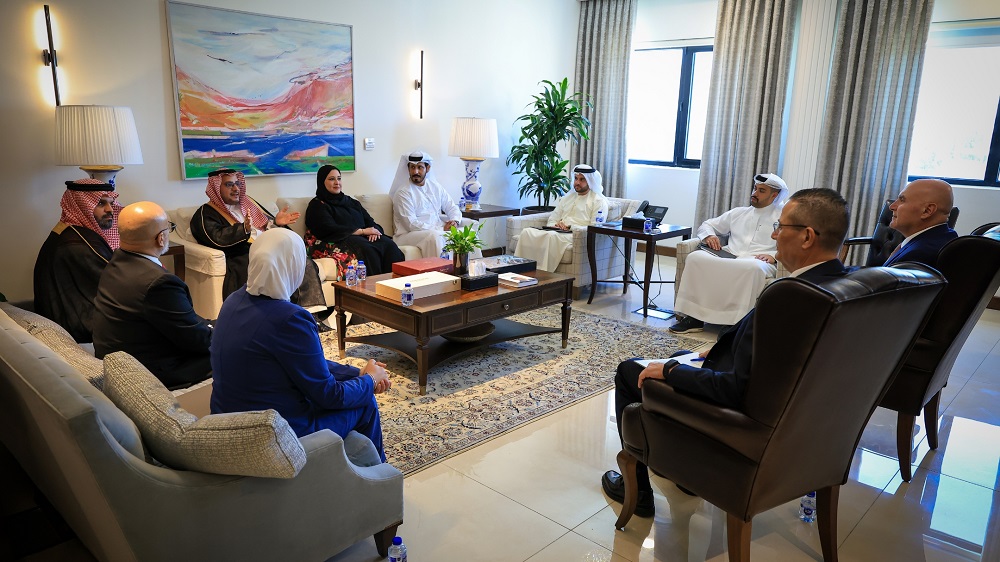
Deputy Prime Minister and Minister of State for Economic Affairs
Muhannad Shehadeh chaired the meeting at the Prime Ministry with a
delegation from the Middle East and North Africa Financial Action
Task Force (MENAFATF), led by MENAFATF President Hamid Al Zaabi.
Shehadeh said Jordan’s political commitment forms a cornerstone for
directing national efforts and mobilizing the resources needed to
ensure the evaluation succeeds. He stressed that institutional
coordination and integrated roles among concerned agencies guarantee
practical, sustainable results.
He noted that Jordan’s reforms, grounded in the constitution, reflect
a national duty to protect the economy, strengthen trust in
institutions and safeguard social stability.
Jordan continues updating its legislation to keep pace with
international standards, he said, and looks forward to deepening its
partnership with the Financial Action Task Force (FATF) and MENAFATF
to bolster its regional and international standing.
Adel Sharkas, chairman of the National Committee for AML, CFT and
governor of the Central Bank of Jordan, briefed the meeting on
national efforts to strengthen the system, describing a systematic
national plan backed by firm political and institutional will.
Sharkas said the committee has updated legislative, regulatory and
procedural frameworks in line with international best practices and
adopted a plan for legislative amendments alongside a National Risk
Assessment project involving government agencies and the private
sector. The exercise, he said, produced an accurate picture of
national risks and clear priorities for addressing them.
Al Zaabi praised Jordan’s experience as an important model for
turning political commitment into tangible results, pointing to
reforms that helped the kingdom exit the FATF’s gray list in 2023.
He also credited Jordan’s contributions during its 2025 MENAFATF
presidency, including the first-ever meeting of regional central bank
governors, held to advance the presidency’s priorities and shape
regional AML and CFT policy.
MENAFATF Executive Secretary Suliman Aljabrin outlined the procedures
and stages of the mutual evaluation, emphasizing that involving all
national entities is essential to ensure the assessment’s accuracy
and to convert its findings into an actionable roadmap.
MENAFATF was established in 2004 and comprises 21 Arab countries
working to counter money laundering and terrorist financing risks
across the Middle East and North Africa.
MENAFATF Vice President Sheikha May Al Khalifa and Samya Abou Sharif,
director of Jordan’s AML and CFT Unit, also attended.
//Petra// NQ