HLT-KUWAIT-SURGERYKuwait advances health sector with robotic, remote surgeryBy Mohammad Al-Moseb

Saudi Arabia’s Voluntary Carbon Market Fuels the Shift to a Low-Carbon

Under UAE President’s directives, UAE launches urgent relief response for Ghana flood victims

Combating Desertification and Drought: Qatar a Model in Preserving Natural Resources, Establishing Environmental Stability

Amman, Sept 19 (Petra) – The new academic year for students in the
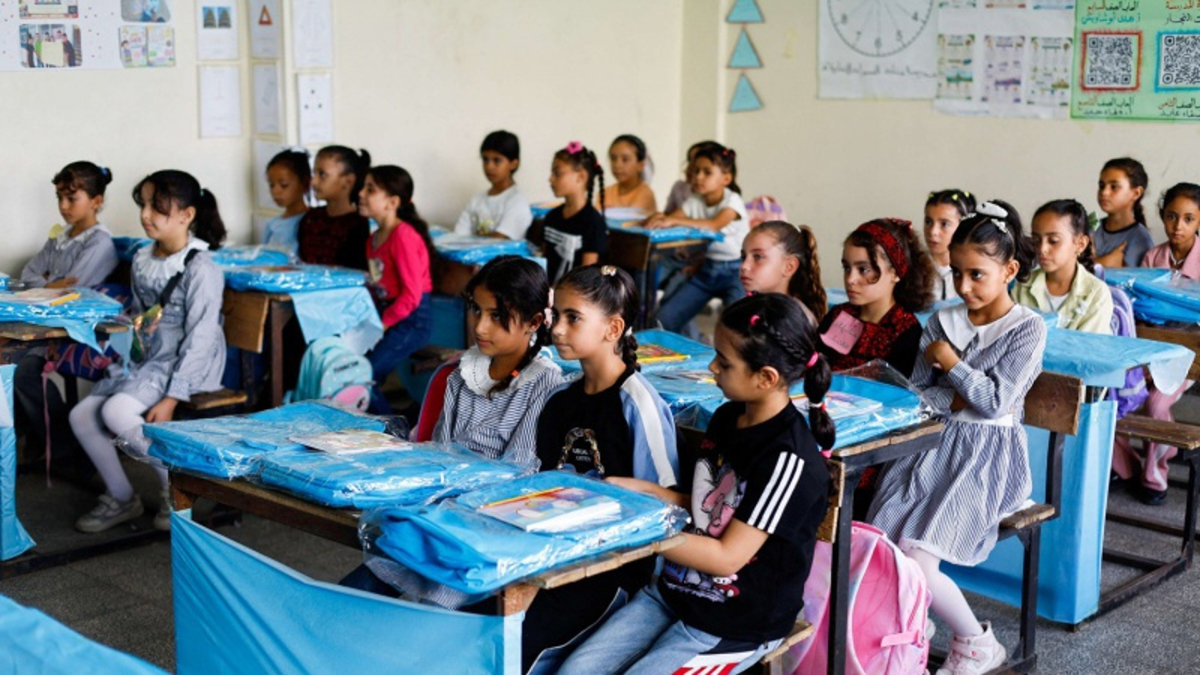
Gaza Strip began on Saturday under exceptional circumstances
following a three-year hiatus caused by Israel’s war which kept
children from classrooms.
The Ministry of Education and Higher Education said the start of the
2026/2027 academic year came after the necessary arrangements were
put in place and the situation was assessed with multiple educational
pathways adopted to accommodate the condition of all students, both
inside and outside the enclave.
The Ministry attributed the delayed start of the academic year to
technical and logistical reasons, as well as for weather reasons and
high temperatures, particularly given that a large number of students
will be receiving their education in tents and caravans.
It said the educational process will proceed along two primary
tracks, in-person and virtual, to ensure educational continuity and
the progression of students’ learning. The in-person learning is
designated for students currently within the Strip who are able to
attend physical schools.
The Ministry’s plan for Gaza relies on expanding in-person education
through setting up about 700 educational points distributed across
various areas, in addition to 25 temporary schools expected to be
handed over soon.
The total number of students in Gaza stands at approximately 541,000,
including about 100,000 in schools run by the United Nations Relief
and Works Agency for Palestine Refugees (UNRWA).
Alongside in-person education, virtual schooling will continue for
students unable to attend physical learning centers, as well as for
students from Gaza currently located outside the Strip.
Virtual schools catering to Gaza students abroad serve approximately
20,000 students, while virtual schools within the Strip target around
70,000 students who cannot access in-person education.
The Ministry is preparing to launch the “eSchool” communication
platform for the Strip, tailored to the region, coinciding with the
start of the academic year, which is aimed to enhance communication
between students and educational staff.
Remote programs for psychological support, counseling, and crisis
intervention will also continue, alongside technical support to
address urgent issues facing students and staff.
To support and enhance interactive learning in schools, 1,926 schools
have been connected to high-speed fiber-optic internet over the past
few months, ensuring that the vast majority of schools are equipped
with high-performance internet access.
To guarantee a supportive educational environment and reliable energy
supplies, the number of schools equipped with solar power systems has
reached over 900, about 45 percent of all schools, with work underway
to equip dozens more in the near future.
In the West Bank, about 846,000 students enrolled in schools on
September 5 for the start of the 2026/2027 academic year.
//Petra//SS