Jordan’s Q2 2026 GDP Expands 3.0%, Outperforming Regional Headwinds, International Forecasts
ENV-KUWAIT-SUSTAINABLITYKuwait strengthens environmental sustainability through strategic initiativesBy Zahra Al-Kadhmi
HLT-KUWAIT-SURGERYKuwait advances health sector with robotic, remote surgeryBy Mohammad Al-Moseb

Saudi Arabia’s Voluntary Carbon Market Fuels the Shift to a Low-Carbon

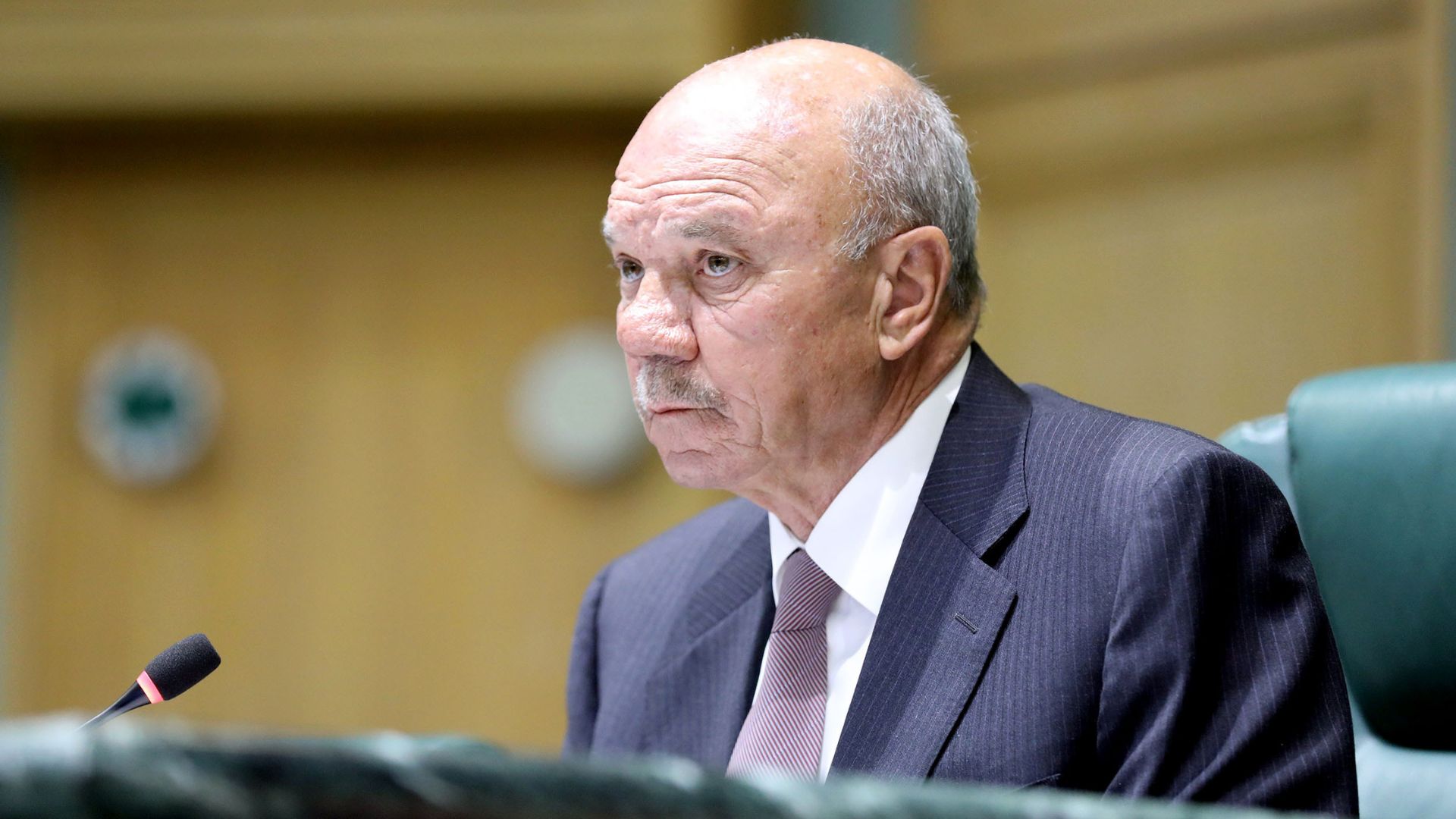
Karak, Oct. 1 (Petra)– Senate President Faisal Al-Fayez on Thursday
evening inaugurated the National Educational Conference, titled
“Community Security and Peace: Our Shared Responsibility,” organized
by Al-Thawabet Educational Private Schools.
The opening ceremony was attended by a number of officials, directors
of government departments, sheikhs and community leaders, academics
and educators, as well as a large gathering of women and members of
the local community.
In remarks during the opening ceremony, Al-Fayez said community peace
and security are neither a gift to be granted nor a marginal issue,
stressing that they cannot be built through laws and security
measures alone, but require a cohesive society.
He said community peace is not merely a slogan, but a daily practice
and a national behavior, noting that every responsible word and every
initiative that brings people together rather than divides them
constitutes another building block toward a safer and more stable
society capable of shaping its future.
Al-Fayez said Jordan, due to its geopolitical location, has faced
major challenges since its establishment and has been among the
countries most affected by regional developments. Nevertheless, he
added, Jordan has remained resilient through the wisdom of the
Hashemite leadership, the sacrifices of previous generations, the
awareness of its people, and the vigilance of its security and armed
forces.
He noted that Jordan has demonstrated throughout its history that it
is an oasis of security and stability in a region beset by conflicts
and political crises.
He called on everyone, particularly young Jordanians, to recognize
that national security and the social peace enjoyed by the country
are the true guarantees of the future of coming generations and the
nation.
Al-Fayez said current challenges have intensified due to political
and security instability in several Arab countries, the spread of
terrorism and extremism, the scourge of drugs, the repercussions of
the October 7 events, and the Iranian-American-Israeli war and its
impact on regional stability.
He warned that the drums of war are once again sounding loudly across
the region, adding that the most serious challenge lies in the
continuation of the Israeli occupation’s aggressive and expansionist
policies, its efforts to annex the West Bank, liquidate the
Palestinian cause, forcibly displace the Palestinian people, and make
Jordan an alternative homeland for Palestinians.
He also warned of attempts to undermine the Hashemite custodianship
and the dangers posed by Israel’s unlawful policies in Jerusalem,
which he said seek to entrench the occupation throughout the occupied
Palestinian territories, as well as what he described as Iranian
ambitions in the region.
Al-Fayez stressed that Jordan is confronting these challenges firmly
and rejecting any schemes that undermine its national principles,
sovereignty, security or stability.
He reaffirmed Jordan’s consistent position on the Palestinian issue,
namely enabling the Palestinian people to exercise their rights and
establish an independent Palestinian state.
He also said Jordan rejects Iranian attacks against the Kingdom and
the Arab Gulf states and will continue to confront them, stressing
that Jordan will not allow its territory to become an arena for war
between conflicting parties.
Al-Fayez expressed his pride in the positions of King Abdullah II,
who, he said, has repeatedly warned through various international
forums against any attempt to undermine Jordan or its firmly
established national principles, while strongly defending Arab
causes.
He said the King, in his recent address to the United Nations General
Assembly, warned the international community about Israel’s
aggressive policies in the region and affirmed that Jordan would
confront any attempts to undermine its security and stability.
The King also stressed, according to Al-Fayez, that the security of
Jordan, its northern borders and its water security are integral to
its national security.
Al-Fayez said this firm royal position reflects Jordan’s commitment
to protecting its vital interests and treating any threat to its
security and stability as an issue that cannot be ignored.
He added that King Abdullah II had exposed to the international
community the policies of what he described as the extremist Israeli
government and the war crimes it commits in the occupied West Bank
and Gaza Strip, while calling on the international community to hold
it accountable and ensure that it does not remain outside the
framework of international law.
Al-Fayez noted that the King has affirmed Jordan’s commitment to a
just peace, support for the resilience of the Palestinian people, and
continued fulfillment of the responsibility of the Hashemite
custodianship and preservation of the existing historical and legal
status quo at Islamic and Christian holy sites in Jerusalem.
The King has also stressed that Jordan’s commitment to diplomacy does
not override its commitment to humanitarian values and should not be
misinterpreted as weakness, Al-Fayez said.
He emphasized that community peace has become a genuine measure of
the strength of the state, the cohesion of society, and its ability
to confront crises and challenges.
“Community peace and security do not mean that we all agree,”
Al-Fayez said, stressing that they mean being able to disagree
without becoming enemies, resorting to the law rather than force,
dialogue rather than exclusion, and the national interest rather than
narrow interests.
He called for promoting a culture of dialogue, rejecting defamation,
treason accusations and hate speech, and rejecting violence,
regionalism and factionalism.
A cohesive society based on trust, respect, national belonging and
loyalty to its political leadership, he said, is better able to
preserve its security and stability.
Founder of Al-Thawabet Schools, lawyer Mohammad Saleh Al-Tarawneh,
said peace is not merely a word but a value that people live by,
while tolerance is not weakness but the courage of great souls.
Under the Hashemite banner, Jordan, under the leadership of King
Abdullah II, continues to uphold its identity and principles while
embracing dialogue, moderation and coexistence, he said.
Al-Tarawneh added that the Hashemite leadership is not merely a name
in history, but a presence in the hearts and minds of Jordanians, a
banner that unites them and a homeland around which they come
together, ensuring that the values of loyalty and belonging remain
deeply rooted.
He said community security and peace are not created by a single
institution, but by a kind word, an aware family, a teacher who
nurtures students, a reformer who brings people together, and young
people who carry their country in their hearts.
He noted that this understanding prompted Al-Thawabet Schools to
expand its role beyond education into the wider community, including
through organizing a national forum for parents to emphasize that
families and schools are partners in raising individuals and building
the future.
Director of the Southern Mazar District Education Directorate, Dr.
Ali Al-Faqra, said: “From building the learner to building the human
being, an educational vision emerges for creating a safe and balanced
society.”
He said that community security and peace are not merely about the
absence of crime or violence, nor about measures taken after a
problem occurs, but about a culture within society, human awareness
and a system of values developed from an early age and growing with
individuals until it becomes part of their behavior and decisions.
As an educational expert, Al-Faqra said, he believes education has a
role that extends beyond traditional teaching, describing it as one
of the most important preventive tools for building individuals
capable of managing differences, controlling their behavior,
respecting others and assuming responsibility toward their country
and society.
He stressed that educational work should not focus solely on
addressing problems after they occur, but should also ask how they
can be prevented in the first place, noting that this is where the
strength of education lies.
A child who learns from an early age that dialogue is a means of
resolving disagreements, violence is not a way to assert oneself,
differences do not mean hostility, and others’ rights must be
respected, will be better prepared in the future to become a citizen
who contributes to the stability of society, he said.
He stressed that education for security and peace should not be
treated as an additional lesson on the school timetable, but rather
as a culture embedded throughout the educational environment.
The ceremony featured a number of speeches highlighting the
importance of community peace as an expression of the strength of the
state and the cohesion of society, as well as its ability to confront
crises and challenges of all kinds.
//Petra// MF