Jordan’s Q2 2026 GDP Expands 3.0%, Outperforming Regional Headwinds, International Forecasts

ENV-KUWAIT-SUSTAINABLITYKuwait strengthens environmental sustainability through strategic initiativesBy Zahra Al-Kadhmi

HLT-KUWAIT-SURGERYKuwait advances health sector with robotic, remote surgeryBy Mohammad Al-Moseb

Saudi Arabia’s Voluntary Carbon Market Fuels the Shift to a Low-Carbon

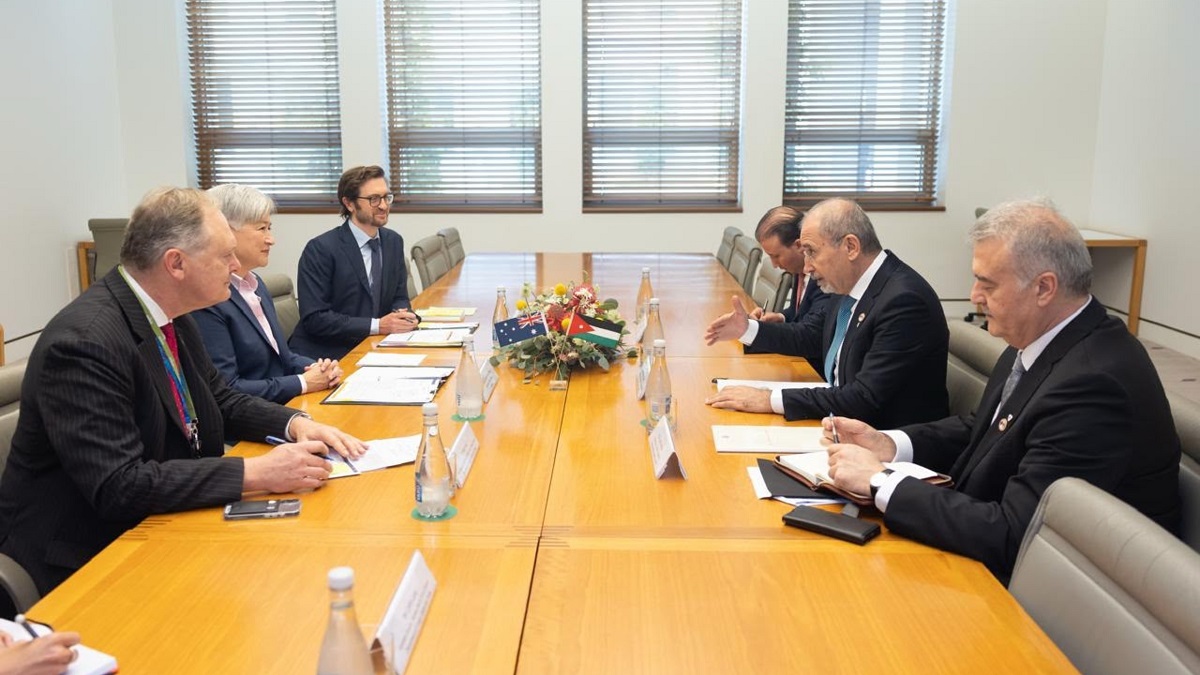
CANBERRA, Oct. 13 (Petra) — Minister of Foreign and Expatriates
Affairs Ayman Safadi met with Australian Foreign Minister Penny Wong
on Tuesday during King Abdullah II’s state visit to Australia, with
talks focusing on strengthening bilateral ties and expanding
cooperation across several sectors.
The ministers highlighted the significance of the King’s visit and
its expected outcomes in deepening cooperation between the two
countries and enhancing coordination on regional and international
issues of shared concern.
Safadi and Wong discussed opportunities to broaden
Jordanian-Australian cooperation in economic affairs, trade,
investment, defense, security, tourism and education. They also
exchanged views on regional developments and ongoing efforts to
de-escalate tensions and restore security and stability.
Separately, Safadi received a rare Jordanian archaeological artifact
on behalf of King Abdullah II, following Australia’s decision to
return the piece to its country of origin. The artifact was
discovered through joint Jordanian-Australian archaeological work at
Wadi al-Hammah in the Tabqet Fahel area.
The handover took place at the National Gallery of Australia during a
ceremony held alongside the King’s state visit. The return
underscores the countries’ shared commitment to safeguarding cultural
heritage, preserving archaeological treasures and ensuring that
historical artifacts are returned to their places of origin.
Dating back to approximately 12,000 BC, the artifact is one of three
engraved claystone pieces that formed an architectural stone panel.
The pieces were unearthed in 1983 by a joint archaeological mission
involving the University of Sydney and Worcester College. The
artifact was transferred to the National Gallery of Australia in 1985
under arrangements agreed upon by Jordan and Australia.
The three pieces are collectively regarded as the oldest known
large-scale sculpture in the world. The two other components remain
in Jordan, housed at the Jordan Museum in Amman and Dar al-Saraya
Museum in Irbid.
During the handover ceremony, attended by Australian Government
Special Envoy for the Arts Susan Templeman and museum officials
responsible for cultural and artistic affairs, Safadi stressed the
importance of continued cooperation between Jordan and Australia in
archaeological research, excavation and preservation.
He expressed appreciation to the Australian government and the
National Gallery of Australia for their cooperation and for
facilitating the artifact’s return to Jordan.
//Petra//WH