Jordan’s Q2 2026 GDP Expands 3.0%, Outperforming Regional Headwinds, International Forecasts

ENV-KUWAIT-SUSTAINABLITYKuwait strengthens environmental sustainability through strategic initiativesBy Zahra Al-Kadhmi

HLT-KUWAIT-SURGERYKuwait advances health sector with robotic, remote surgeryBy Mohammad Al-Moseb

Saudi Arabia’s Voluntary Carbon Market Fuels the Shift to a Low-Carbon

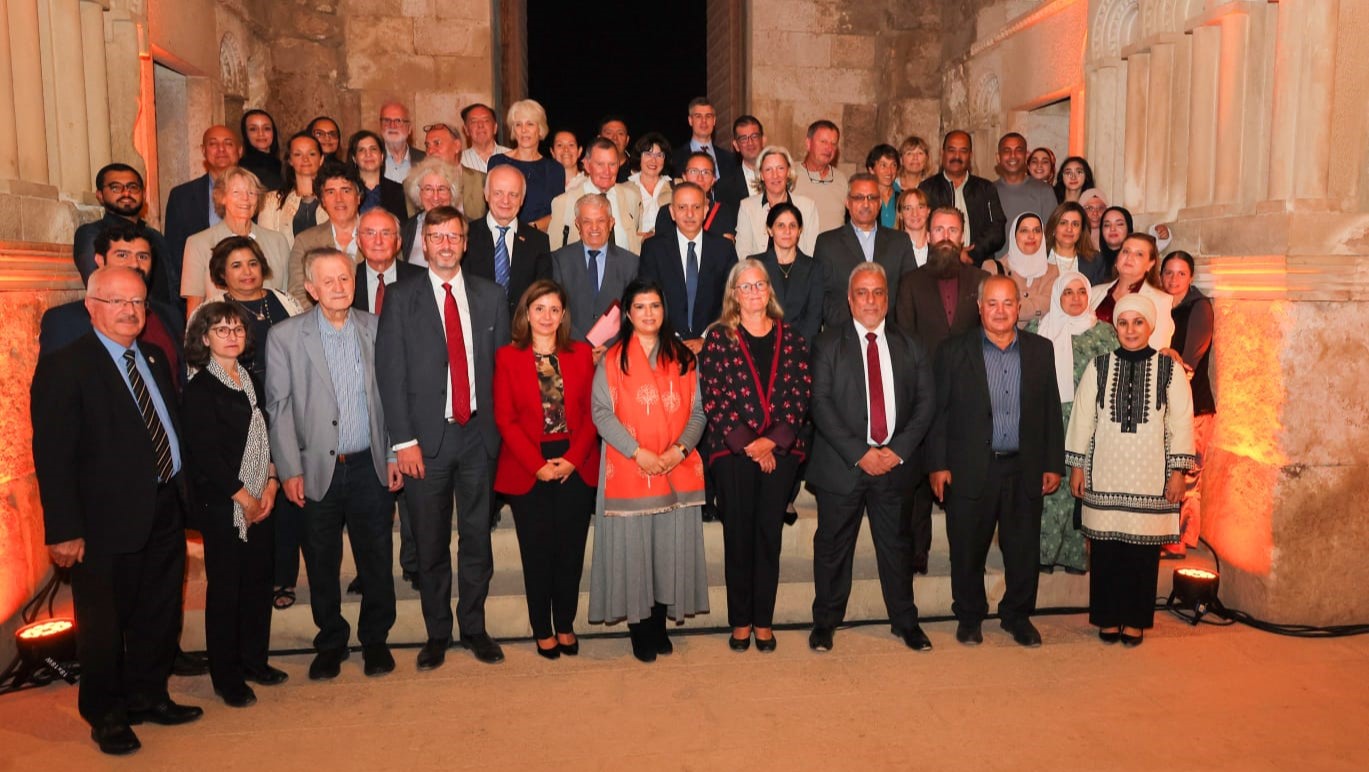
AMMAN, Oct. 13 (Petra) — Her Royal Highness Princess Sumaya bint El
Hassan, Vice-Chair of the Board of Trustees of the Jordan Museum, on
Tuesday attended a celebration marking the 50th anniversary of the
German Protestant Institute of Archaeology in Amman, held under her
patronage at the Umayyad Palace on Amman’s Citadel Hill.
The ceremony was attended by Her Royal Highness Princess Dana Firas,
President of the Petra National Trust and ICOMOS Jordan; German
Ambassador to Jordan Dr Bertram von Moltke; Institute Director Dr
Brita Jansen; Director-General of the Department of Antiquities Dr
Fawzi Abu Danneh; Professor Dr Dieter Vieweger, Director-General of
the Institute in Jerusalem and Amman; and Dr von Dobschütz, a
founding member of its Support Association.
In her address, Princess Sumaya said the anniversary celebrated not
only five decades of archaeological research and discovery, but also
the enduring friendship and partnership between Jordan and Germany.
She stressed that responsibility for heritage extends beyond
protecting archaeological sites to preserving historical evidence and
knowledge, interpreting their significance and making them accessible
to future generations. Once a site or its historical context is lost,
she noted, no technological advancement can fully restore the
knowledge that has disappeared.
Princess Sumaya emphasised the central role of Jordanian institutions
and researchers in safeguarding national heritage, highlighting the
importance of equitable international partnerships, knowledge
exchange and investment in the next generation of researchers.
She also underscored the role of science diplomacy in strengthening
understanding and cooperation between institutions and countries.
Concluding her address, she said: “The past was not ours to create,
but its preservation has now become, in part, our responsibility.”
Princess Dana Firas praised the Institute’s contribution to
understanding Jordan’s archaeological and cultural heritage through
research, excavations, documentation, restoration and specialist
training. She highlighted the value of international cooperation and
the partnership between German research and Jordanian expertise.
Institute Director Dr Brita Jansen outlined the Institute’s
archaeological work at sites across Jordan, from Umm Qais in the
north to Ba’ja in the south. She also highlighted its collaboration
with the Department of Antiquities, Jordanian universities and other
institutions, as well as its contribution to research, training and
the dissemination of knowledge.
Jansen praised the International Conference on the History and
Archaeology of Jordan, held every three years under the patronage of
His Royal Highness Prince El Hassan bin Talal, and expressed the
Institute’s readiness to support the Department of Antiquities
through the conference’s scientific committee.
German Ambassador Dr Bertram von Moltke highlighted the strength of
Jordanian-German relations and the countries’ close cooperation in
archaeology and cultural heritage protection.
Dr Fawzi Abu Danneh also emphasised the importance of joint
archaeological research, the exchange of expertise and the use of
modern scientific methods in excavation, documentation and
conservation. He reaffirmed the Department of Antiquities’ commitment
to international cooperation and to developing Jordanian research
capabilities.
The Jordan Museum houses archaeological finds from the Institute’s
excavations, including material from Tall Zira’a, and supports
researchers studying its collections.
In 2019, Princess Sumaya inaugurated Tall Zira’a: A Mirror of
Jordan’s History, an exhibition organised by the Jordan Museum, the
Department of Antiquities and the German Archaeological Institute.
The exhibition presented discoveries from a site with more than 5,000
years of continuous settlement before moving to the Museum of
Jordanian Heritage at Yarmouk University in Irbid in 2020.
//Petra// AJ