Jordan’s Q2 2026 GDP Expands 3.0%, Outperforming Regional Headwinds, International Forecasts
ENV-KUWAIT-SUSTAINABLITYKuwait strengthens environmental sustainability through strategic initiativesBy Zahra Al-Kadhmi

HLT-KUWAIT-SURGERYKuwait advances health sector with robotic, remote surgeryBy Mohammad Al-Moseb

Saudi Arabia’s Voluntary Carbon Market Fuels the Shift to a Low-Carbon

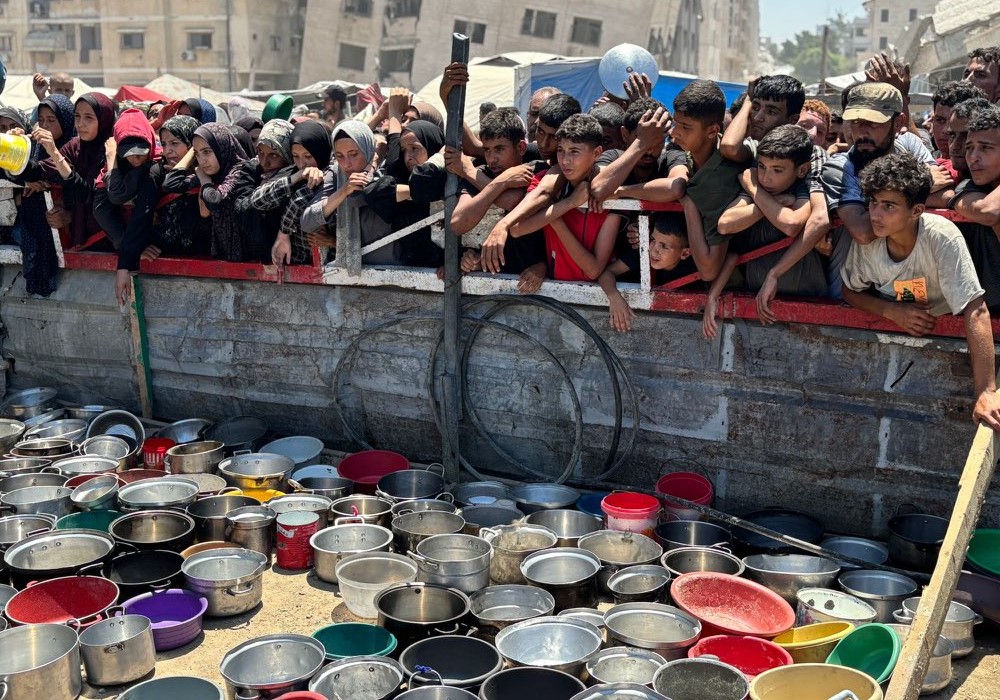
Gaza, October 19 (QNA) – Concerns are mounting over the worsening food security crisis in the Gaza Strip as winter approaches after the World Food Programme (WFP) announced on Monday a one-third reduction in its food assistance due to a lack of funding, a move that will deprive approximately half a million Palestinians of vital aid. Warnings have been issued regarding the potential impact of this decision on the already catastrophic humanitarian situation in the territory.
The UN agency stated that it requires $450 million to sustain its essential operations in Gaza and the West Bank over the next six months.
The WFP explained that it reduced the number of beneficiaries receiving monthly food assistance in the Gaza Strip from approximately 1.6 million to 1.1 million people.
Furthermore, the agency halved food rations, providing families with one food parcel instead of two, along with a smaller quantity of flour, reduced the number of daily hot meals from 250,000 to 150,000 and cut the value of cash assistance provided to 75,000 families.
In this context, Director of the Government Media Office in the Gaza Strip, Dr. Ismail Al Thawabta described the WFP’s announcement as catastrophic, warning that it would have devastating repercussions for the humanitarian situation. He characterized the decision as a green light that will accelerate the onset of famine and deepen the humanitarian disaster already being endured by Palestinians, particularly children, women, the sick, and the elderly, amid the ongoing war.
In remarks to Qatar News Agency (QNA), Al Thawabta held the Israeli occupation responsible for the repercussions of this decision, as well as for the ongoing starvation and blockade, warning that the announcement signals dangerous consequences for the humanitarian situation.
He urged the United Nations and the international community to take immediate action to secure the necessary funding to ensure the program can continue its operations, stressing that hundreds of thousands must not be left to face an uncertain fate.
It is unacceptable, he stated, that the world fails to provide the modest sums required to save lives, while billions are channeled into arming the occupation and fueling its killing machine.
Al Thawabta called on international bodies and organizations to pressure the occupation to open all border crossings, ensure the unrestricted and unconditional flow of humanitarian aid, provide urgent financial support for relief programs, and facilitate the entry of thousands of trucks carrying food, relief supplies, and medical aid into the Gaza Strip.
For her part, Spokesperson for the Ministry of Social Development in Gaza, Aziza Nofal warned of the decision’s consequences. In a statement to QNA, she described it as the collapse of the final line of defense for the human dignity of more than half a million people who relied entirely on World Food Programme aid to keep their families alive.
She explained that the suspension of food assistance would affect tens of thousands of impoverished families, including widows, orphans, the elderly, and persons with disabilities, as well as those living in displacement camps, warning that this could lead to a sharp rise in rates of acute malnutrition among children and pregnant women. Nofal stated that the Ministry’s teams, emergency committees, and local partners are no longer able to bridge the aid gap, given the severe shortage of essential supplies and the fact that many community kitchens and partner organizations have ceased operations.
She called on the World Food Programme, UN agencies, and relief organizations to declare a humanitarian emergency and establish an urgent crisis task force to reprioritize needs and secure emergency funding to resume aid programs without delay.
She also urged humanitarian and charitable institutions to fund food parcel and emergency meal programs, and to provide urgent social protection for affected families.
Analyzing the situation, Economic Analyst Ahmed Abu Qamar warned of a decline in the flow of humanitarian aid through crossings controlled by Israeli occupation forces. He noted that the volume of aid has dropped by as much as 70 percent compared to previous periods, with the daily number of incoming trucks falling by more than half.
In a statement to QNA, Abu Qamar explained that the quantity of aid entering the Gaza Strip no longer meets the minimum needs of the population, and that the reduction in the number of trucks is directly affecting the availability of food supplies in markets and distribution centers.
He further pointed out that the halt to aid coincides with international organizations scaling back their programs due to funding shortages and the obstruction of supplies, in addition to disruptions in the entry of commercial goods. He emphasized that what is required at this stage is not a reduction in aid, but rather its expansion, particularly regarding shelter supplies, tents, blankets, winter clothing, and heating equipment, as the winter season approaches.
He warned that a decline in aid would widen the scope of poverty and deprivation, while compounding the burdens on humanitarian organizations amidst an economic collapse and a severe lack of liquidity.
For its part, Hemaiah Center for Human Rights (HCHR) expressed deep concern and condemnation regarding the World Food Programme’s announcement that it would reduce some of its aid due to a lack of funding. The Center asserted that the international community must fulfill its legal, humanitarian, and moral responsibilities toward the Palestinians in Gaza.
In a press statement, the Center stressed that food is not a conditional grant, nor is it a privilege that can be withdrawn, suspended, or delayed; rather, it is a fundamental human right that must not be compromised or made subject to financial calculations and the priorities of donors.
It warned that leaving approximately half a million people without aid, given the current humanitarian conditions, threatens to exacerbate hunger and malnutrition, and endangers the lives of children, women, the elderly, the sick, and displaced persons.
The Center reiterated that the right to adequate food is intrinsically linked to the right to life, human dignity, and health. It noted that the rules of international humanitarian law mandate the protection of civilians, the facilitation of relief access, and the assurance that the population can obtain its basic needs, while explicitly prohibiting the starvation of civilians as a method of warfare. Palestinian medical sources reported that the death toll from the Israeli aggression on the Gaza Strip since October 7, 2023, has risen to 74,480 martyrs and 175,539 injured, as of October 19, 2026, amid a continuing blockade and restrictions on the entry of food, medicine, and humanitarian supplies. (QNA)