Jordan’s Q2 2026 GDP Expands 3.0%, Outperforming Regional Headwinds, International Forecasts
ENV-KUWAIT-SUSTAINABLITYKuwait strengthens environmental sustainability through strategic initiativesBy Zahra Al-Kadhmi

HLT-KUWAIT-SURGERYKuwait advances health sector with robotic, remote surgeryBy Mohammad Al-Moseb

Saudi Arabia’s Voluntary Carbon Market Fuels the Shift to a Low-Carbon

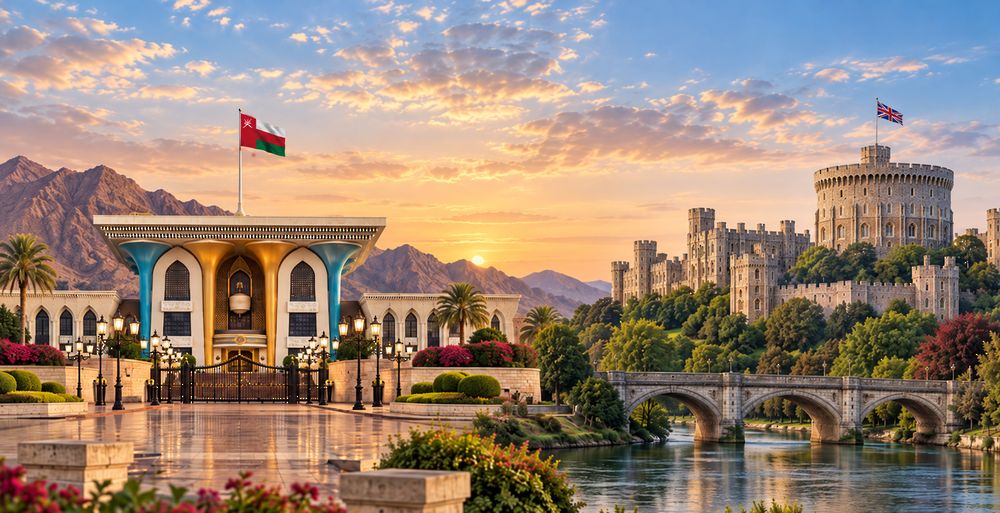
Muscat and London: Deep-Rooted Diplomacy and Institutional Cooperation Bolstering Regional SecurityMuscat, 19 Oct 2026 (ONA) — The political and diplomatic relations between the Sultanate of Oman and the United Kingdom are among the most deeply rooted bilateral relations in the region, their foundations extending over more than two centuries. This relationship is described as “deep, historic and firmly established,” and the friendship between the two countries rests upon the “Treaty of 1800,” which laid the foundations of their strategic partnership.Diplomatic relations between the two countries continue through high-level visits and regular mechanisms, with His Majesty the Sultan’s Royal visit to the United Kingdom representing the first state visit since 1982. Regular mechanisms have likewise been an important factor in the evolution of diplomatic relations, foremost among them the Oman-UK Joint Working Group, which held its 18th round in Muscat in September 2025.The two countries also signed the Comprehensive Agreement on Enduring Friendship and Bilateral Cooperation in 2019, described as a strong indicator of the mutual commitment to elevating bilateral relations, extending back centuries, into a new era of cooperation.The relationship between the two countries transcends the bilateral dimension to encompass coordination on issues of regional security and stability. All these indicators affirm that the Omani-British relationship is not merely a historical legacy, but an effective and continuing political and diplomatic partnership, renewed through high-level visits, institutional mechanisms and continuous coordination on regional and international challenges.In statements to Oman News Agency (ONA), a number of researchers and specialists in political affairs and international relations affirmed that the Royal visit of His Majesty Sultan Haitham bin Tarik to the United Kingdom reflects the level of the firmly established historical relations between the two friendly countries across numerous fields, particularly diplomatic and political, noting that the dimensions of this visit will be reflected positively in the future of bilateral cooperation between the two sides during the coming phase.Awadh bin Said Baqwair, a member of the State Council, said that Oman and Britain enjoy firmly established historical ties extending over more than two centuries, as the Sultanate of Oman and the United Kingdom are bound by relations of friendship through the Treaty of Friendship and Cooperation of 1798 in the era of the Sultan Sultan bin Ahmed Al Busaidi. He explained that Muscat and London have maintained those close relations in terms of political consultation and coordination, and through reciprocal visits between senior officials of the two countries.He noted that the strategic maritime location of the two countries contributed pivotally to commercial communication, particularly over the past decades, especially since the dawn of the Omani Renaissance in 1970, as well as during the era of the Renewed Renaissance under the leadership of His Majesty Sultan Haitham bin Tarik.He explained that the Sultanate of Oman possesses a strategic location on the open seas, with the Sea of Oman and the strategic Strait of Hormuz in the north, and the Arabian Sea and the Indian Ocean to the east, centre and south of the Sultanate of Oman, while the United Kingdom has a unique maritime location with the North Sea. He affirmed that the maritime link between the two countries played a major role in commercial and civilisational communication.He explained that the foreign policy of the two friendly countries witnesses harmony and continuous political consultation, whether on the geopolitical issues of the region, on the Sultanate of Oman’s positive role in matters of securing maritime navigation, or on diplomatic communication on all regional and international issues, particularly as the political and historical legacy of the two friendly countries is substantial and extends over more than two centuries.He noted that the Omani-British Friendship Association plays a prominent role in continuing cooperation, and that the continuous visits between officials of the two countries, and in support of the fields of defence, economic and educational cooperation and in the field of technology transfer, have made the relations of cooperation and friendship a distinguished model in the relations of the two countries.He said: “The course of historical relations between the two countries has contributed to creating stability and peace in the region for long decades, and there is no doubt that the international order has witnessed major changes. Hence, the two friendly countries contribute to the matter of de-escalation and finding political solutions to all conflicts, particularly the Palestinian cause and also the situation in the Arabian Gulf region.”He explained that, in light of this, Muscat and London continue consultations and contacts between the two leaderships and at the level of foreign ministers in finding political solutions, particularly as diplomacy has become the first option for ending regional conflicts, which is affirmed by both the Sultanate of Oman and the United Kingdom. He noted that geopolitical developments in the region fall within the framework of major challenges that require the wisdom of diplomacy and dialogue, which requires the coordination of continuous diplomatic and political efforts.For his part, Dr. Abdullah bin Saleh Baabood, an academic specialising in international relations and Gulf and Middle East affairs, noted that the Royal visit of His Majesty Sultan Haitham bin Tarik to the United Kingdom is a clear expression of the depth and importance of the historical relationship between the two friendly countries. The visit, he added, represents an ideal and timely opportunity to deepen and develop the strategic relations and develop their instruments.He explained that the Omani-British relationship is unique in the fabric of regional alliances, for it is neither a traditional alliance nor a simple historical connection, but a deeply rooted historical partnership reflecting an evolved understanding of how to protect national sovereignty amid mounting regional pressures.He added that relations between the two friendly countries encompass cooperation in numerous political, diplomatic, economic, commercial and military fields, crowned in 2019 by the two countries signing the Joint Defence Agreement, and that these bilateral relations possess a legal depth extending over more than two centuries.He noted that 2019 constituted a watershed in the course of bilateral relations with the Joint Defence Agreement, then the Comprehensive Agreement on Enduring Friendship and Bilateral Cooperation, as the relationship moved to a multidimensional institutional structure encompassing technology, education, health, culture, economy and innovation. In January 2022 came the Sovereign Investment Partnership. He affirmed that each new agreement means that the relationship is not static but based on effective and vital common interests.He explained that the Sultanate of Oman and the United Kingdom agree on numerous files and current regional issues, as Muscat and London support UN efforts towards a political and diplomatic solution to these issues. He said in this regard: “On the Palestinian file, the Sultanate of Oman welcomed Britain’s decision to recognise the State of Palestine as a step towards justice, and in the current regional crisis, Britain has commended Omani efforts to find diplomatic solutions.”He believes that the Sultanate of Oman’s relationship with the United Kingdom may be the clearest example of the Omani method of managing international relations, founded upon positive neutrality, non-interference in the affairs of others, support for dialogue and keeping channels of communication open with all, an approach followed by Omani policy.He noted that the Omani distinctiveness in managing international relations lies in the ability to separate partnership from alignment, for a close defence and strategic partnership with a major power does not mean adopting its policies or its antagonisms. He added that Oman draws this distinction with precision, granting some states military and logistical facilities but refusing to turn its territory into a platform for any party against another. Friendship with one party in Omani philosophy does not mean enmity towards another.He explained that the transition from the era of the Blessed Renaissance to the era of the Renewed Renaissance added a clear economic dimension to the bilateral relations between the Sultanate of Oman and the United Kingdom, as Britain is now the largest investment partner of the Sultanate of Oman with more than 50 percent of foreign direct investment, and British companies lead five of eight green hydrogen concessions. This links the partnership directly to Oman Vision 2040, so that the relationship is no longer merely military or political but is expanding and deepening across all fields and levels.He said that at a critical moment in the region’s history, when old orders are fracturing and new alliances are emerging, the Omani-British partnership plays a strategic role, noting that the Sultanate of Oman is among the states that always seek to keep channels of communication open with all parties to regional conflicts in order to resolve thorny issues through political and diplomatic means. In this regard, he believes that strengthening the Omani-British partnership is not a diplomatic luxury so much as a strategic necessity.He explained that the Omani-British relationship does not revolve around historical legacy alone, but reflects an evolved understanding of how a state preserves the independence of its political decision in a rapidly changing international order, and how another power, in a world heading towards multipolarity, maintains its importance through partnerships that respect independence rather than demanding loyalty, as he put it.Dr. Omran bin Mohammed Al Abri, Head of the Department of Political Science at the College of Economics and Political Science at Sultan Qaboos University, said that the Omani-British relationship is one of the oldest continuous relationships in the region, but it was not a single relationship so much as successive relationships whose content changed with the shifting balance of power.He noted that the relationship between the two friendly countries was a mirror of the international order: in the era of British hegemony, London was the near-sole partner; with the Cold War, it turned into a security partnership; then the British withdrawal from east of Suez during the period between 1968 and 1971 came as a true turning point in the course of bilateral relations.He explained that the Omani approach with Britain is a clear example of what he termed positive neutrality and compound hedging. The features of this approach centre on three matters: the separation of files, so that disagreement on one issue does not obstruct cooperation on another; strategic silence, that is, managing differences away from the media; and transforming the relationship into a mediation asset, as happened in the files of British detainees. Thus, the Sultanate of Oman has become, for Britain, a strategic partner.He said that he looks to the future with realistic optimism, for Britain today, in his view, is a power seeking reliable partners, and Oman is a state seeking economic diversification within the Oman Vision 2040, which contributes to finding genuine points of convergence. The promising fields, in his estimation, are green hydrogen and renewable energy, Duqm as a logistical and industrial platform, maritime security amid the turbulence of the corridors, education and scientific research, and financial and technical services.— Ends/Khalid