Jordan’s Q2 2026 GDP Expands 3.0%, Outperforming Regional Headwinds, International Forecasts
ENV-KUWAIT-SUSTAINABLITYKuwait strengthens environmental sustainability through strategic initiativesBy Zahra Al-Kadhmi
HLT-KUWAIT-SURGERYKuwait advances health sector with robotic, remote surgeryBy Mohammad Al-Moseb
Saudi Arabia’s Voluntary Carbon Market Fuels the Shift to a Low-Carbon
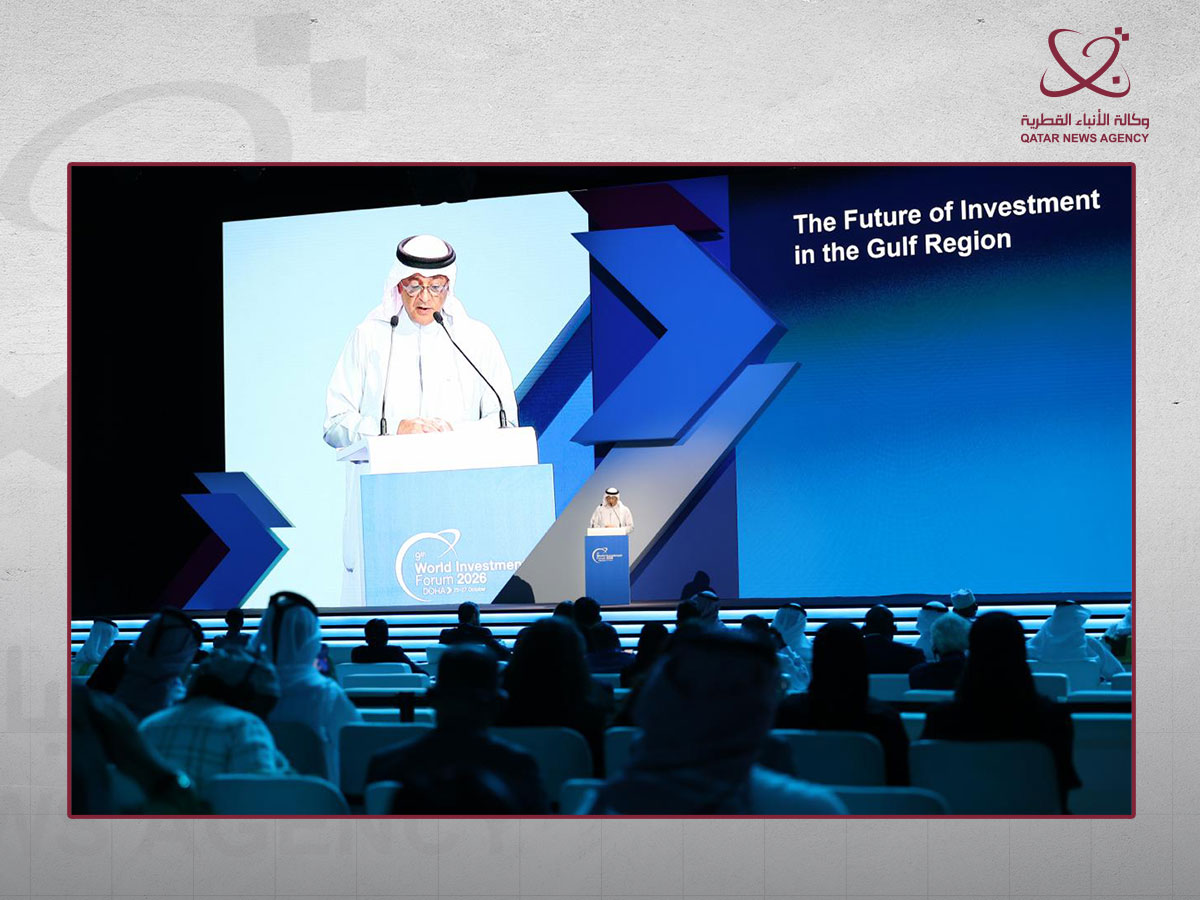
Doha, October 25 (QNA) – HE Secretary-General of the Gulf Cooperation Council (GCC) Jasem Mohamed Albudaiwi affirmed that the State of Qatar provided an inspiring model for transforming ambitious visions into global achievements. Through its pioneering development experience, Qatar has demonstrated that when ambition is coupled with a clear vision, firm resolve, and strategic planning, it not only creates achievements but also shapes the future, turning challenges into opportunities and opportunities into sustainable successes.
This came during His Excellency’s participation in a panel session titled “The Future of Investment in the Gulf,” held on the sidelines of the ninth edition of the World Investment Forum 2026. Hosted by the State of Qatar in partnership with the United Nations Conference on Trade and Development (UNCTAD) under the theme “Investing in the Future,” the event was attended by various ministers and senior officials.
In his address, the GCC Secretary-General expressed his sincere gratitude and appreciation to the State of Qatar for its continuous efforts to foster international economic and investment dialogue, as well as its contribution to strengthening the presence and standing of the GCC on both regional and international stages.
He noted that the GCC states are open to the world and are moving toward deeper economic integration, driven by an aspiration to build long-term investment partnerships that serve mutual interests. In this context, Albudaiwi pointed out that the forum takes place amidst rapid transformations in the global economy, a period marked by the reconfiguration of supply chains, the decisive role of emerging technologies in shaping future economies, and intensifying competition to attract foreign investment.
His Excellency added that, amidst these transformations, a fundamental question arises which is how investor confidence can be bolstered and the sustainability of investment flows be ensured in a world increasingly marked by geopolitical challenges, challenges by which maritime corridors and global supply chains are directly impacted.
He explained that the answer lies in the proven capacity of the GCC states to confront these challenges and mitigate their repercussions. They have achieved this by strengthening joint coordination, diversifying trade and logistical routes, and ensuring the continuity of economic activities and supply chains.
GCC Secretary-General highlighted those recent developments, and the associated threats to the security of vital maritime corridors, most notably the Strait of Hormuz, have underscored that the stability of energy flows, trade, and supply chains is not merely a regional priority, but a cornerstone for global economic stability and investor confidence.
He further stated that economic integration is no longer just a development option, but a strategic necessity for enhancing resilience against global shocks, sustaining growth, and solidifying confidence in the investment environment. Albudaiwi emphasized that this interconnectedness is built upon a firm, integrative framework, foremost among which are the Customs Union, the GCC Common Market, the interlinking of payment systems among member states, and the GCC Railway project, all of which serve to enhance supply chain efficiency and reduce the cost of doing business.
He stated that the GCC states can no longer be viewed as six separate markets; rather, they must be recognized as an interconnected Gulf economic and investment ecosystem, anchored by a substantial economic, financial, and institutional base. He also explained that the Gulf economy ranks among the world’s ten largest, with a gross domestic product (GDP) of $2.4 trillion and foreign trade exceeding $1.8 trillion. Collectively, the GCC states rank fifth globally, with sovereign wealth fund assets estimated at over $5 trillion.
In his concluding remarks, GCC Secretary-General underscored that a primary indicator of the growing integration among the economies of the GCC states is the upward trend in regional investment activity. In 2025, the total stock of foreign direct investment (FDI) into the GCC reached over $792 billion, of which more than $171 billion represents intra-GCC investments, accounting for approximately 22 percent of total foreign investment stock in the bloc.
He added that this underscored an important point: investors in any GCC country gain access not only to an individual national market, but also to an interconnected regional system linking Gulf markets with one another and the global economy. (QNA)