Jordan’s Q2 2026 GDP Expands 3.0%, Outperforming Regional Headwinds, International Forecasts
ENV-KUWAIT-SUSTAINABLITYKuwait strengthens environmental sustainability through strategic initiativesBy Zahra Al-Kadhmi

HLT-KUWAIT-SURGERYKuwait advances health sector with robotic, remote surgeryBy Mohammad Al-Moseb

Saudi Arabia’s Voluntary Carbon Market Fuels the Shift to a Low-Carbon

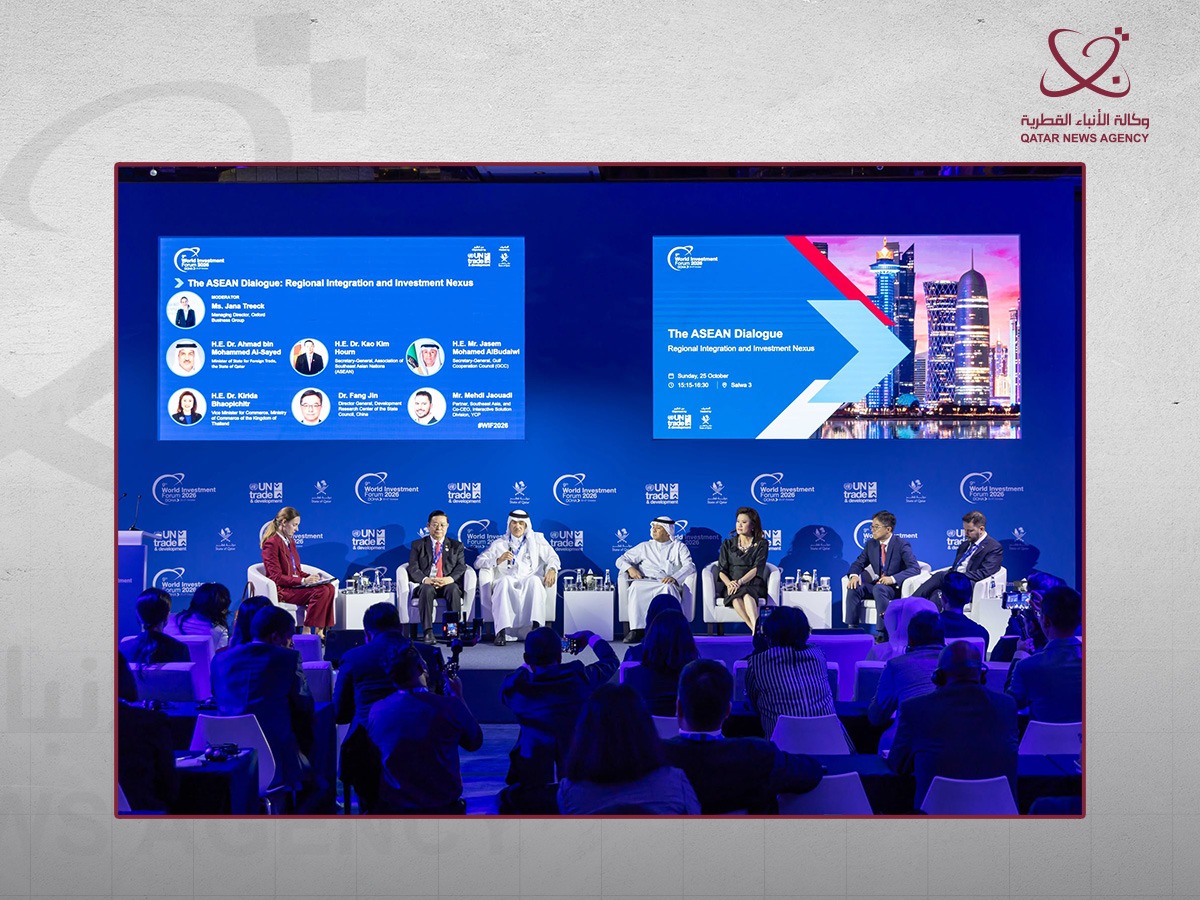
Doha, October 25 (QNA) – A panel discussion, held as part of the 9th World Investment Forum, being held in Doha, explored the prospects for economic cooperation between the Gulf Cooperation Council (GCC) states and the Association of Southeast Asian Nations (ASEAN), as well as the ASEAN experience in attracting investment.
Titled “The ASEAN Dialogue: Regional Integration and Investment Nexus,” the session examined the drivers of ASEAN’s investment success and its resilience. It also identified new opportunities for regional and inter-regional partnerships, including with the Gulf region, aimed at unlocking sustainable growth and connectivity.
During the session, HE Minister of State for Foreign Trade Affairs at the Ministry of Commerce and Industry Dr. Ahmed bin Mohammed Al Sayed emphasized that the ASEAN bloc is of great importance to the State of Qatar and the GCC states as a whole. This is particularly significant given that the bloc comprises a population of 700 million, boasts a gross domestic product (GDP) of approximately USD 4 trillion, and attracted over USD 240 billion in foreign direct investment (FDI) inflows in 2025.
HE the Minister of State for Foreign Trade Affairs at the Ministry of Commerce and Industry highlighted the importance of bilateral investment relations between the two blocs, notably the investments made by Gulf sovereign wealth funds within the ASEAN region, and commended the excellence in human capital development across ASEAN member states. He further expressed an aspiration to strengthen both bilateral and multilateral approaches to increase long-term domestic and foreign direct investment between the two blocs.
For his part, HE GCC Secretary-General Jasem Mohamed Albudaiwi said that the global economy is undergoing profound transformations, shaped by geopolitical uncertainty, shifting supply chains, and evolving investment patterns. He emphasized that regional integration goes beyond merely expanding markets; rather, it aims to create an environment that is more resilient, competitive, and attractive to investors.
His Excellency indicated that economic integration serves as a cornerstone of the development agenda for the GCC member states, facilitated through a customs union, a common market, and economic connectivity. This has bolstered the Gulf’s position as a global hub for trade, investment, energy, and logistics, with the combined gross domestic product (GDP) of the GCC economies reaching approximately USD 2.4 trillion, and the value of merchandise trade amounting to nearly USD 1.8 trillion.
His Excellency added that the two regions complement each other’s strengths: the Gulf states possess investment capabilities, energy resources, and advanced infrastructure, while ASEAN is characterized by its manufacturing networks, dynamic markets, and interconnected production chains. He based this assessment on the outcomes of the summits between the GCC and ASEAN, held in Riyadh (2023) and Kuala Lumpur (2025).
HE GCC Secretary-General outlined priorities for future cooperation, focusing on strengthening practical collaboration in advanced manufacturing, digital transformation, clean energy, logistics, and investment facilitation. He also emphasized advancing discussions on a free trade agreement between the GCC and ASEAN to unlock promising opportunities for the peoples of both regions. Furthermore, he called for transforming regional integration into intra-regional investments, economic alignment into productive partnerships, and political commitments into tangible opportunities.
For their part, Secretary-General of ASEAN Dr. Kao Kim Hourn and HE Vice Minister for Commerce of the Kingdom of Thailand Kirida Bhaopichitr highlighted in their remarks the significant interest and vast potential for joint action and cooperation between the GCC states and the ASEAN member states. The ASEAN Secretary-General further outlined four priorities for collective action: enhancing investment in strategic sectors, including energy, critical minerals, and food security, advancing digital and knowledge-based industries, accelerating sustainable development and the green transition, and deepening global investment partnerships.
He highlighted the role of institutional integration, transparency, and regulatory certainty in bolstering investor confidence and attracting foreign direct investment.
According to the dialogue’s concept paper distributed during the session, the ASEAN, including its Economic Community, comprises 11 member states, a market of nearly 700 million people, and a gross domestic product (GDP) exceeding USD 4 trillion. As per the World Investment Report 2026, foreign direct investment (FDI) inflows to the region reached a record high of USD 246 billion in 2025, accounting for 15 percent of global FDI flows, while the region’s share of global GDP stood at 3.6 percent, and its share of global trade at 9 percent. (QNA)