
Jordan’s Q2 2026 GDP Expands 3.0%, Outperforming Regional Headwinds, International Forecasts
ENV-KUWAIT-SUSTAINABLITYKuwait strengthens environmental sustainability through strategic initiativesBy Zahra Al-Kadhmi

HLT-KUWAIT-SURGERYKuwait advances health sector with robotic, remote surgeryBy Mohammad Al-Moseb

Saudi Arabia’s Voluntary Carbon Market Fuels the Shift to a Low-Carbon

AMMAN, Oct. 26 (Petra) – A targeted market study highlights promising
commercial opportunities for Jordanian exporters in Malaysia across
the agri-food, confectionery, olive oil, and pharmaceutical sectors,
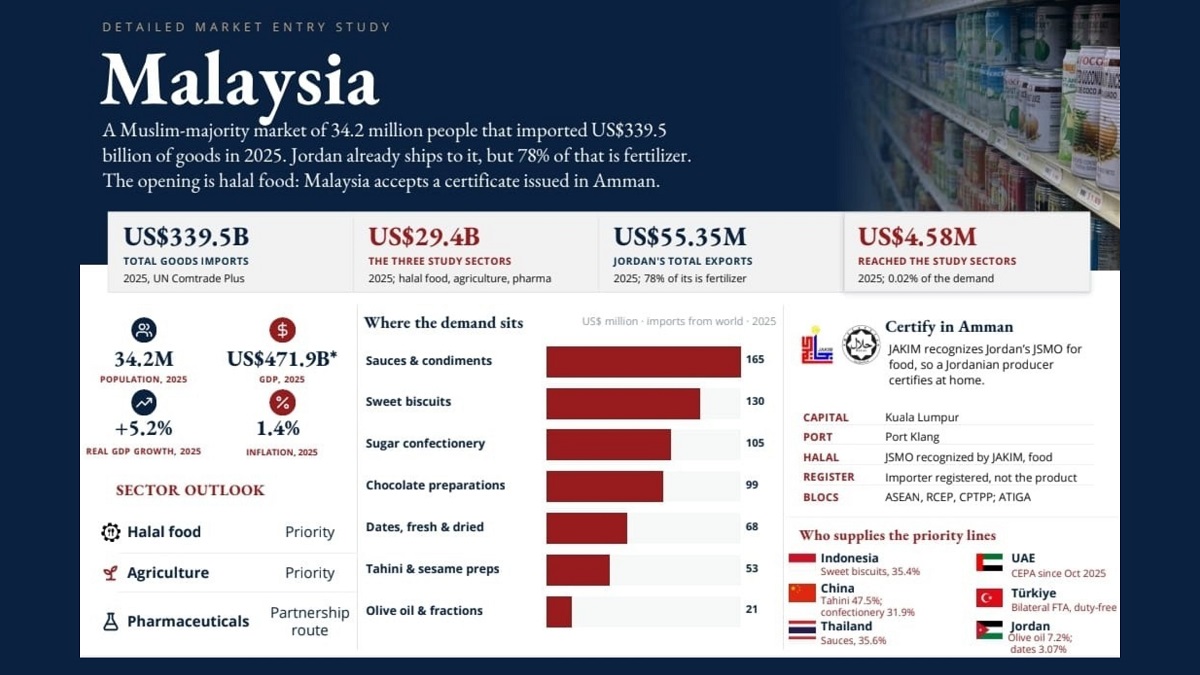
leveraging Malaysia’s overall $339.5 billion import market last year.
Prepared by Trade First Jordan in partnership with the Ministry of
Industry, Trade and Supply, the report indicates that Jordanian
exports to Malaysia reached $55.35 million last year. Fertilizers
accounted for nearly 78 percent of that total, while combined exports
of halal food, agricultural products, and pharmaceuticals stood at
$4.58 million, underscoring significant room for product
diversification.
Malaysia imported $68.1 million in fresh and dried dates, $104.5
million in sugar confectionery, $53 million in tahini and sesame
preparations, and $21.4 million in olive oil and its derivatives over
the past year. Jordan currently ranks ninth among Malaysia’s date
suppliers with a 3.07 percent market share, while tahini and sesame
product shipments totaled $705,000, holding a 1.33 percent market
share. Notably, Jordan holds the third position in supplying
non-virgin olive oil varieties to Malaysia, commanding a 7.2 percent
market share.
The report emphasizes that Malaysia’s official recognition of halal
certificates issued by the Jordan Standards and Metrology
Organization (JSMO) streamlines export procedures, enabling producers
to complete halal verification locally prior to shipment.
In the pharmaceutical sphere, Malaysia’s imports under HS Chapter 30
surpassed $2.7 billion last year, including $898.5 million in
packaged medicaments, $65.2 million in antibiotics, and $19.5 million
in vitamin preparations. Entering the Malaysian pharmaceutical market
requires establishing a partnership with a registered local entity to
navigate product registration with regulatory authorities–a process
that typically spans up to 18 months, with expedited pathways
available for eligible products.
To successfully enter the Malaysian market, the study recommends
securing local import partners, verifying specific customs
classifications, and calculating landed costs at Port Klang,
factoring in freight, insurance, tariffs, and taxes. Exporters are
advised to conduct trial shipments, engage local distributors, and
finalize date supply contracts four to five months ahead of Ramadan
before expanding into broader food categories.
The findings form part of a broader study unveiled this month by
Trade First Jordan and the Ministry, evaluating entry strategies for
five promising target markets: Malaysia, Indonesia, Tanzania,
Uzbekistan, and Kenya. Combined, these markets represent an
accessible addressable demand estimated at $2.5 billion for
high-quality Jordanian manufactured goods.
//Petra// AA