
Jordan’s Q2 2026 GDP Expands 3.0%, Outperforming Regional Headwinds, International Forecasts
ENV-KUWAIT-SUSTAINABLITYKuwait strengthens environmental sustainability through strategic initiativesBy Zahra Al-Kadhmi

HLT-KUWAIT-SURGERYKuwait advances health sector with robotic, remote surgeryBy Mohammad Al-Moseb

Saudi Arabia’s Voluntary Carbon Market Fuels the Shift to a Low-Carbon

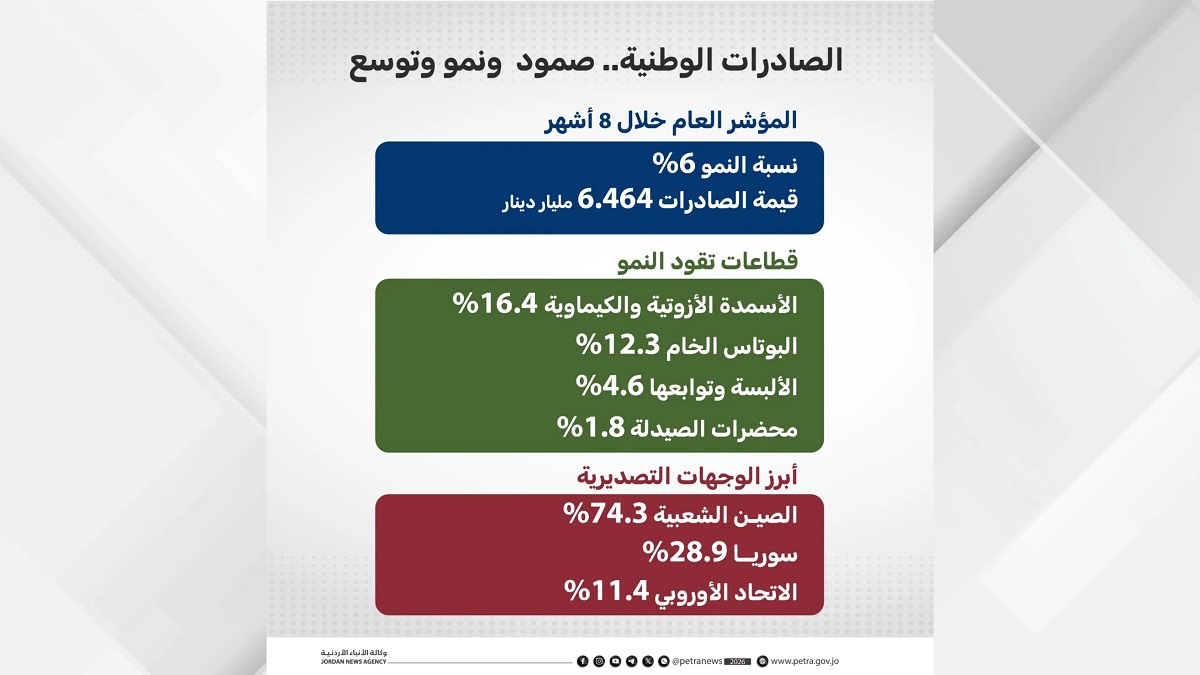
Amman, Oct. 26 (Petra) — The national exports increased by 6 percent
during the first eight months of 2026, reaching JD6.464 billion, up
from JD6.098 billion in the same period last year, as the country’s
industrial sector maintained growth despite regional tensions and
disruptions to trade and supply chains.
The increase was supported by stronger exports of several major
industrial products, including knitted apparel and related goods,
which rose 4.6 percent, nitrogenous and chemical fertilizers by 16.4
percent, pharmaceutical products by 1.8 percent and crude potash by
12.3 percent.
Exports to key international markets also recorded significant gains,
rising 28.9 percent to Syria, 74.3 percent to China and 11.4 percent
to the European Union.
Industry leaders said the figures highlight Jordanian manufacturers’
ability to maintain their presence in overseas markets, adapt to
logistical challenges and expand their export destinations.
President of the Jordan and Amman Chambers of Industry Fathi Jaghbir
told the Jordan News Agency (Petra) that the growth reflects the
resilience of Jordan’s industrial sector and the continued
competitiveness of its products in international markets.
He said manufacturers had faced rising shipping and insurance costs,
disruptions to transport routes and delays in the delivery of raw
materials and production inputs, placing additional pressure on
operating costs.
Despite these challenges, Jordanian industries maintained production
and fulfilled export commitments, demonstrating their ability to
respond to changing regional conditions, he added.
Jaghbir noted that export growth was not confined to a single
industry but extended across several manufacturing sectors,
indicating a broader and more diversified export base.
He stressed that the positive performance does not mean regional
tensions have had no impact on businesses, but rather reflects the
industrial sector’s ability to manage disruptions while sustaining
operations.
Jaghbir called for continued diversification of export markets and
products to reduce dependence on individual destinations and
strengthen manufacturers’ resilience to external shocks.
He also emphasized the need to expand higher-value manufacturing,
lower production and transportation costs, improve market access and
capitalize on Jordan’s international trade agreements.
The priority, he said, is to turn the current increase into sustained
export growth that supports industrial investment, expands production
capacity and creates employment opportunities.
He added that the performance reinforces the importance of
manufacturing as a driver of economic growth and a key contributor to
the objectives of Jordan’s Economic Modernization Vision.
President of the Jordan Exporters Association, Senator Ahmad Khodari,
said the latest figures demonstrate the strength of Jordan’s
industrial sector and its ability to compete internationally despite
regional political and economic uncertainty.
He attributed part of this resilience to Jordan’s security and
stability, which have helped businesses maintain production and
export operations amid regional challenges.
Khodari said the expansion into new markets is particularly
significant, as it allows manufacturers to diversify their customer
bases and reduce reliance on traditional export destinations.
He noted that stronger export demand can encourage manufacturers to
increase production and investment, generating new jobs and
supporting efforts to reduce unemployment.
Growing exports also strengthen foreign currency inflows and support
the balance of payments, contributing to the country’s overall
economic and monetary stability, he added.
Khodari said continued export expansion aligns with the Economic
Modernization Vision’s priorities of improving industrial
competitiveness, attracting investment and creating sustainable
employment.
He highlighted the progress Jordanian manufacturers have made in
modernizing production lines, adopting advanced technologies and
improving product quality and standards, enabling them to enter new
international markets.
Jordanian products have established a presence in Singapore and South
Korea, he said, reflecting the industry’s expanding international
reach.
Khodari added that the Jordan Exporters Association is preparing new
initiatives to strengthen access to promising markets, particularly
China, Russia, Belarus, Kazakhstan and Armenia.
The association is also seeking to expand Jordan’s export presence in
Africa, with preparations underway to organize a trade exhibition in
Kenya to introduce Jordanian products to potential buyers and
establish new commercial partnerships.
He emphasized that international exhibitions remain an important
platform for promoting national industries, connecting exporters with
overseas importers and opening new distribution channels.
Khodari said sustaining export growth would require continued
investment in manufacturing capabilities, stronger international
marketing efforts and further diversification of export destinations
to reinforce Jordan’s position in global markets.
//Petra// RZ