Saudi Arabia’s Voluntary Carbon Market Fuels the Shift to a Low-Carbon

Under UAE President’s directives, UAE launches urgent relief response for Ghana flood victims

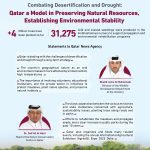
Combating Desertification and Drought: Qatar a Model in Preserving Natural Resources, Establishing Environmental Stability
UAE allocates US$30 million for emergency humanitarian response in El Obeid, calls for civilian protection, safe humanitarian aid access in Sudan

Amman, May 24 (Petra) — As the Hashemite Kingdom of Jordan stands on the cusp of its 79th Independence Day, the halls of the Lower House of Parliament resonate with reflections on a journey marked by resilience, progress, and an unwavering national spirit.
For Jordan’s elected representatives, this Sunday’s anniversary is far more than a historical commemoration; it is an affirmation of the nation’s identity, a testament to its enduring strength, and a mandate for its continued modernization under the esteemed Hashemite leadership.
Lawmakers articulate a shared vision of independence as the very foundation upon which Jordan’s modern identity has been built. They speak of a nation defined by its integrity, its steadfast commitment to Arab causes, and its history of principled leadership.
“This is a homeland of history, identity, strength, and stability,” House Speaker Ahmad Safadi asserted, capturing a common sentiment. “A nation that has only known sincerity in defending its kin, never trading on the suffering of peoples, and always aligning with the just causes of the Arab and Islamic worlds.” This deep-seated identity, MPs emphasize, is a legacy to be cherished and imparted, a lesson in patriotism for future generations.
A dominant theme in the parliamentarians’ reflections is the profound commitment to political modernization, a path charted by His Majesty King Abdullah II. They view the evolution towards a more robust democracy and parliamentary governance as a core expression of independence.
First Deputy Speaker Mustafa Khasawneh meticulously traced this trajectory, highlighting the King’s Discussion Papers as catalysts for reform.
He cited crucial milestones, including the establishment of the Constitutional Court and the Independent Election Commission, and the landmark 2021 reforms aimed at bolstering political parties and increasing their representation in Parliament – a figure set to reach approximately 50 percent in upcoming elections.
“We are witnessing a new era of political competition and development,” Khasawneh noted, underscoring the drive to deepen citizen participation and embed party-based governance.
MP Dina Al-Bashir, Head of the Foreign Affairs Committee, echoed this, celebrating the “qualitative shifts” under His Majesty’s reign. She lauded the three pillars of modernization – political, economic, and administrative – for fostering a more representative parliament and enhancing the role of women and youth, key focuses also highlighted by MP Hussein Kreishan. This democratic deepening, they argue, is not merely an internal affair but a strengthening of the nation’s independent character.
The parliamentarians spoke with one voice on Jordan’s unwavering support for the Palestinian cause, a cornerstone of its independent foreign policy. Speaker Safadi passionately reaffirmed this, declaring, “Jordan will remain a steadfast ally for Palestine, led by His Majesty the King, who personally demonstrated this commitment with airdrops over Gaza.”
He stressed the widely held conviction that regional peace hinges upon a just and comprehensive solution that guarantees a sovereign Palestinian state. This sentiment was reinforced by MPs like Ayman Al-Badadwa and Dina Al-Bashir, who also emphasized the profound significance of the Hashemite Custodianship over Jerusalem’s Islamic and Christian holy sites – a historical responsibility Jordan carries with immense pride and dedication.
The ability to build a modern, thriving state is seen by the lawmakers as a direct dividend of 79 years of independence. They lauded the establishment of a robust framework based on institutions and the rule of law, which has enabled Jordan to navigate regional turbulence while pursuing progress and prosperity.
MP Haitham Al-Ziyadin spoke of His Majesty’s drive to build an “unprecedented system of comprehensive modernization,” aimed at creating a modern civil state, enhancing active citizenship, and improving the quality of life for all Jordanians.
This involves not only political reform but also economic development, a focus on the knowledge economy, and the empowerment of youth and women, ensuring that the fruits of independence are shared by all.
//Petra// AA
24/05/2025 11:45:45