
Jordan’s Q2 2026 GDP Expands 3.0%, Outperforming Regional Headwinds, International Forecasts
ENV-KUWAIT-SUSTAINABLITYKuwait strengthens environmental sustainability through strategic initiativesBy Zahra Al-Kadhmi

HLT-KUWAIT-SURGERYKuwait advances health sector with robotic, remote surgeryBy Mohammad Al-Moseb

Saudi Arabia’s Voluntary Carbon Market Fuels the Shift to a Low-Carbon

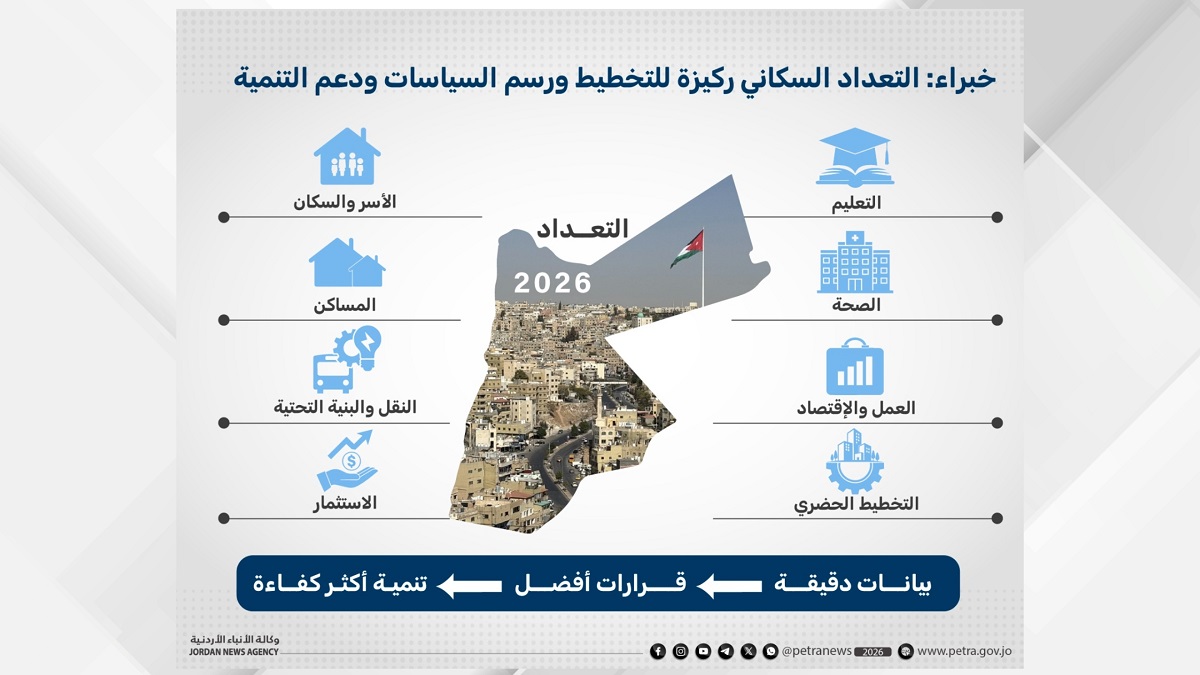
Amman, Sept. 30 (Petra) — Experts and representatives of
international organizations have stressed the importance of the
Population and Housing Census as a legal and national requirement for
producing reliable data and supporting planning, policymaking, and
economic and development decisions based on accurate and updated
information.
Speaking to the Jordan News Agency (Petra), they said the census is
not limited to determining the number of residents, but also provides
detailed information on their demographic and social characteristics,
geographic distribution, and needs.
They noted that census results provide an important basis for
planning, policymaking, and allocating resources and services
according to population needs. The data also serve the private
sector, research and academic institutions, and support international
comparisons.
The 2026 Population and Housing Census in the Kingdom will begin
Thursday and continue through Oct. 31, under the slogan “Our Census
for a Better Future.” Around 12,000 field researchers will
participate in the census, which aims to collect and update data on
approximately 2.5 million households.
Ghazi Shbeikat, an International Monetary Fund expert and former
minister of labor and former director of the Department of
Statistics, said the census is not simply a project to collect
population figures, but represents the “infrastructure of national
information.”
He described it as one of the most important statistical operations
conducted by the Department of Statistics and statistical agencies
worldwide, noting that its results serve as a key reference for many
statistics and policies in subsequent years.
Shbeikat said the economic importance of the census lies in providing
the population base needed to properly interpret many indicators.
Spending on education and healthcare, for example, needs to be
assessed alongside information on the number of people benefiting
from these services, their ages, places of residence, and economic
and social characteristics.
He added that indicators such as per capita income, unemployment,
poverty, school enrollment and service coverage cannot be accurately
measured without a reliable and updated population database.
He explained that a key feature of the census is its ability to
identify differences that national averages may overlook. An
indicator may appear positive at the national level while concealing
significant gaps between governorates, districts and municipalities,
as well as between urban and rural areas and different age and social
groups. The census therefore helps decision-makers identify where
needs are concentrated rather than simply estimating their overall
size at the national level.
Shbeikat also highlighted the importance of the census for
international comparisons. When conducted in accordance with
internationally recognized statistical standards and methodologies,
Jordan’s data can be compared with those of other countries in areas
including population, education, employment, urbanization, housing
and development. He noted that such comparisons are not limited to
ranking countries, but can also help identify strengths and gaps and
draw on other countries’ experiences in policymaking.
He said census figures also provide investors with information about
Jordan’s population size, age structure, education levels, workforce
distribution, city sizes, population distribution, housing patterns
and potential demand for goods and services. The availability of
accurate and updated data, he added, provides greater clarity when
assessing investment opportunities and reduces uncertainty for
investors.
He noted that international institutions, financing bodies, rating
agencies and researchers rely on official data to develop an
understanding of Jordan’s economy and society. A well-conducted
census therefore provides data for domestic use while strengthening
confidence in the country’s statistical system and supporting the
accurate presentation of its conditions, needs and opportunities.
Al-Shbeikat stressed that the benefits of census results extend
beyond the government to the private sector, municipalities in urban
planning, research and academic institutions, and society as a whole.
Former Minister of Planning and International Cooperation Suhair
Al-Ali stressed the importance of the census in determining
population size, composition, demographic and social characteristics,
and needs. She said this information is important for development
planning and for preparing short-, medium- and long-term plans to
address needs in education, healthcare, transport, employment,
housing and other sectors.
Al-Ali said the census also helps the government allocate resources
efficiently according to population needs in different areas,
particularly by identifying the population’s age and educational
structure and poverty and unemployment rates in different areas.
She added that comparing the results of the previous census with the
new one can show trends across different sectors and age groups, as
well as changes in poverty and unemployment. She called on everyone
to cooperate with the census, describing it as a national interest.
Musa Shteiwi, president of the Economic and Social Council, said the
importance of the Population and Housing Census lies primarily in the
need for reliable data on society, enabling the state to plan and
manage effectively. He described data as the “compass of the state,
and what is not measured cannot be managed.”
He said census information, including population size, geographic
distribution, age structure and health and education services,
provides a picture of society at the time the census is conducted.
Such information should then be translated into development
priorities through planning and monitoring, he added.
Shteiwi said sound planning contributes to distributing services
according to the development needs of each area or governorate. He
also stressed the need for continuous data updates to measure changes
in society and assess the impact of development policies.
Himyar Abdulmoghni, representative for the United Nations Population
Fund (UNFPA) in Jordan, said the Population and Housing Census is one
of the country’s key national sources of data, providing a
comprehensive picture of the population, including its demographic,
social and economic characteristics, geographic distribution and
housing conditions.
He said the census is an important tool for supporting evidence-based
planning and policymaking, with its results helping identify
development needs and priorities and allocate resources and services
efficiently and fairly, particularly in education, healthcare, social
protection, housing and infrastructure.
Abdulmoghni said countries conduct censuses periodically because they
provide a reliable and updated database that enables national
institutions to monitor demographic and social changes, prepare for
future needs, measure progress under national plans and strategies,
and assess progress toward the Sustainable Development Goals. This
contributes to improving the quality of services and supporting
population well-being.
//Petra//WH