Saudi Arabia’s Voluntary Carbon Market Fuels the Shift to a Low-Carbon

Under UAE President’s directives, UAE launches urgent relief response for Ghana flood victims
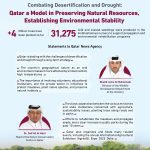
Combating Desertification and Drought: Qatar a Model in Preserving Natural Resources, Establishing Environmental Stability
UAE allocates US$30 million for emergency humanitarian response in El Obeid, calls for civilian protection, safe humanitarian aid access in Sudan

Amman, May 21 (Petra) – The Integrity and Anti-Corruption Commission (IACC) has recovered and prevented the loss of approximately JD 61 million in public funds and uncovered suspected tax evasion totaling JD 110 million in 2024, according to its annual report presented to His Majesty King Abdullah II on Wednesday.
The report states that the IACC handled 1,167 investigative cases in 2024, in addition to 840 carried over from previous years. Of these, 1,280 cases were resolved, 194 were referred to the Public Prosecutor, and 750 were closed. The remainder are still under investigation.
The report highlights a significant decline in corruption cases within public sector institutions in recent years, attributing this to the IACC’s proactive and preventive measures, including awareness workshops and outreach programs. The number of cases referred to the judiciary in 2024 dropped by 45% compared to 2023.
Last year, the commission helped recover JD 141 million. It has also requested judicial authorities pursue those who benefited from general amnesties to return ill-gotten public funds, as these are not covered by the pardons.
A recent poll conducted by the Center for Strategic Studies at the University of Jordan showed that public confidence in the commission rose to 81%, up from 73% last year.
Experts, speaking to the Jordan News Agency (Petra), emphasized that the report reflects His Majesty’s continued commitment to safeguarding public funds and combatting corruption and tax evasion, which pose major obstacles to sustainable economic development.
Amer Bani Amer, Director General of Hayat Center – RASED, stated that submitting the report to the King underscores the state’s serious intent to strengthen the national integrity system. He praised the commission’s shift from reactive investigations to proactive community engagement, including its collaboration with civil society and media through the National Integrity Index, which provides scientific data on integrity in Jordan.
He noted that royal support enhances the commission’s independence and impact on public policy and boosts public trust in anti-corruption efforts. The commission’s initiatives, legislative reforms, and cooperation with other oversight bodies have also contributed to Jordan’s improved standing on the Transparency International Corruption Perceptions Index.
Hilda Ajeilat, CEO of the Jordan Transparency Center, stressed the commission’s expanded efforts in curbing tax evasion in coordination with other agencies. She highlighted the importance of royal backing in empowering the commission to act with full independence, including His Majesty’s repeated calls to protect whistleblowers and pursue corruption cases without leniency.
Ajeilat also noted the commission’s university-based initiatives targeting youth through awareness campaigns, competitions, and partnerships like the “Universities Against Corruption” project in 2017 with the Arab Anti-Corruption and Integrity Network.
Abeer Mdanat, Executive Director of Rasheed – Transparency International – Jordan, highlighted the commission’s efforts to update the National Integrity Index and conduct training sessions with government institutions to build capacities in governance, fiscal oversight, and the right to access information. The commission also introduced tools to assess employee integrity in service delivery.
She noted the upskilling of commission staff had a positive effect on performance and outcomes, particularly in reducing nepotism and misuse of public funds.
On national coordination efforts, Mdanat pointed to the commission’s partnership with Rasheed to co-develop innovative tools that advance Jordan’s standing in international governance metrics.
Osama Azzam, a governance expert and former director of the Cities and Villages Development Bank, described the reported figures as a clear success in public fund protection. The detection of JD 110 million in tax evasion and savings of JD 61 million affirm the commission’s effectiveness in enhancing fiscal compliance and resource management.
Azzam emphasized that royal support was instrumental in legislative reforms and in creating an enabling environment for the commission’s autonomous and efficient operation. He underscored the value of educating university students on integrity as a long-term investment in building an anti-corruption culture.
He concluded by asserting that these achievements stem from the commission’s internal good governance practices and its efforts to instill them across public institutions. Sound governance, he said, is the foundation of institutional integrity and sustainable national development, in line with the King’s vision.
//Petra// AF
21/05/2025 22:38:49