Saudi Arabia’s Voluntary Carbon Market Fuels the Shift to a Low-Carbon

Under UAE President’s directives, UAE launches urgent relief response for Ghana flood victims

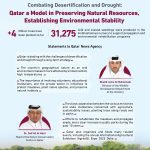
Combating Desertification and Drought: Qatar a Model in Preserving Natural Resources, Establishing Environmental Stability
UAE allocates US$30 million for emergency humanitarian response in El Obeid, calls for civilian protection, safe humanitarian aid access in Sudan

Amman, July 2 (Petra) – An Integrity Caravan delegation, comprising representatives from the Integrity and Anti-Corruption Commission (IACC) and the Hayat Center (Rasid), on Wednesday visited the Jordan Cooperative Corporation (JCC).
Made as part of the second round of the National Integrity Index (2024–2025), the initiative aims to measure the extent of government institutions’ compliance with integrity standards.
The visit is one of a series of the IACC’s field tours, in partnership with Rasid and Plan International, for 119 government entities to strengthen public institutions’ commitment to integrity.
Receiving the delegation, JCC Assistant Director, Ghaleb Haddadin, affirmed the Corporation’s “dedication” to promoting employee-based integrity in its operations and in the delivery of services.
Praising the IACC’s ongoing efforts, he expressed the JCC’s “readiness to fully” support the Integrity Caravan team in completing its work “efficiently.”
Director of the JCC Internal Control Unit and Chairman of the Compliance Committee, Mohammed Rababa’ah, presented a report highlighting the committee’s achievements.
He said the JCC released several methodologies on conflict of interest, reporting suspected corruption, and promoting excellence, which define criteria for measuring employee compliance with integrity standards.
The report also noted the Internal Control Unit issued a circular on the mechanism for accepting gifts and donations.
Additional measures were taken to boost performance, including introduction of the Excellence Committee Charter and charters for service recipients, suppliers, leadership, innovation, and committee operations.
Members of the Integrity Caravan delegation explained the index’s working mechanism in its second cycle, which uses direct and electronic opinion polls to gauge integrity levels based on feedback from employees and service recipients.
The team noted these surveys account for 40 percent of an institution’s assessment score, while the remaining 60 percent is based on documents and supporting institutional evidence, an approach aimed to help identify strengths and areas for improvement.
//Petra// AO
02/07/2025 15:23:19