Saudi Arabia’s Voluntary Carbon Market Fuels the Shift to a Low-Carbon

Under UAE President’s directives, UAE launches urgent relief response for Ghana flood victims

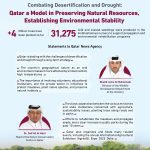
Combating Desertification and Drought: Qatar a Model in Preserving Natural Resources, Establishing Environmental Stability
UAE allocates US$30 million for emergency humanitarian response in El Obeid, calls for civilian protection, safe humanitarian aid access in Sudan

Amman, June 22 (Petra) -Economic and Social Council (ESC) of Jordan issued a policy paper aimed to enhance integration of the outcomes of the Kingdom’s higher education system and needs of the labor market.
Enhancing this alignment constitutes a “fundamental” axis in supporting Jordan’s economic development by preparing university alumni with the required applied and cognitive skills, the paper found.
The effort would contribute to raising the alumni’s “professional readiness” and enhancing their opportunities for “effective and sustainable” integration into the market.
In a press ststement, ESC Chairman, Dr. Musa Shteiwi, said the paper came within the framework of the council’s efforts to contribute to achieve goals of the Economic Modernization Vision (EMV) 2033.
Shteiwi noted this ambition is implemented by integrating “advanced” educational models, mainly the “dual studies” model, which combines academic education with practical training in the workplace.
Shteiwi pointed out that this model is a “key modern” educational experience that seeks to develop human capital and prepare university students for the labor market by directly acquiring technical and professional skills.
To date, he stated a number of Jordanian universities have “successfully” implemented this approach, including Al Hussein Technical University (HTU), which requires its students to complete an 8-month practical training program.
Shteiwi also mentioned German-Jordanian University (GJU), which applies the model in 14 majors, while Al- Balqa’ Applied University (BAU) has allocated 30% of its credit hours to vocational training.
As per the paper, a gradual expansion of the model’s implementation is exhibited in a number of other Jordanian universities, such as University of Jordan, Jordan University of Science and Technology, Al-Hussein Bin Talal University, and Petra University.
The paper noted practical training was integrated under applied projects in partnership with local and international institutions, reflecting a “growing” national trend to link education to the labor market.
The document offered a practical roadmap for embracing the model, divided into three phases aimed to launch “immediate” steps to prepare infrastructure, build lasting partnerships with the productive sector and focus on legislative and institutional reforms to ensure the model’s sustainability within the higher education system.
The research also called for aligning curricula with professional standards, establishing a digital platform to connect students with training providers, launching a national fund to support students, and providing Incentives for the private sector to enhance its engagement in training.
Shteiwi noted enhanced integration represents a “qualitative” shift in the philosophy of Jordan’s higher education toward a participatory production model aimed to support “sustainable” development, provides “true” job opportunities, and enhances universities’ ability to keep pace with economic and societal changes.
Calling for adopting the dual studies model as a “strategic” national option, he said this approach is based on its “pivotal” role in preparing “qualified” national competencies and empowering Jordanian youth to “actively” engage in the process of economic growth and development.
//Petra// AG
22/06/2025 18:43:39