Saudi Arabia’s Voluntary Carbon Market Fuels the Shift to a Low-Carbon

Under UAE President’s directives, UAE launches urgent relief response for Ghana flood victims
Combating Desertification and Drought: Qatar a Model in Preserving Natural Resources, Establishing Environmental Stability
UAE allocates US$30 million for emergency humanitarian response in El Obeid, calls for civilian protection, safe humanitarian aid access in Sudan

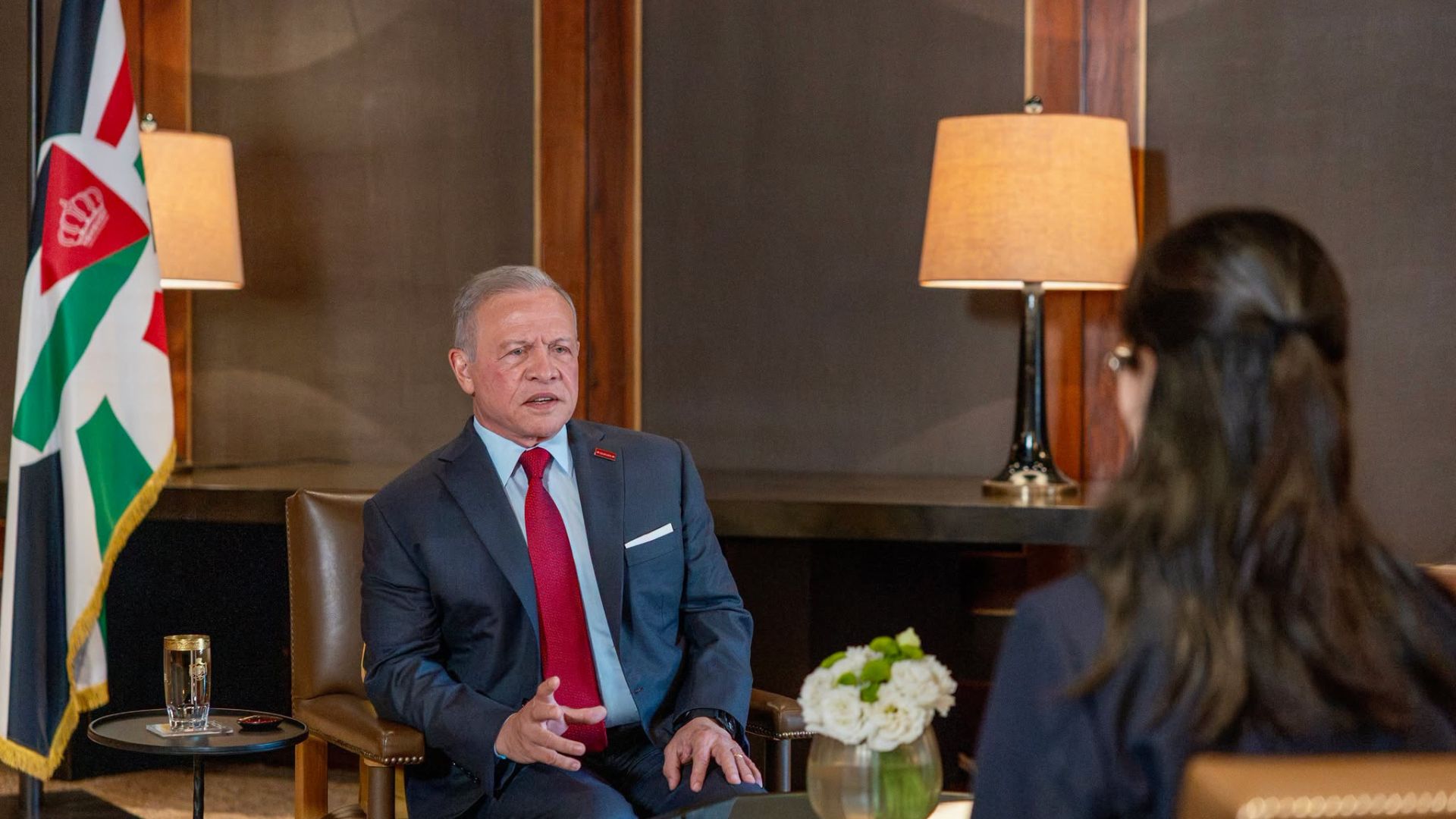
Amman, August 17 (Petra) — His Majesty King Abdullah II sat for an
interview with Xinhua, the official news agency of the People’s
Republic of China, which was published on Monday, in Chinese,
English, and Arabic. The interview focused on Jordan-China relations,
as the two countries will mark the 50th anniversary of the
establishment of diplomatic relations next year.
According to a royal court statement, His Majesty spoke about his
upcoming visit to China, opportunities to build on the strategic
partnership between the two countries, and ways to enhance
cooperation in economic, investment, development, tourism, cultural,
and other fields.
The interview touched on China’s role in the region, with the King
emphasizing the importance of Beijing’s efforts to support
international peace and security, and of building on its significant
presence on the international stage to help advance the two-state
solution.
Below is the full text of the Xinhua interview:
“Xinhua: The year 2025 marked the 10th anniversary of the
establishment of the China-Jordan strategic partnership. How do you
assess the development of bilateral relations over the past decade?
Which key achievements best illustrate the progress made by both
sides in terms of political mutual trust, economic and trade
cooperation, and people-to-people exchanges?
His Majesty King Abdullah II: First, I would like to thank you and
Xinhua News Agency for your keenness on covering Jordan and our
partnership with China. I am looking forward to my upcoming visit to
your great country and to meeting once again with Chinese President
Xi Jinping to discuss ways to take the partnership between our
nations to further heights.
The deep-rooted relationship between the Hashemite Kingdom of Jordan
and the People’s Republic of China serves as a strong foundation for
advancing our shared priorities and fostering innovation and greater
prosperity for our peoples.
Jordan’s strategic location, resources and skilled youth, coupled
with China’s economic strength, technology expertise, and global
reach, create exceptional opportunities to broaden cooperation. And
China continues to play a vital role in promoting international peace
and stability, as well as in addressing regional and global
challenges.
My upcoming visit straddles two important milestones, namely marking
over ten years since the establishment of our strategic partnership
in 2015 and the upcoming 50th anniversary of the establishment of our
diplomatic relations in 2027.
Since the establishment of our strategic partnership, our bilateral
relations have achieved substantial progress. Cooperation has
expanded beyond traditional diplomatic ties to include trade and
investment, infrastructure, education, healthcare and cultural
exchanges. Despite regional and global challenges, our nations have
remained committed to strengthening this partnership, resulting in
steady and mutually beneficial development.
China has also been a key partner in building the capacity of
Jordan’s public sector. Between 2015 and 2025, thousands of
Jordanians in the public and private sectors have benefited from
training programmes offered by the Chinese government. Our
cooperation now spans the entire education ecosystem, from teacher
and supervisor training and Chinese language education to higher
education.
Moreover, Chinese energy investments in Jordan have contributed
significantly to our self-sufficiency and diversification strategy.
In the mining sector, a key investment partnership has culminated in
the 502 million-U.S.-dollar acquisition by China’s State Development
and Investment Group (SDIC Group) of a 28 percent stake in the Arab
Potash Company.
We look forward to expanding cooperation into areas such as green
energy, scientific innovation, tourism and civil aviation, while
further deepening our strategic partnership.
Xinhua: Jordan is advancing its economic modernisation and green
development agenda. What are the current priorities for the kingdom’s
reform and development? How does Jordan seek to deepen practical
cooperation with China in areas such as renewable energy, the digital
economy and talent development to further support its national
transformation?
King Abdullah II: Despite decades of regional instability, Jordan is
advancing its Economic Modernisation Vision, a roadmap to 2033 that
focuses on prosperity, improved quality of life and inclusive
long-term growth through strategic partnerships.
Jordan’s economic modernisation agenda recognises that an efficient,
digitally enabled public sector is fundamental to economic
competitiveness and investment attraction. Jordan has made
substantial progress in digitising government services, and a key
priority is integrating AI into public administration to streamline
processes. These efforts are driving the digital transformation of
Jordan’s public sector.
Jordan is also well positioned to serve as a regional manufacturing
and export hub. Chinese manufacturing investments could leverage this
position, benefiting from our natural resources, skilled workforce,
stable business environment, strategic location and extensive network
of trade agreements.
In addition, sustainability is one of the three pillars of the
Economic Modernisation Vision. The energy sector best illustrates
this progress: renewable energy has grown from less than 1 percent of
electricity generation a decade ago to approximately 27 percent
today, with a target of 40 percent by 2035. To sustain this momentum,
Jordan is investing in the supporting infrastructure for renewable
energy, including a pipeline of nearly one gigawatt of new renewable
generation and energy storage projects representing more than 1
billion dollars in investment opportunities.
Another key priority is promoting higher-value, sustainable and
resilient tourism growth. The objective is not simply to maximise
visitor numbers, but to diversify source markets, encourage longer
stays, improve connectivity and ensure greater benefits for local
communities. Tourism cooperation should also support Jordanian
employment, facilitate knowledge transfer and protect Jordan’s
cultural and natural heritage. We look to strengthen air connectivity
with China as one of our top global partners and main targeted
markets for inbound and outbound tourism.
We also see strong potential for deeper cooperation with China by
positioning Jordan as a preferred filming destination for the Chinese
film industry, building on our superior production capabilities and
unique filming locations.
Xinhua: Amid a complex and evolving regional landscape, Jordan plays
a vital role in helping maintain stability in the Middle East. Could
you elaborate on Jordan’s efforts to promote regional stability,
particularly regarding the Palestinian issue? How can Jordan and
China further strengthen coordination and cooperation to contribute
to peace and stability in the region?
King Abdullah II: Despite the regional situation, we have
consistently striven to be proactive, encouraging cooperation in the
interest of peace while always staying true to our principles. Our
diplomatic engagements have focused on this approach. I have always
said and believed that the Palestinian issue remains the core issue
in our region; what we have seen in recent years underscores this
reality. Unless addressed, the region will remain vulnerable to
recurring cycles of violence that will become more severe and broader
in scope, with reverberations extending far beyond its borders.
Palestinians are facing unprecedented measures, with intensified
settler attacks, fast-paced and massive illegal settlement expansion,
land grabs and confiscations, house demolitions and violations, as
well as harassment and incitement at Jerusalem’s Muslim and Christian
holy sites. These measures cannot go unnoticed or unaddressed. It is
a responsibility upon us all to ensure respect for international law,
UN resolutions and human rights.
In Jordan, our efforts have been and will continue to be focused on
establishing regional calm, undertaking our duties under the
Hashemite Custodianship over Muslim and Christian holy sites in
Jerusalem, working to end unilateral measures that obstruct peace,
and pushing for a just and comprehensive solution to the Palestinian
issue that results in the establishment of a viable, independent and
sovereign state of Palestine based on the 1967 lines, with East
Jerusalem as its capital, living side-by-side with Israel in peace
and security.
But we also look to coordinate with China as a key global player and
partner to use its considerable influence and voice on the
international stage to help push for the realisation of the two-state
solution.
Our humanitarian efforts in Gaza continue, and we are grateful for
China’s contributions to ongoing relief efforts.
Xinhua: As the international landscape undergoes profound changes,
the role of Global South countries is becoming increasingly
significant. How does Your Majesty view the role of China and Arab
countries in global governance? How can Jordan serve as a bridge to
enhance cooperation between Arab states, China, and other
international partners?
King Abdullah II: Global South countries are playing an increasingly
important role in the international arena, becoming more and more
central to the global economy, security, and to advancing sustainable
development. This further reinforces the importance of strengthening
a global system that remains firmly anchored in international law.
We appreciate China’s calls for a fair international order, and we
look to strengthen our cooperation to foster stronger international
cooperation and respect for international law. The crises we are
facing today serve as a reminder that we are all interconnected, and
highlight the necessity of fostering collective action and dialogue.
It is time for our regions to work together to establish better
resilience and advance joint efforts to respond to various
disruptions and crises.
As a permanent member of the UN Security Council, China plays an
important role in safeguarding international peace and security. We
have seen relations between China and Arab countries grow in recent
years, reflecting shared interests in development and mutually
beneficial cooperation.
For our part, Jordan has always been relentless in our efforts to
foster regional interconnectivity, closer cooperation and deeper
ties. Jordan has consistently pursued a foreign policy based on
dialogue and constructive engagement. Our commitment to international
law and the peaceful resolution of disputes has enabled us to build
trusted partnerships and dialogue across different regions.
Xinhua: This year marks the 70th anniversary of diplomatic relations
between China and Arab countries. How does Your Majesty evaluate the
cooperation model based on mutual respect and win-win outcomes
between China and Arab states?
King Abdullah II: This milestone is a testament to a relationship
that has endured regional crises and shifts. Its durability comes
from ongoing practical engagement and a dedication to seeking common
ground and advancement of mutual interests. The win-win outcomes
approach is the key recipe behind the sustainable Arab-China
cooperation model, enabling both sides to see tangible deliverables
and fostering trust and strategic partnerships. There is also great
untapped potential that we can further explore and build on to
establish regional and global synergies; China is, after all, a
global economic and political powerhouse, and it has become a global
model and inspiration for development and economic progress. We hope
to see closer international collaboration in the days and years
ahead. Arab countries stand to benefit greatly from China’s
experience.
We also look forward to further fostering closer people-to-people
ties, building lasting friendships and mutual understanding between
our nations.
Xinhua: Thank you, Your Majesty.
King Abdullah II: Thank you.”
//Petra// AK