Saudi Arabia’s Voluntary Carbon Market Fuels the Shift to a Low-Carbon

Under UAE President’s directives, UAE launches urgent relief response for Ghana flood victims

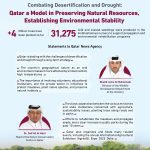
Combating Desertification and Drought: Qatar a Model in Preserving Natural Resources, Establishing Environmental Stability
UAE allocates US$30 million for emergency humanitarian response in El Obeid, calls for civilian protection, safe humanitarian aid access in Sudan


AMMAN, Aug. 15 (Petra) — Minister of Investment Tariq Abu Ghazaleh
emphasized that Jordan views China as a strategic partner in
advancing industrial and economic transformation, alongside
strengthening investment cooperation rooted in mutual interests.
In an interview with the Chinese news agency Xinhua, Abu Ghazaleh
noted that his visit to China last June provided firsthand insight
into China’s developmental model and the immense potential it holds
for bilateral economic collaboration.
He highlighted that the visit–which included participation in the
China International Supply Chain Expo, high-level meetings with
Chinese officials and leading enterprises, and a tour of the Xiongan
New Area–has opened broader horizons for the Jordanian-Chinese
partnership.
Abu Ghazaleh underscored that China’s global standing as an
industrial, technological, and commercial powerhouse makes it a vital
partner in supporting Jordan’s Economic Modernization Vision.
He pointed out that China’s 15th Five-Year Plan priorities–spanning
advanced manufacturing, technological innovation, digital
transformation, and green development–closely align with Jordan’s
national roadmap, both placing innovation and value-added industrial
growth at the core of sustainable economic expansion.
Highlighting Jordan’s strategic trajectory, Abu Ghazaleh explained
that the Kingdom is currently navigating the second phase (2026–2029)
of its Economic Modernization Vision (2023–2033). This phase
prioritizes foreign investment attraction, public-private
partnerships, and high-impact economic projects, creating new avenues
for international collaboration with key partners like China.
He revealed that comprehensive legislative and structural reforms
implemented in recent years have dramatically elevated Jordan’s
investment climate, fueling a 25 percent surge in foreign direct
investment (FDI) inflows in 2025 to surpass USD 2 billion.
Pointing to existing success stories, the Minister cited the
strategic partnership between Chinese investors and the Arab Potash
Company as a benchmark of mutually beneficial industrial cooperation,
which has amplified production capacities, boosted exports, and
solidified Jordan’s standing as a reliable global supplier of
agricultural fertilizers and inputs.
Abu Ghazaleh added that Chinese investments in Jordan have expanded
steadily across renewable energy, manufacturing, and logistics,
generating local employment and introducing cutting-edge production
methodologies. He specifically highlighted the Jincheng Group
industrial complex in Qatraneh, Karak Governorate, as a premier model
of specialized industrial investment that bolsters supply chain
resilience and workforce development.
The Minister stressed that Jordan offers a stable, investor-friendly
ecosystem underpinned by modern legislation, competitive incentives,
and a strategic geographical hub connecting Asia, Europe, and Africa.
With unfettered access to over 50 global markets through
comprehensive free trade agreements, highly skilled human capital,
and advanced logistics infrastructure, Jordan stands ready as an
ideal regional platform for Chinese enterprises eyeing regional and
international expansion.
Concluding his remarks, Abu Ghazaleh expressed eagerness to elevate
bilateral economic ties to new heights, focusing on advanced
industries, electronics, renewable energy, energy storage, electric
mobility, rail systems, agritech, and pharmaceuticals.
//Petra// AA