Saudi Arabia’s Voluntary Carbon Market Fuels the Shift to a Low-Carbon
Under UAE President’s directives, UAE launches urgent relief response for Ghana flood victims
Combating Desertification and Drought: Qatar a Model in Preserving Natural Resources, Establishing Environmental Stability
UAE allocates US$30 million for emergency humanitarian response in El Obeid, calls for civilian protection, safe humanitarian aid access in Sudan

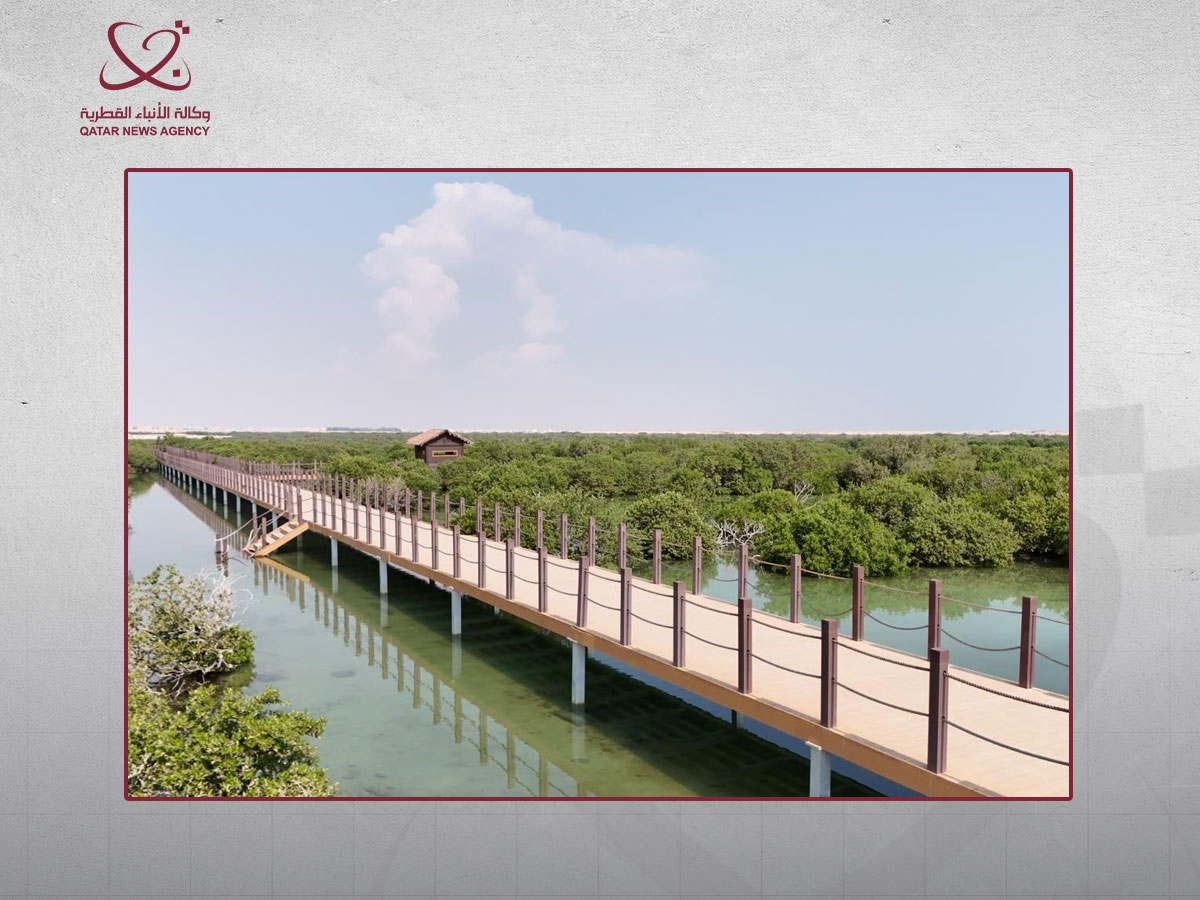
Doha, July 26 (QNA) – The Ministry of Environment and Climate Change (MECC) has affirmed that Qatar’s mangrove forests cover an estimated area of almost 14 square kilometers, with over 7 square kilometers located in the Al Thakira Reserve alone.
The Ministry noted that it will continue efforts to protect these forests and expand planting in appropriate sites.
In a statement to mark the International Day for the Conservation of the Mangrove Ecosystem, which falls annually on July 26, MECC highlighted that these trees are prevalent in several parts of the country, including Al Khor, Al Thakhira, Al Wakrah, and Mesaieed, in addition to Al Aaliya Island, Fuwairit, Al Ruwais, Al Areesh, and Al Jumail.
Work is underway with a host of national entities and institutions to protect these trees and their areas of expansion, prevent their overexploitation, and implement planting programs in accordance with studies that observe the ecological characteristics of suitable growth sites, the statement read.
Director of the Wildlife Development Department at MECC Khalid Juma Al Muhannadi said protecting mangrove forests isn’t limited to expanding their extent, but depends on integrated management of mangrove distribution areas, beginning with site suitability assessments based on tidal dynamics, soil conditions, and salinity levels, and extending to monitoring seedling growth and assessing their condition after restoration planting.
Al Muhannadi further highlighted that the success of restoration programs isn’t measured solely by the number of seedlings planted, but also by their ability to achieve natural growth, survive, and support marine habitats.
He noted that the Ministry’s efforts combine protecting existing mangrove stands, promoting natural regeneration of mangroves, and meticulously planned expansion of mangrove planting without disrupting the ecological balance of coastal areas.
Al Muhannadi pointed out that successful mangrove restoration requires appropriate site selection, timing, and planting techniques, and must be implemented under the supervision of the Ministry.
He called on individuals and entities seeking to launch initiatives in this field to coordinate with MECC in advance to ensure the suitability of proposed sites and compliance with approved environmental requirements, thereby protecting coastal ecosystems and achieving the desired outcomes in the long run.
The Ministry stated that global estimates indicate that one hectare of mangrove forests contains a carbon stock equivalent to approximately 3,754 tons of carbon dioxide when accounting for carbon stored in trees and soils, underscoring their significance in strengthening efforts to address climate change.
It remarked that mangrove trees serve as natural coastal buffers, helping protect shorelines from erosion and reducing the impacts of waves and coastal storms.
They also provide critical breeding, nursery, and feeding grounds for numerous fish, shrimp, and crustacean species, while offering natural habitats for resident and migratory birds, thereby bolstering marine and coastal biodiversity, the Ministry underlined.
In addition, MECC stressed the ecological, tourism, and economic importance of mangrove forests, noting that their distribution areas, particularly the Al Thakira Reserve, are popular destinations for nature enthusiasts and ecotourism.
Mangroves also play a vital role in supporting fisheries resources and maintaining ecological balance in coastal ecosystems, the statement underscored.
The Ministry suggested that mangrove forests hold significant tourism and economic value, asserting that their expansion areas, especially the Al Thakira Reserve, are among the preferred destinations for nature enthusiasts and ecotourism, while also supporting fisheries resources and maintaining ecological balance in coastal ecosystems.
As such, the Ministry urged community members and coastal visitors to protect these trees, avoid uprooting or damaging them, and ensure that no waste is dumped in expansion areas, in support of national efforts to conserve natural resources for future generations.
Mangroves are evergreen shrubs that grow in intertidal ecosystems and shallow muddy shorelines. They are highly salt-tolerant and can thrive in oxygen-poor soils, using specialized aerial roots known as pneumatophores that extend above the water and mud surface. (QNA)