Saudi Arabia’s Voluntary Carbon Market Fuels the Shift to a Low-Carbon

Under UAE President’s directives, UAE launches urgent relief response for Ghana flood victims

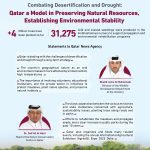
Combating Desertification and Drought: Qatar a Model in Preserving Natural Resources, Establishing Environmental Stability
UAE allocates US$30 million for emergency humanitarian response in El Obeid, calls for civilian protection, safe humanitarian aid access in Sudan


Damascus, May 20 (Petra) – Deputy Prime Minister and Minister of Foreign and Expatriate Affairs Ayman Safadi and Syrian Foreign Minister Asaad Al-Shibani reaffirmed on Tuesday the importance of establishing a Higher Coordination Council between the two countries, calling it an institutional step that will enhance bilateral cooperation and serve both nations and the broader region.
Speaking at a joint press conference following the council’s inaugural meeting in Damascus, the ministers said Jordan and Syria are moving forward with concrete steps to institutionalize cooperation across key sectors in line with the vision of His Majesty King Abdullah II and Syrian President Ahmad Al-Shara’.
Safadi and Al-Shibani praised the council’s progress in outlining a roadmap for cooperation through direct discussions among ministers of water, energy, industry and trade, and transport. They also stressed the importance of strengthening joint defense and security cooperation in addressing common threats, particularly terrorism, arms smuggling, and drug trafficking.
Safadi lauded Syria’s clear commitment to deepening historic ties with Jordan and congratulated Damascus on the recent lifting of U.S. and EU sanctions, describing it as a vital step toward rebuilding the country. He noted Jordan’s role in advocating for the removal of sanctions on the international stage.
“I am honored to be in Damascus today, along with colleagues from the ministries of water, industry and trade, energy, and transport, to attend the first meeting of the Higher Coordination Council. The visit, directed by His Majesty King Abdullah II, aims to strengthen the bonds of fraternity and shared interests with our Syrian brothers,” Safadi said.
He described the day’s talks as “a day of achievement,” noting consensus on activating cooperation in energy, water, industry, trade, transport, and health, with health ministers meeting on the sidelines of an international conference.
Safadi underscored the mutual interest in reaching integration, saying the council’s work would be translated into actionable outcomes that citizens in both countries would feel in the near term.
He reaffirmed Jordan’s full support for Syria during its transitional phase, aiming to help the country become “a free, sovereign, stable, and unified nation that serves as a pillar of regional security.”
The foreign minister condemned Israeli military actions in southern Syria, warning that such aggression threatens both Syrian and Jordanian national security. “What threatens your security threatens ours,” Safadi said. “Israeli attacks on southern Syria are also attacks on Jordan’s security.”
Safadi rejected Israeli justifications for targeting Syria, stating that Damascus has made it clear it seeks to rebuild and does not wish for conflict. He described Israeli actions as illegal, illegitimate, and destabilizing.
He also reiterated Jordan’s support for a comprehensive and just peace based on the end of occupation in Palestine, Syria, and Lebanon, and emphasized that peace must deliver rights and security for all.
On Syria’s future, Safadi stated, “The Syrian people are capable and resilient. If given the opportunity, they will turn Syria into a success story.”
He confirmed that the council was a joint Syrian-Jordanian initiative intended to lay the foundation for institutional cooperation across sectors, serving the interests of both nations and the broader region.
Highlighting Syria’s geographic role as Jordan’s gateway to Europe and Jordan as Syria’s path to the Gulf and the Arab world, Safadi said the agreed-upon projects would benefit both countries and enhance regional integration.
He reiterated Jordan’s commitment to supporting over 1.3 million Syrians residing in the kingdom, with the majority living outside refugee camps, and stressed that voluntary return is contingent on Syria’s successful reconstruction.
Al-Shibani, for his part, thanked Jordan for its historic support, especially following Syria’s political shift on December 8. He said the lifting of sanctions would pave the way for deeper economic and strategic ties with Jordan and beyond.
“From the very first day after December 8, coordination with Jordan has been at the highest level,” Al-Shibani said, noting Syria’s appreciation for Jordan’s firm stance against foreign interference and Israeli threats, which he said affect the entire region.
He emphasized that Tuesday’s meetings marked a genuine step forward in building strategic partnerships and leveraging geographic proximity to expand cooperation toward both the Arab world and Europe.
Al-Shibani praised Jordan’s hospitality toward Syrian refugees and said joint diplomatic efforts contributed to the lifting of sanctions, a move that would have positive impacts across the region.
//Petra// AF
20/05/2025 21:12:36