Saudi Arabia’s Voluntary Carbon Market Fuels the Shift to a Low-Carbon

Under UAE President’s directives, UAE launches urgent relief response for Ghana flood victims
Combating Desertification and Drought: Qatar a Model in Preserving Natural Resources, Establishing Environmental Stability
UAE allocates US$30 million for emergency humanitarian response in El Obeid, calls for civilian protection, safe humanitarian aid access in Sudan

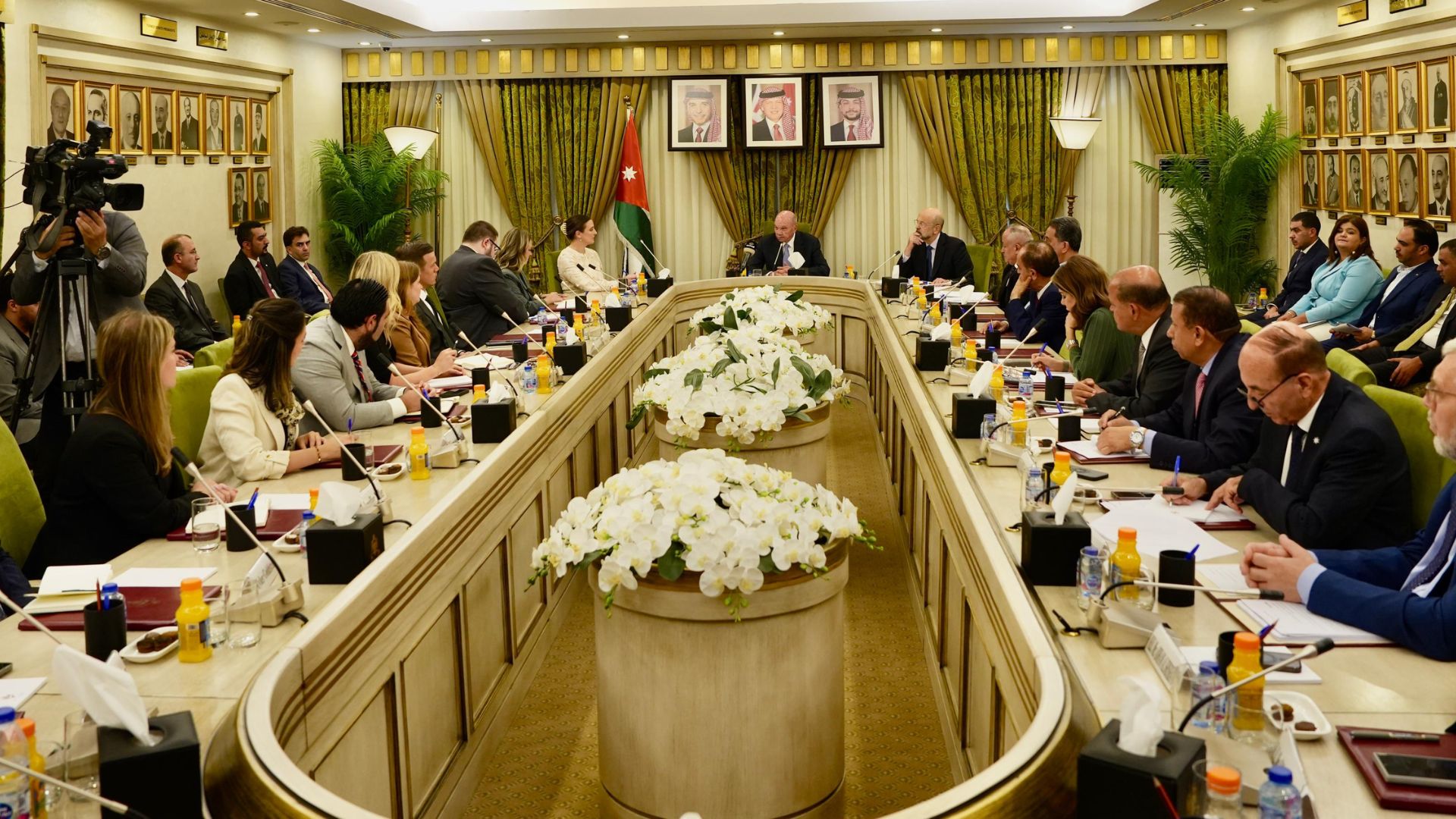
Amman, Aug. 12 (Petra) – Senate President Faisal Fayez reaffirmed the
strength of Jordan-US relations and Jordan’s commitment, under the
directives of His Majesty King Abdullah II, to further develop
cooperation across various fields, advance mutual interests, and
expand bilateral economic and investment partnerships.
Fayez made the remarks during a meeting held Wednesday by the
Senate’s Arab, International, and Expatriate Affairs Committee,
chaired by Senator Omar Razzaz, with several advisers to members of
both chambers of the US Congress.
The meeting addressed current regional developments, ongoing
escalation and its repercussions, as well as the continued Israeli
aggression against the Palestinian people and Israel’s failure to
implement the Gaza ceasefire agreement proposed by the US
administration and accepted by the international community.
Fayez called on the United States and the international community to
exert effective pressure on Israel to halt its aggressive and
expansionist policies, settler attacks in Jerusalem and the occupied
West Bank, land annexation policies, and settlement construction.
He expressed appreciation for US financial and economic support to
Jordan in addressing economic challenges stemming from regional
developments. Fayez said Jordan plays a central role in regional
stability and that preserving its security and stability is in the
interest of all parties, warning that attempts to undermine the
Kingdom’s security would have serious repercussions across the
region.
Regarding Iranian attacks against Jordan, Fayez underscored that the
Kingdom rejects attacks on its territory and on Arab Gulf states. He
noted that His Majesty has repeatedly stressed that Jordan will not
allow itself to become an arena for regional conflict or permit its
territory to be used to attack any friendly or neighboring country.
“Jordan is a state of peace and stability, committed to the
principles of good neighborliness and non-interference in the affairs
of others,” Fayez stated. He added that these positions had not
prevented the Iranian regime and its proxies in the region from
targeting Jordan with missiles and drones, posing a threat to its
territory and citizens, which, he noted, was unacceptable.
Fayez called on the international community to assume its
responsibilities by working to halt Iranian attacks and uphold
international law. He stressed that Jordan’s security is inseparable
from that of the Gulf states and that any threat to the Kingdom would
affect regional stability as a whole.
He also reviewed His Majesty’s efforts to promote regional security
and stability, stressing that lasting stability requires the
establishment of a Palestinian state in accordance with the two-state
solution and international legitimacy resolutions, as well as an end
to expansionist ambitions in the region, which he said would
otherwise perpetuate violence and instability.
Fayez underlined that Jordan rejects any proposed settlement of the
Palestinian issue that would come at the expense of its national
principles and higher interests. He reiterated Jordan’s position, as
expressed by His Majesty through the “three noes”: no alternative
homeland, no resettlement, and no forced displacement, while
stressing that the Hashemite Custodianship over Muslim and Christian
holy sites in Jerusalem is a red line.
He reaffirmed Jordan’s rejection of settlement construction and
continued Israeli attempts to forcibly displace Palestinians in the
West Bank and Gaza Strip. Fayez called on the US administration to
take clear positions to prevent further Israeli escalation and halt
settler attacks, while supporting His Majesty’s efforts to establish
a political horizon leading to a just resolution of the Palestinian
issue and an end to expansionist policies.
For his part, Razzaz pointed out that Jordan’s economy has
demonstrated resilience and maintained stability despite regional
economic and political challenges.
He noted that Jordan’s economic challenges are closely linked to
regional developments, underscoring the need for continued support
for development, infrastructure, water, and other key sectors to
achieve sustainable development outcomes.
Razzaz also stressed the importance of expanding communication with
Congress and US and European institutions and strengthening Jordan’s
engagement with decision-making circles to explain its positions and
advance its national interests. He stressed that active diplomacy and
international partnerships complement economic support and protect
Jordanian interests and strengthen the Kingdom’s regional role.
He explained that developments in Palestine cannot be viewed as a
local issue isolated from the broader region because of their direct
repercussions for Jordan. Razzaz warned that continued acts he
described as genocide and settlement expansion against Palestinians
in Jerusalem, the West Bank, and Gaza would deepen instability and
undermine prospects for a political settlement. He called for a just
and comprehensive political solution that addresses the root causes
of the conflict and shields Jordan from its repercussions.
Committee members, meanwhile, said the Jordan-US relationship
represents a longstanding strategic partnership, noting that US
support over the years has contributed to Jordan’s economy and its
ability to respond to crises.
US assistance, the members noted, extends beyond financial support to
political and diplomatic cooperation and confidence-building between
the two countries, stressing the importance of continued cooperation
in supporting Jordan’s stability and its regional role.
//Petra// AO