Saudi Arabia’s Voluntary Carbon Market Fuels the Shift to a Low-Carbon

Under UAE President’s directives, UAE launches urgent relief response for Ghana flood victims
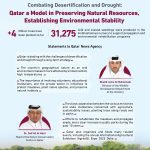
Combating Desertification and Drought: Qatar a Model in Preserving Natural Resources, Establishing Environmental Stability
UAE allocates US$30 million for emergency humanitarian response in El Obeid, calls for civilian protection, safe humanitarian aid access in Sudan

Ulaanbaatar, August 24, 2026 (SUNA) — The joint China-Arab plan for 2026–2031 to combat drought, desertification, and land degradation was officially launched in the Mongolian capital, Ulaanbaatar, during a meeting of the Steering Committee of the China-Arab International Center for Research on Drought, Desertification and Land Degradation (CAIRCDDLD). The meeting was held on the sidelines of the 17th session of the Conference of the Parties to the United Nations Convention to Combat Desertification (COP17), taking place from August 17 to 28. Sudan participated in the meeting on Monday for the first time with a high-level delegation headed by Secretary-General of the Higher Council for Environment and Natural Resources, Suleiman Al-Bouni Suleiman, alongside representatives of Arab countries, the People’s Republic of China, and international partners. The meeting reviewed the CAIRCDDLD’s 2026–2031 work plan and annual performance report and witnessed the launch of the five-year joint plan, which seeks to deepen China-Arab cooperation in addressing the growing challenges of drought, desertification, and land degradation through the development of joint satellite-monitoring tools, smart decision-support systems, and enhanced technology and technical expertise transfer. China also announced the identification of 30 practical technologies for combating desertification across six main categories, with efforts underway to adapt them for application in Arab countries. The plan also includes expanding partnerships to international institutions, companies, and civil society organizations in support of the expert network and joint research cooperation. In his address, the Secretary-General of the Higher Council for Environment and Natural Resources expressed Sudan’s appreciation for the role played by the CAIRCDDLD in promoting scientific cooperation, knowledge exchange, and the development of practical solutions to address drought and land degradation. He stressed that these issues pose a direct challenge to food and water security and the livelihoods of agricultural and pastoral communities in Sudan. Al-Bouni reviewed Sudan’s national efforts to combat desertification and land degradation, noting the implementation of sustainable and integrated land and natural-resource management systems, as well as the establishment of a national network of research centers and institutions working in the field of combating desertification. He said the network strengthens scientific coordination and information exchange while helping identify research priorities. He affirmed that Sudan possesses extensive experience and significant potential in monitoring desertification, managing and restoring land, drawing on its diverse ecological and climatic conditions and its range of agricultural and pastoral systems, in addition to the presence of specialized scientific and research institutions. At the conclusion of his address, Sudan announced its interest and readiness to host the headquarters of the Center. It also proposed concluding a memorandum of understanding between Sudan and the CAIRCDDLD to strengthen cooperation in scientific research, capacity building, technology transfer, and the development of multi-hazard early-warning systems, as well as the implementation of joint projects to enhance resilience to drought and land degradation. Sudan reaffirmed the importance of expanding scientific and technical partnerships with the CAIRCDDLD and all international partners in order to develop sustainable solutions to the challenges of drought, desertification, and land degradation and to promote sustainable environmental development in Sudan and the Arab region.BH/BH