Jordan’s Q2 2026 GDP Expands 3.0%, Outperforming Regional Headwinds, International Forecasts
ENV-KUWAIT-SUSTAINABLITYKuwait strengthens environmental sustainability through strategic initiativesBy Zahra Al-Kadhmi

HLT-KUWAIT-SURGERYKuwait advances health sector with robotic, remote surgeryBy Mohammad Al-Moseb

Saudi Arabia’s Voluntary Carbon Market Fuels the Shift to a Low-Carbon

Sultan
Qaboos University Marks International Translation Day
Muscat, 5 Oct 2026 (ONA) — Sultan Qaboos University, represented by the
Department of English Language and Translation at the College of Arts and
Social Sciences, organized an academic and professional event on the occasion
of International Translation Day 2026 under the title: “Translation
between Education and Practice: Envisioning the Future of Translation Programs
in the Age of Artificial Intelligence.”
The event sought to explore the impact of artificial intelligence on the
translation profession and the transformations in translators’ roles and career
paths, to identify the practical applications of AI tools in translation, and
to examine the opportunities and challenges associated with their use. It also
discussed the extent to which academic translation programs align with labour
market requirements amid rapid technological developments, and the enhancement
of communication among academics, professional translators and students.
The event included a lecture delivered by Professor Dr. Lynn Booker from the
Department of Languages, Linguistics and Translation and holder of the Canadian
Research Chair in Translation, entitled “The Cognitive Challenge in
Translator Training Programs in the Age of Artificial Intelligence.” In
her lecture, she addressed the importance of integrating “deliberate
cognitive challenge” into translation education by placing learners before
cognitive challenges that drive them toward critical thinking and away from
reliance on machine output.
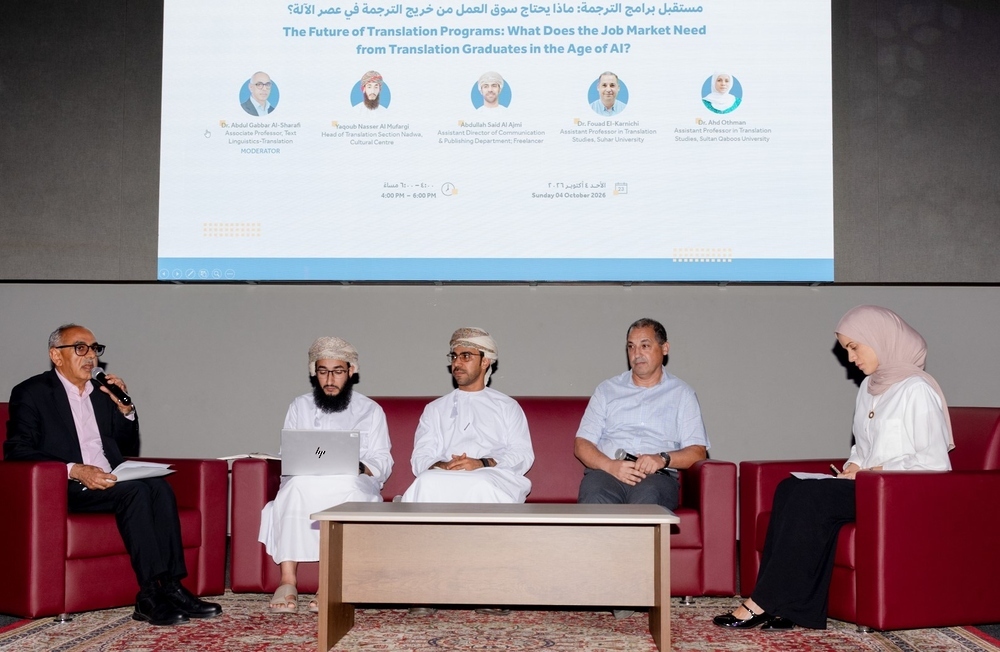
The event included a panel discussion entitled “The Future of Translation
Programs: What Does the Labour Market Need from Translation Graduates in the
Age of the Machine?” with the participation of a group of academics,
practitioners and specialists in the field of translation. It focused on the
impact of artificial intelligence on the translation market, the anticipated
transformations in translators’ roles and career opportunities, and the
competencies required by the labour market. It also addressed the implications
of these transformations for academic translation programs and ways to develop
their curricula and outputs in line with professional and technological
developments.
The event come up with a number of recommendations for developing translator
training programs in a manner that keeps pace with the transformations brought
about by artificial intelligence in the translation market and the requirements
of the profession.
— Ends/AH