Saudi Arabia’s Voluntary Carbon Market Fuels the Shift to a Low-Carbon

Under UAE President’s directives, UAE launches urgent relief response for Ghana flood victims

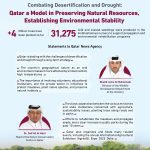
Combating Desertification and Drought: Qatar a Model in Preserving Natural Resources, Establishing Environmental Stability
UAE allocates US$30 million for emergency humanitarian response in El Obeid, calls for civilian protection, safe humanitarian aid access in Sudan

AMMAN, July 26 (Petra) — The Ministry of Water and Irrigation
launched a specialized workshop on Sunday to kick off the formulation
of the Water Sector Integrity and Anti-Corruption Strategy, executed
in collaboration with the German Agency for International Cooperation
(GIZ).
Bringing together members of the strategic steering and technical
committees, the initiative forms part of the ministry’s ongoing
efforts to institutionalize corporate governance, transparency, and
integrity across water sector entities.
According to a ministry statement, Assistant Secretary-General for
Administrative and Financial Affairs, Dr. Mohammad Al-Afeeshat,
emphasized that the initiative–implemented through GIZ’s Water
Sector Governance Project–aligns directly with the National Water
Strategy 2023–2040, the Public Sector Modernization Roadmap, and the
National Anti-Corruption and Integrity Strategy 2026–2030.
Al-Afeeshat noted that the framework aims to elevate operational
efficiency, advance sustainable development goals, and reinforce
national stability, expressing appreciation for the continued backing
of international development partners.
The workshop outlined an action plan for the coming months, anchored
by a comprehensive risk assessment framework alongside
capacity-building programs, awareness initiatives, and governance
upgrades tailored for sector institutions.
Austrian technical advisor and expert Georg Huber delivered a
presentation detailing global best practices in governance, integrity
enforcement, and sound water resource management, offering strategic
recommendations to guide the drafting process.
Participants agreed on establishing two core governance bodies to
manage the strategy’s development and implementation: a steering
committee to oversee overall policy direction and project milestones,
and a technical team tasked with day-to-day execution and technical
deliverables.
//Petra// AA