Jordan’s Q2 2026 GDP Expands 3.0%, Outperforming Regional Headwinds, International Forecasts
ENV-KUWAIT-SUSTAINABLITYKuwait strengthens environmental sustainability through strategic initiativesBy Zahra Al-Kadhmi

HLT-KUWAIT-SURGERYKuwait advances health sector with robotic, remote surgeryBy Mohammad Al-Moseb

Saudi Arabia’s Voluntary Carbon Market Fuels the Shift to a Low-Carbon

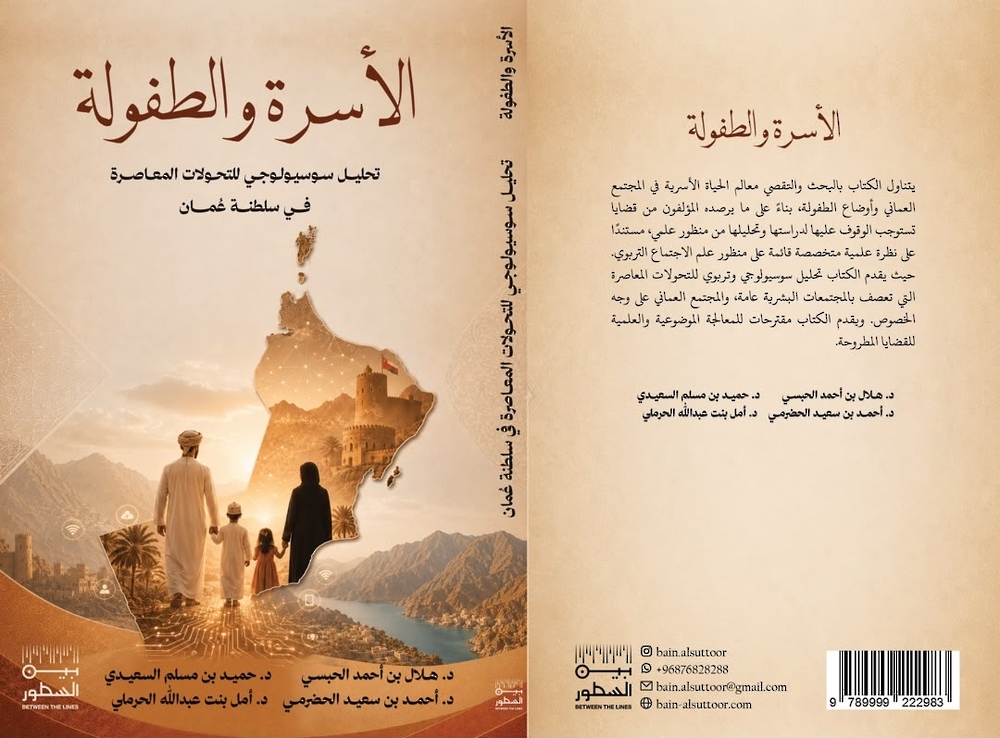
New Academic Work Explores Family
and Childhood Transformations in Oman
Muscat, 24 Jun 2026 (ONA) — A new
academic book titled “Family and Childhood: A Sociological Analysis of
Contemporary Transformations in the Sultanate of Oman” has been published
by Bain Al Sutoor Publishing House.
The book examines shifts in family
and childhood structures in Oman from a sociological and educational
perspective, against the backdrop of changes linked to education, urbanisation,
women’s employment, technology, the digital space and artificial intelligence.
The work is the result of a joint
research collaboration between Dr. Hilal bin Ahmed Al Habsi, Dr. Humaid bin Musallam
Al Saeedi, Dr. Ahmed bin Said Al Hadhrami and Dr. Amal bint Abdullah Al
Harmali. It explores the reality of the Omani family and its contemporary
transformations, and their impact on socialisation patterns, value formation
and social relations within society.
Across seven interconnected
chapters, the book provides a conceptual grounding for issues of family,
childhood and social change, drawing on sociological theories to understand
contemporary transformations. It then analyses the Omani family’s reality,
particularly the shift from extended to nuclear family structures, and the
effects of education, urbanisation, women’s employment and technology on family
structure and functions.
The book also examines childhood in
Omani society, children’s rights, socialisation institutions, and the impact of
digital transformations on parenting, along with the psychological and social
challenges that arise. It considers challenges facing the family and offers
scenarios for future change, exploring the role of social policies and
educational institutions in supporting families in the digital age.
The authors raise questions about
the contemporary family’s ability to remain a fundamental unit in building
society and guiding behaviour, and whether the family can retain its primary
role in shaping children’s perceptions amid the expanding digital space and new
patterns of social interaction.
The book concludes with findings and
recommendations for policymakers, educational institutions and families on
protecting childhood, strengthening family cohesion and preserving cultural
identity, making it a valuable reference for researchers, policymakers and
those concerned with family and community development.
— Ends/Khalid