Jordan’s Q2 2026 GDP Expands 3.0%, Outperforming Regional Headwinds, International Forecasts
ENV-KUWAIT-SUSTAINABLITYKuwait strengthens environmental sustainability through strategic initiativesBy Zahra Al-Kadhmi

HLT-KUWAIT-SURGERYKuwait advances health sector with robotic, remote surgeryBy Mohammad Al-Moseb

Saudi Arabia’s Voluntary Carbon Market Fuels the Shift to a Low-Carbon

Amman, Oct. 7 (Petra) — Jordan is seeking to leverage its extensive
free trade network, mineral resources and transport infrastructure to
build stronger regional value chains and advance joint industries
capable of competing in global markets, Industry, Trade and Supply
Minister Yarub Qudah said.
Speaking at the Made in Gulf 2026 Forum and Exhibition in Bahrain,
Qudah said Jordan had expanded its free trade agreements to overcome
the limitations of its domestic market and establish a stronger
production base.
He said agreements with the United Kingdom, European Union, United
States and Canada, together with the Greater Arab Free Trade Area,
offer a competitive advantage that could be harnessed to support
regional industrial integration, subject to rules of origin and other
eligibility requirements.
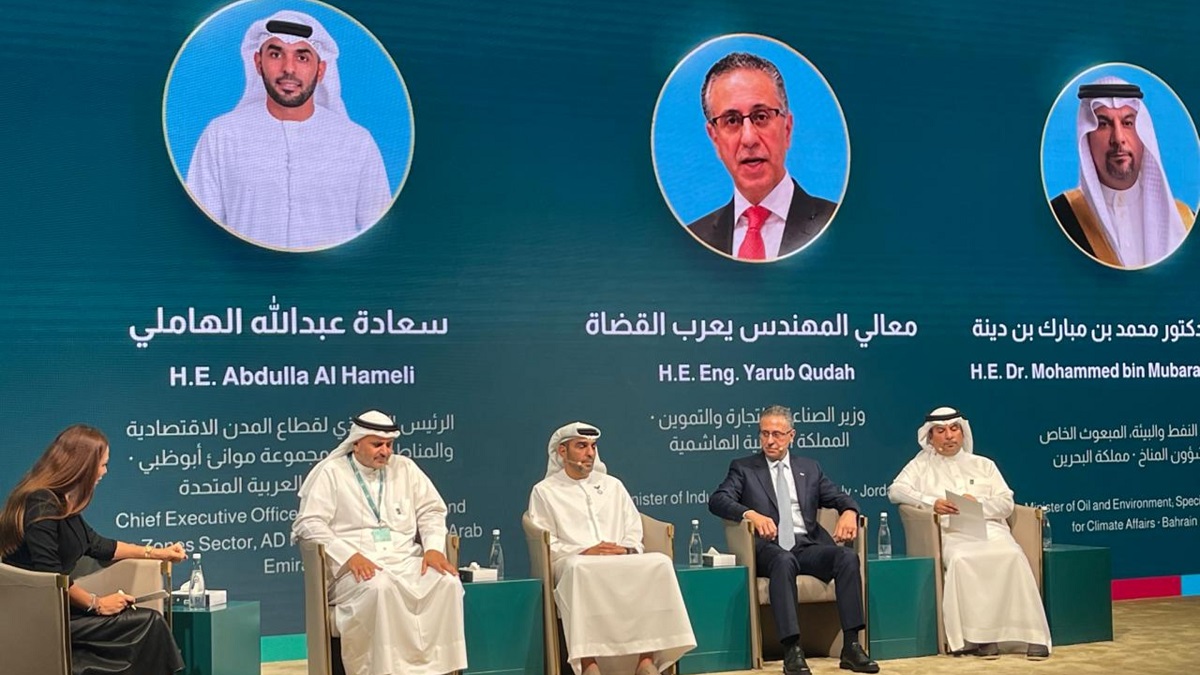
Qudah made the remarks during a panel on “Industrial Integration and
Regional Value Chains” at the forum, which runs from October 6 to 8.
He said regional countries could combine their raw materials,
financial resources and industrial capabilities to develop high-value
joint ventures, shifting the focus from self-sufficiency and
industrial localization toward global competitiveness.
With competition among major economic powers increasingly centered on
rare minerals, semiconductors and high-value industries, Qudah said
the region has the resources and financing capacity to build
specialized production chains based on the comparative advantages of
individual countries.
As one potential model, he proposed developing a regional industry
around Jordan’s silica reserves, starting with purification and the
production of high-purity silicon before moving into silicon wafer
manufacturing.
Later stages of production could be distributed among countries
according to their industrial strengths, creating an integrated chain
encompassing semiconductors, computers, solar cells and panels, as
well as silica-based fiber optics.
Qudah said Jordan, the United Arab Emirates, Bahrain, Saudi Arabia
and Kuwait could participate in such partnerships by combining raw
materials, financing, expertise and specialized manufacturing
capabilities.
Building these industries could also strengthen the region’s role in
data and related technologies as global investment in the sector
accelerates, he added.
Qudah cited food production as another area suited to regional
integration, with investment from regional countries supporting
Jordanian agriculture and agricultural output feeding into food
manufacturing elsewhere in the region. Such a model, he said, would
connect agriculture, manufacturing and exports while increasing
regional added value.
He also highlighted transport and logistics as a central component of
industrial integration, saying recent disruptions have demonstrated
the need for interconnected supply chains and alternative routes that
can keep trade moving when individual corridors are interrupted.
Aqaba Port is operating above its capacity, with about 70% of its
activity serving the wider region, Qudah said, noting that a
significant volume of Gulf-bound goods passes through the port.
He pointed to the planned railway linking Aqaba Port with Jordan’s
phosphate and potash mines as an initial building block for regional
supply-chain integration. The line could later connect with the Maan
dry port, while a subsequent national railway network would extend
northward to the Syrian border.
Such infrastructure could ultimately connect with Gulf and regional
railway systems, creating a broader transport network linking the
Gulf Cooperation Council countries and the Levant with outlets on the
Mediterranean, Red Sea, Arabian Gulf and the ocean, he said.
Qudah said a multi-route regional network would strengthen the
resilience of regional economies and supply chains and reduce their
vulnerability to external disruptions.
The panel also brought together Bahrain’s Minister of Oil and
Environment and Special Envoy for Climate Affairs Mohammed bin
Mubarak Bin Daina, AD Ports Group CEO for Economic Cities and Free
Zones Abdullah Al Hameli, and Foulath Holding Chairman Mishari
Al-Judaimi.
//Petra// RZ