Jordan’s Q2 2026 GDP Expands 3.0%, Outperforming Regional Headwinds, International Forecasts
ENV-KUWAIT-SUSTAINABLITYKuwait strengthens environmental sustainability through strategic initiativesBy Zahra Al-Kadhmi

HLT-KUWAIT-SURGERYKuwait advances health sector with robotic, remote surgeryBy Mohammad Al-Moseb

Saudi Arabia’s Voluntary Carbon Market Fuels the Shift to a Low-Carbon

Aqaba, Sept. 28 (Petra) — The Ministry of Youth is implementing a
comprehensive project to develop and rehabilitate Aqaba Youth City,
with the aim of improving its sports and youth facilities and
enhancing its capacity to host tournaments, training camps, and
sporting activities.
The project is part of the ministry’s efforts to develop sports and
youth infrastructure across the Kingdom and improve the ability of
facilities to accommodate sports and youth events. It also seeks to
make use of Aqaba’s location and climate, which provide suitable
conditions for various sports during different seasons.
The project is being implemented in two phases at a total estimated
cost of nearly JD4 million. It is intended to prepare Aqaba Youth
City to host local and international tournaments and training camps,
while strengthening its role as a sports destination alongside its
tourism characteristics.
The first phase focuses on developing the city’s stadium, currently
the only grass football pitch in the governorate, as well as
rehabilitating its facilities and services. The second phase will
include additional stands, services, and supporting facilities to
improve the city’s readiness to accommodate teams, clubs, national
squads, and sporting events.
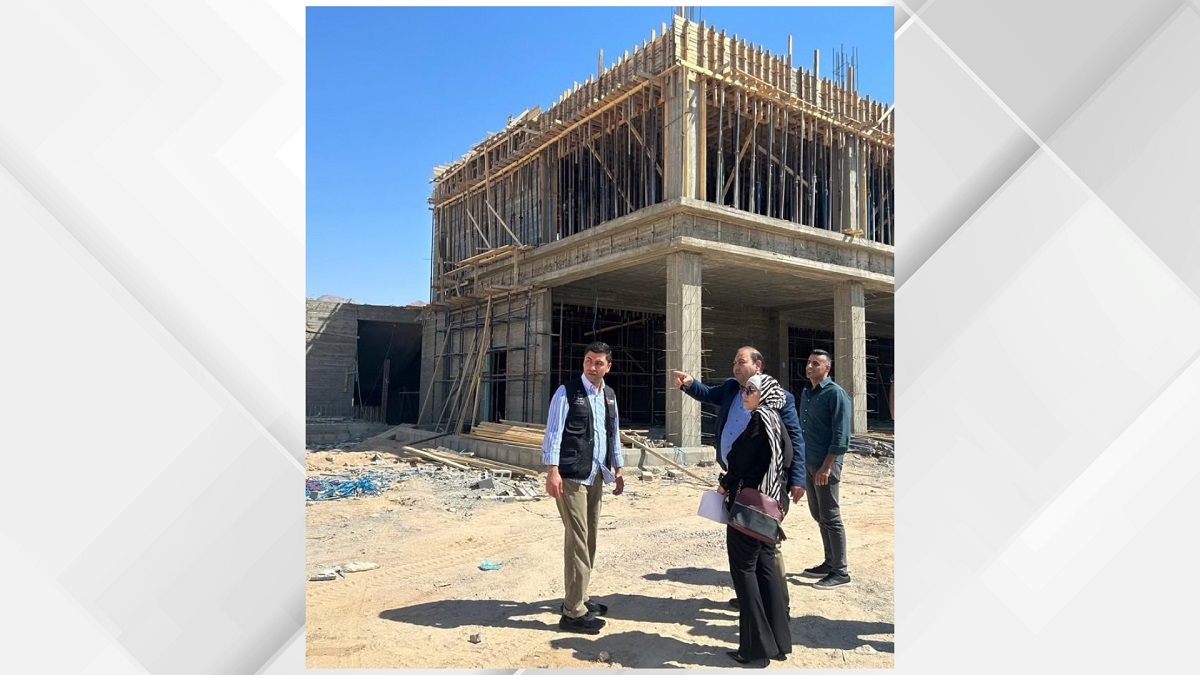
During an inspection tour by Ministry of Youth Secretary-General
Mazen Abu Baqar, attended by Aqaba Youth Directorate Director Ahmad
Al-Hassan, Abu Baqar briefed Petra on the progress of the project and
its various components.
Abu Baqar said the project is being implemented in two phases, with
the first costing around JD2 million. Work on the first phase is
about 50 percent complete and is expected to be completed in early
2027, after which the second phase, expected to take about one year,
will begin.
He said the first phase includes reconstructing and rehabilitating
the stands, maintaining the existing stands, and installing a metal
canopy covering about 700 square metres over the first-class stands.
It will also include facilities serving VIPs, journalists, and
spectators.
The project also includes a services and facilities building covering
about 2,065 square metres, dedicated entrances for the two teams and
administrative staff, and parking for around 250 vehicles, along with
the required open areas, pavements, and lighting works.
The first phase further includes maintenance of the facades of
existing buildings, rehabilitation of players’ changing rooms, and
maintenance, painting, protective, and roof-insulation works to
improve the services provided to teams, athletes, and spectators.
Abu Baqar said the stadium development is being carried out in
coordination with the Jordan Football Association, the Aqaba Special
Economic Zone Authority, Aqaba Governorate, and the Aqaba Governorate
Council, in accordance with the technical requirements approved by
the Jordan Football Association and FIFA.
He said the project aims to gradually increase the stadium’s capacity
to around 4,000 spectators once the development phases are completed,
enabling it to host matches, tournaments, and major sporting events.
Regarding the second phase, Abu Baqar said it will include stands
with a capacity of around 2,500 spectators, service buildings for
teams, and four lighting towers for the regulation-size football
pitch, in line with the technical requirements for hosting matches.
The phase will also include a water well to serve the city, a new
entrance with access for team buses and a security room,
rehabilitation of the existing entrance near the newly developed
stands, and parking for buses and cars. It will also improve
facilities for players, referees, administration, and filming, in
addition to upgrading lighting and other services required for
hosting matches.
As part of expanding the sports facilities, the ministry is also
working on a new project adjacent to Aqaba Youth City. The project
will include a five-a-side football pitch, two padel courts, two 3×3
basketball courts, a services building, and facilities for sports
teams.
The project covers a total tender area of about 5,000 square metres,
including a 1,000-square-metre five-a-side football pitch, two padel
courts covering 500 square metres, two 3×3 basketball courts covering
400 square metres, and a 180-square-metre services building. It will
also include parking, stands serving the sports facilities, and
sanitary and service facilities for users, while taking into account
the needs of persons with disabilities through suitable entrances,
exits, and facilities.
The ministry has also floated a tender to study the construction of a
multi-purpose sports hall with a capacity of around 2,000 spectators,
providing an additional facility for various sports activities and
events.
Abu Baqar said the development plan also includes rehabilitating
Aqaba Youth Hostel, located within the city complex, so it can
accommodate young people from different governorates and be used for
training camps and sports teams. It will also support the ministry’s
annual Al Hussein Youth Camps for Work and Construction.
He said the development of these facilities is intended to establish
an integrated sports system bringing together sports fields, training
facilities, services, and accommodation for athletes, young people,
teams, and national squads.
The project also includes support from Royal initiatives, in addition
to allocations from the Aqaba Governorate Council.
Abu Baqar stressed the importance of cooperation and coordination
among the Ministry of Youth, the Jordan Football Association, the
Aqaba Special Economic Zone Authority, Aqaba Governorate, and the
governorate council in implementing the development works according
to sporting needs and technical requirements.
He said the development aims to provide a sports environment capable
of attracting teams, training camps, and tournaments from Jordan and
abroad, making use of Aqaba’s location and climate, particularly
during winter. This could contribute to tourism and economic
activity, provide young people with wider opportunities to
participate in sports, and strengthen the city’s role as a sports and
youth destination.
Meanwhile, the Ministry of Youth is continuing rehabilitation and
maintenance work at youth centres across Aqaba Governorate and its
villages to improve their readiness and enhance their ability to
provide programmes and activities for young people.
//Petra//WH