HLT-KUWAIT-SURGERYKuwait advances health sector with robotic, remote surgeryBy Mohammad Al-Moseb

Saudi Arabia’s Voluntary Carbon Market Fuels the Shift to a Low-Carbon

Under UAE President’s directives, UAE launches urgent relief response for Ghana flood victims

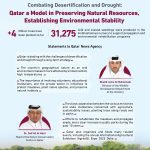
Combating Desertification and Drought: Qatar a Model in Preserving Natural Resources, Establishing Environmental Stability

Governorates, Sept. 21 (Petra) — Farmers in Tafileh and Maan are
receiving practical training on the safe use of reclaimed water for
irrigation as part of efforts to ease pressure on scarce water
resources and strengthen agriculture’s resilience to climate change.
The Food and Agriculture Organization of the United Nations (FAO)
conducted workshops and field training covering suitable crops,
irrigation methods, water quality and safety standards, as well as
the legal and regulatory requirements governing the use of reclaimed
water in agriculture.
The activities brought together 50 farmers and civil society
representatives, four representatives from the ministries of
Agriculture, Water and Irrigation, and Environment, and four
wastewater treatment plant workers.
Participants visited wastewater treatment plants in Tafileh and Maan
to examine the treatment process, plant operations and procedures for
testing water quality. They were also briefed on storage and
distribution systems, safety requirements and the costs and fees
associated with using treated water for irrigation.
A separate field visit provided a practical demonstration at a farm
where reclaimed water is used through a drip irrigation system to
irrigate olive trees, allowing participants to examine its
application and exchange experience on appropriate farming practices.
The training also addressed social and cultural attitudes toward
reclaimed water and the role of civil society organizations in
raising awareness and encouraging its safe and responsible use.
FAO Policy and Education Specialist Samia Akroush briefed
participants on efforts to improve water-use efficiency in
agriculture, expand climate-smart farming practices and strengthen
the capacity of local communities and civil society organizations.
The workshops were organized under the Building Resilience to Cope
with Climate Change in Jordan through Improving Water Use Efficiency
in the Agriculture Sector (BRCCJ) project, which seeks to help
farming communities respond to water scarcity and climate-related
pressures through improved resource management and practical
agricultural practices.
Funded by the Green Climate Fund, the project is implemented by FAO
in partnership with the ministries of Water and Irrigation,
Agriculture and Environment and the United Nations Development
Programme.
The project, which falls within the Economic Modernisation Vision,
covers Madaba, Karak, Tafileh and Maan in the Dead Sea Basin, where
water scarcity and climate change pose particular challenges to
agricultural communities.
//Petra// RZ