Jordan’s Q2 2026 GDP Expands 3.0%, Outperforming Regional Headwinds, International Forecasts
ENV-KUWAIT-SUSTAINABLITYKuwait strengthens environmental sustainability through strategic initiativesBy Zahra Al-Kadhmi

HLT-KUWAIT-SURGERYKuwait advances health sector with robotic, remote surgeryBy Mohammad Al-Moseb

Saudi Arabia’s Voluntary Carbon Market Fuels the Shift to a Low-Carbon

Amman, June 4 (Petra) — Food security indicators strengthened in
2024 as food self-sufficiency rose to its highest level in four
years, supported by increased domestic production and growing
surpluses across a broad range of agricultural commodities, according
to new data released by the Department of Statistics.
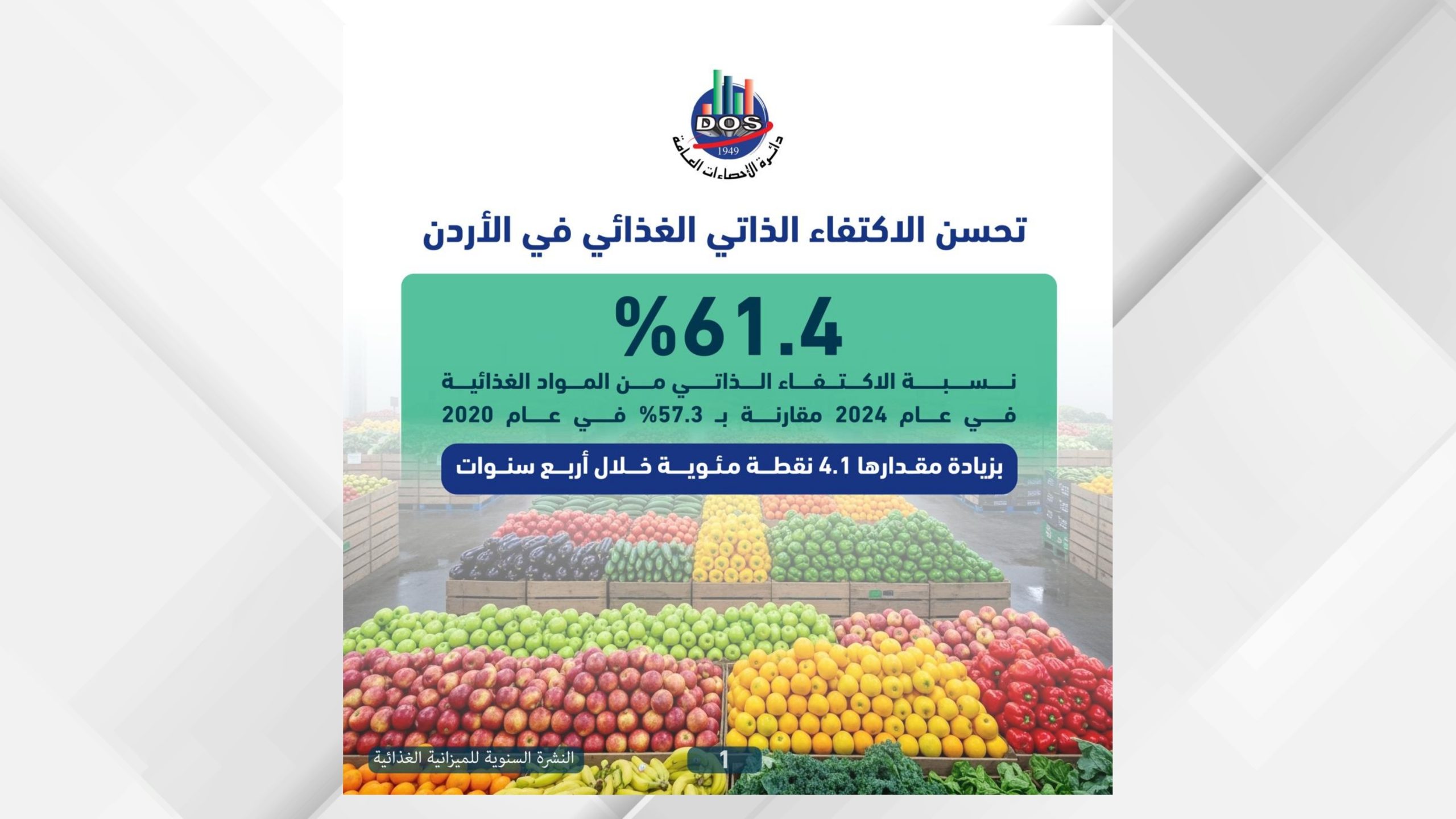
The department’s annual Food Balance Sheet showed that the overall
food self-sufficiency rate reached 61.4 percent in 2024, up from 57.3
percent in 2020, representing an increase of 4.1 percentage points
over the period.
The improvement comes amid notable growth in domestic food production
and an expansion in the number of agricultural products generating
output beyond local consumption requirements.
According to the report, 28 agricultural products recorded production
surpluses in 2024, compared with 22 products four years earlier,
highlighting increased productive capacity across several
agricultural subsectors.
Fresh vegetables continued to account for some of the strongest
self-sufficiency indicators. Melons recorded a self-sufficiency rate
of 485 percent, while zucchini reached 173 percent and tomatoes 167
percent, reflecting production volumes that significantly exceeded
domestic demand and provided additional export opportunities.
Overall, the self-sufficiency rate for vegetables reached 137
percent, underscoring the sector’s position as one of the country’s
strongest agricultural performers.
Fruit production also generated substantial surpluses. Apricots
achieved a self-sufficiency rate of 271 percent, while olive
production maintained full self-sufficiency at 100 percent.
The olive oil sector continued to post strong results, with
self-sufficiency rising to 114 percent, indicating production levels
above local consumption and reinforcing the sector’s role as a key
contributor to agricultural output.
In the livestock sector, fresh milk maintained full self-sufficiency
across all categories, while table eggs recorded a surplus with a
self-sufficiency rate of 108.1 percent.
Poultry meat reached 83.1 percent self-sufficiency, reflecting the
sector’s continued ability to meet the majority of domestic demand.
Red meat, however, remained one of the categories most dependent on
imports. The report showed a self-sufficiency rate of 35.9 percent,
highlighting the continued reliance on external markets to bridge the
gap between domestic production and consumption.
The findings point to broader progress in strengthening food security
and enhancing the resilience of domestic food supply chains, although
dependence on imports remains evident in several strategic
commodities.
The annual Food Balance Sheet, considered one of the country’s key
food-security statistical products, provides detailed data on
production, consumption, imports, exports and self-sufficiency levels
across major food groups, supporting policymaking and long-term
planning in the agricultural sector.
//Petra// RZ