Jordan’s Q2 2026 GDP Expands 3.0%, Outperforming Regional Headwinds, International Forecasts
ENV-KUWAIT-SUSTAINABLITYKuwait strengthens environmental sustainability through strategic initiativesBy Zahra Al-Kadhmi

HLT-KUWAIT-SURGERYKuwait advances health sector with robotic, remote surgeryBy Mohammad Al-Moseb

Saudi Arabia’s Voluntary Carbon Market Fuels the Shift to a Low-Carbon

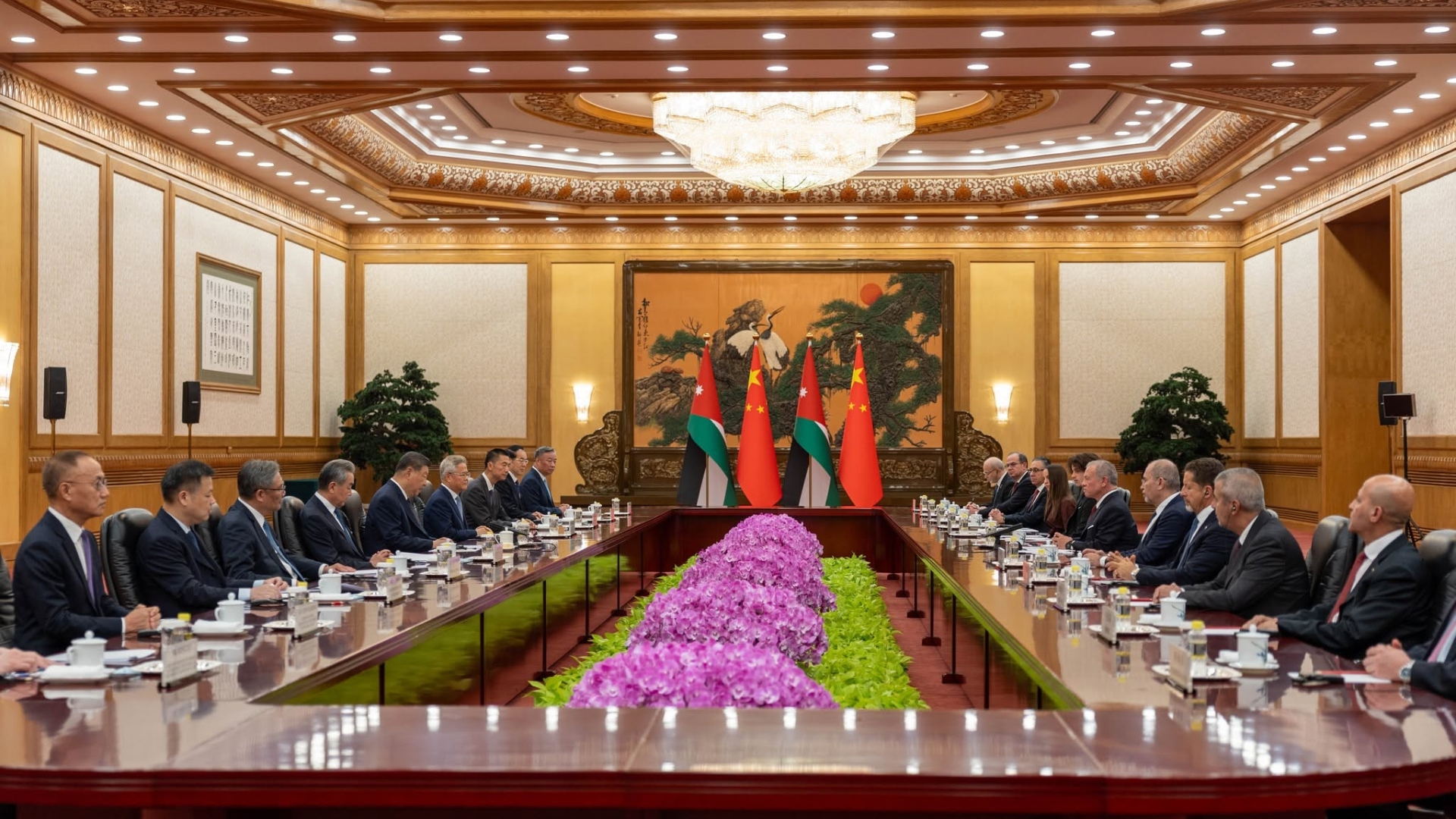
Beijing, Aug.24 (Petra) — The Hashemite Kingdom of Jordan and the
People’s Republic of China issued a joint statement on Monday,
following talks between His Majesty King Abdullah II and President Xi
Jinping, in Beijing.
Following is the full text of the joint statement:
“Joint Statement by the People’s Republic of China and the Hashemite
Kingdom of Jordan on Deepening the Strategic Partnership Between the
Two Countries
At the invitation of His Excellency President Xi Jinping of the
People’s Republic of China, His Majesty King Abdullah II ibn Al
Hussein of the Hashemite Kingdom of Jordan paid a state visit to the
People’s Republic of China from August 18 to 24, 2026.
During the visit, His Excellency President Xi Jinping and His Majesty
King Abdullah II ibn Al Hussein held productive talks that reaffirmed
their commitment to continuing efforts to translate the Strategic
Partnership between the two friendly countries into broader practical
cooperation across various fields, and to strengthen coordination and
cooperation on international and regional issues of mutual interest.
His Majesty also met with China Premier Li Qiang, and Chairman of the
Standing Committee of the National People’s Congress of China Zhao
Leji, during which the two sides engaged in discussions on ways to
further consolidate the historic Jordanian-Chinese friendship and
deepen strategic cooperation.
The two sides issued the following statement:
The two sides affirmed that since the establishment of diplomatic
relations between China and Jordan in 1977, and particularly
following the elevation of bilateral relations to the level of a
Strategic Partnership in 2015, the course of their joint efforts has
seen steady growth, reflected in the strengthening of mutual
political trust, the achievement of tangible results in areas of
practical cooperation, as well as growing cultural exchanges and
closer coordination in multilateral forums, all of which serve the
interests of the two friendly countries and peoples, and are in line
with their respective positions and priorities. In this context, the
two sides agree to move forward in deepening the Strategic
Partnership between the two countries, in conjunction with the
ongoing preparations to mark the 50th anniversary of the
establishment of diplomatic relations between them, which falls in
2027.
Both sides expressed their satisfaction with the positive atmosphere
that prevailed during the visit, commended the advanced level that
the Strategic Partnership between Jordan and China has reached in all
fields, and expressed their commitment to continuing to strengthen
cooperation that mutually benefits and serves the interests of the
two friendly countries and their peoples.
In this context, the two sides agreed to strengthen cooperation in
various fields, including trade, investment, energy and minerals,
agriculture, tourism, education and culture, health, media, human
resources, and social welfare.
They also agreed to explore ways to expand cooperation in emerging
economic sectors such as green economy, digital economy, artificial
intelligence, and advanced industries, as well as to strengthen
industrial and development cooperation, in order to contribute to
shared prosperity.
The two sides also agreed that the digital economy is an important
trend in global economic development and expressed their commitment
to cooperating in this area. They emphasised the importance of
increasing cooperation in the tourism sector and taking practical
steps to achieve this, including launching direct flights between the
two countries as soon as possible.
The two sides also underscored the importance of exploring broader
avenues for cooperation in the field of environmental conservation.
In this context, the Jordanian side expressed its support of China’s
bid to host, in the Chinese city of Xiamen, the permanent secretariat
of the United Nations Convention on the Law of the Sea (UNCLOS)’s
Biodiversity Beyond National Jurisdiction (BBNJ) Agreement (High Seas
Treaty).
The two sides agreed to strengthen cooperation in the fields of law
enforcement and judicial affairs, and to step up efforts to combat
cross-border crime and organised crime.
The two sides expressed their commitment to strengthening
coordination and cooperation in the field of counter-terrorism, and
to working together to combat all terrorist organisations listed by
the United Nations Security Council, reaffirming their steadfast and
mutual support for each other’s efforts in the fight against
terrorism.
The Jordanian side expressed its appreciation for the important
initiatives put forward by His Excellency President Xi Jinping,
including the Community with a Shared Future for Mankind initiative,
the Belt and Road Initiative (BRI), and other global development,
global security, global civilisation, and global governance
initiatives.
The Chinese side commended His Majesty King Abdullah II ibn Al
Hussein’s important role in efforts to achieve security, stability,
and just peace in the Middle East, and in promoting regional economic
cooperation, thereby serving the cause of comprehensive economic
development and strengthening global economic cooperation.
Both sides reaffirmed their commitment to maintaining coordination on
issues of mutual interest and to continuing to strengthen mutual
trust at the political level. The Jordanian side reaffirmed its
commitment to the One-China principle, its support for China’s unity,
and its recognition that the Government of the People’s Republic of
China is the sole legitimate government representing China as a
whole, and that Taiwan is an integral part of Chinese territory.
The Jordanian side expressed its appreciation for the vision set out
by His Excellency President Xi Jinping in April 2026, embodied by the
four principles aimed at safeguarding and strengthening peace and
stability in the Middle East.
Both sides emphasised the need to consolidate the ceasefire in Gaza
and to ensure the immediate, adequate, and unrestricted flow of
humanitarian aid. The Chinese side commended the important role
played by the Kingdom in delivering humanitarian aid to Gaza,
emphasising the pivotal importance of the Jordanian land corridor in
delivering humanitarian aid to Palestinians in Gaza.
The Jordanian side commended China’s constructive role in support of
efforts to alleviate the humanitarian crisis in Gaza. Both sides
emphasised that any arrangements concerning Gaza must ensure that
Palestinians are able to govern themselves and manage their own
affairs, preserve the unity of the West Bank and the Gaza Strip, and
pave the way for the Palestinian National Authority to resume its
responsibilities in the Strip.
Both sides emphasised the importance of supporting the United Nations
Relief and Works Agency for Palestine Refugees (UNRWA) and enabling
it to carry out its UN mandate.
Both sides expressed their deep concern at Israel’s dangerous
escalation of the situation in the West Bank and East Jerusalem,
including the increasing frequency of settler violence, land
confiscation, and the construction and expansion of settlements, as
well as attempts to alter the historical and legal status quo of
Muslim and Christian holy sites in Jerusalem.
Both sides dismissed as null and void all unlawful measures aimed at
annexing the occupied West Bank or any part thereof, which constitute
a breach of international law and relevant UN resolutions.
Both sides affirmed that the two-state solution is the only way to
achieve just and lasting peace, and emphasised the need to take
practical steps, in accordance with a clear timetable, to establish
an independent, sovereign Palestinian state on the 4 June 1967 lines,
with East Jerusalem as its capital, so that it may live in security
and peace alongside Israel, in accordance with international law and
relevant UN resolutions.
They emphasised the need to support Palestine’s accession to full
membership of the United Nations.
The Jordanian side expressed its appreciation of China’s steadfast
support for the legitimate rights of the Palestinian people and the
considerable efforts it has made to support the peace process.
The Chinese side expressed its support for the historic role of the
Hashemite Custodianship, exercised by His Majesty King Abdullah II
ibn Al Hussein, over Muslim and Christian holy sites in Jerusalem,
and for its role in preserving the historical and legal status quo
there.
Both sides underscored the importance of upholding the ceasefire
between the United States of America and the Islamic Republic of
Iran, and reaching a comprehensive solution that addresses all causes
of tension through dialogue and negotiation, whilst ensuring respect
for the sovereignty, security, and territorial integrity of the
countries of the region, and emphasised that the Strait of Hormuz is
a vital international corridor for trade in goods and energy, and
that normal shipping traffic in the Strait must be restored.
Both sides reaffirmed their commitment to upholding the international
system, in which the United Nations plays a central role, and to
safeguarding the international order based on international law and
the fundamental principles governing international relations, in
accordance with the purposes and principles of the Charter of the
United Nations.
They also stressed the importance of respecting the sovereignty and
territorial integrity of states, the principles of good
neighbourliness and non-intervention in their internal affairs, and
the resolution of disputes between states through dialogue and
diplomacy.
Both sides emphasised the need to respect international humanitarian
law and not to politicise human rights issues.
The Chinese side expressed its support for Jordan in hosting the
High-Level Conference on Humanity in War, under the Global Initiative
to Galvanise Political Commitment to International Humanitarian Law,
which will contribute to strengthening joint efforts aimed at
ensuring adherence to and implementation of international
humanitarian law.
Both sides expressed their satisfaction with the success of the visit
and the positive outcomes it yielded, which have helped to strengthen
cooperation and relations between the two countries.
His Majesty King Abdullah II ibn Al Hussein also expressed his
sincere thanks and appreciation to His Excellency President Xi
Jinping, and to the Government and people of China, for the warm
welcome and generous hospitality he was accorded.
At the conclusion of the visit, His Majesty extended an invitation to
His Excellency President Xi Jinping to visit Jordan at a time to be
agreed upon by both sides.
During the visit, the two leaders witnessed the signing of a number
of Agreements and Memorandums of Cooperation which will help to
strengthen cooperation between the two friendly countries.”
//Petra// NQ