Saudi Arabia’s Voluntary Carbon Market Fuels the Shift to a Low-Carbon

Under UAE President’s directives, UAE launches urgent relief response for Ghana flood victims
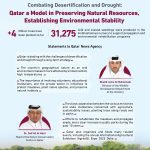
Combating Desertification and Drought: Qatar a Model in Preserving Natural Resources, Establishing Environmental Stability
UAE allocates US$30 million for emergency humanitarian response in El Obeid, calls for civilian protection, safe humanitarian aid access in Sudan

Amman, May 15 (Petra) – Minister of Transport Wissam Tahtamouni on Thursday said Jordan places “high” priority on the transport sector due to its “vital” role in stimulating economic growth, facilitating trade, and supporting tourism.
Tahtamouni noted the ministry is “actively” working to enhance the sector’s “efficiency” and achieve integration with the broader Arab region.
Tahtamouni made the remarks while presiding over the opening ceremony of the 38th General Assembly of the Arab Union of Land Transport (AULT), held in Amman, praising the union’s efforts in supporting pan-Arab economic integration and strengthening the region’s land transport systems.
“We value the AULT’s initiatives in setting technical standards for transporting hazardous materials, advancing the Unified Arab Traffic Project, and building sectoral capacity, which are essential steps to create a safe and sustainable Arab transport system,” she said.
Emphasizing the importance of boosting Arab cooperation, she called on activating transit agreements and streamlining cross-border procedures.
Additionally, she reiterated Jordan’s ongoing commitment to serving as a “strategic” link for advancing Arab integration in the transport sector.
The assembly was attended by AULT Secretary-General, Malek Haddad, Chairman Khalid Al-Hogail, General Assembly members, and representatives from the Council of Arab Economic Unity and the Technical Secretariat of the Council of Arab Ministers of Transport, alongside transport experts from across the Arab world.
Talking to the event, Haddad said the session is a “pivotal” opportunity to assess progress and explore future cooperation avenues.
Haddad also noted the AULT General Secretariat has made “significant” strides in modernizing Arab land transport, including contributions to a unified curriculum for the transport of dangerous goods developed in collaboration with the International Road Transport Union and the Council of Arab Ministers of Transport.
Haddad highlighted progress in digitizing the unified Arab traffic book and launching training programs for drivers and sector personnel through automobile clubs in Arab countries, stating: “These achievements reflect collective efforts, but much work is needed to achieve our shared goals.”
For his part, Al-Hogail underscored the importance of deepening inter-Arab transportation and trade cooperation, affirming integration in the transport sector is a “key” pillar for promoting economic growth and enabling “smoother” movement of goods and people across the region.
//Petra// AO
15/05/2025 15:54:37