Jordan’s Q2 2026 GDP Expands 3.0%, Outperforming Regional Headwinds, International Forecasts
ENV-KUWAIT-SUSTAINABLITYKuwait strengthens environmental sustainability through strategic initiativesBy Zahra Al-Kadhmi

HLT-KUWAIT-SURGERYKuwait advances health sector with robotic, remote surgeryBy Mohammad Al-Moseb

Saudi Arabia’s Voluntary Carbon Market Fuels the Shift to a Low-Carbon

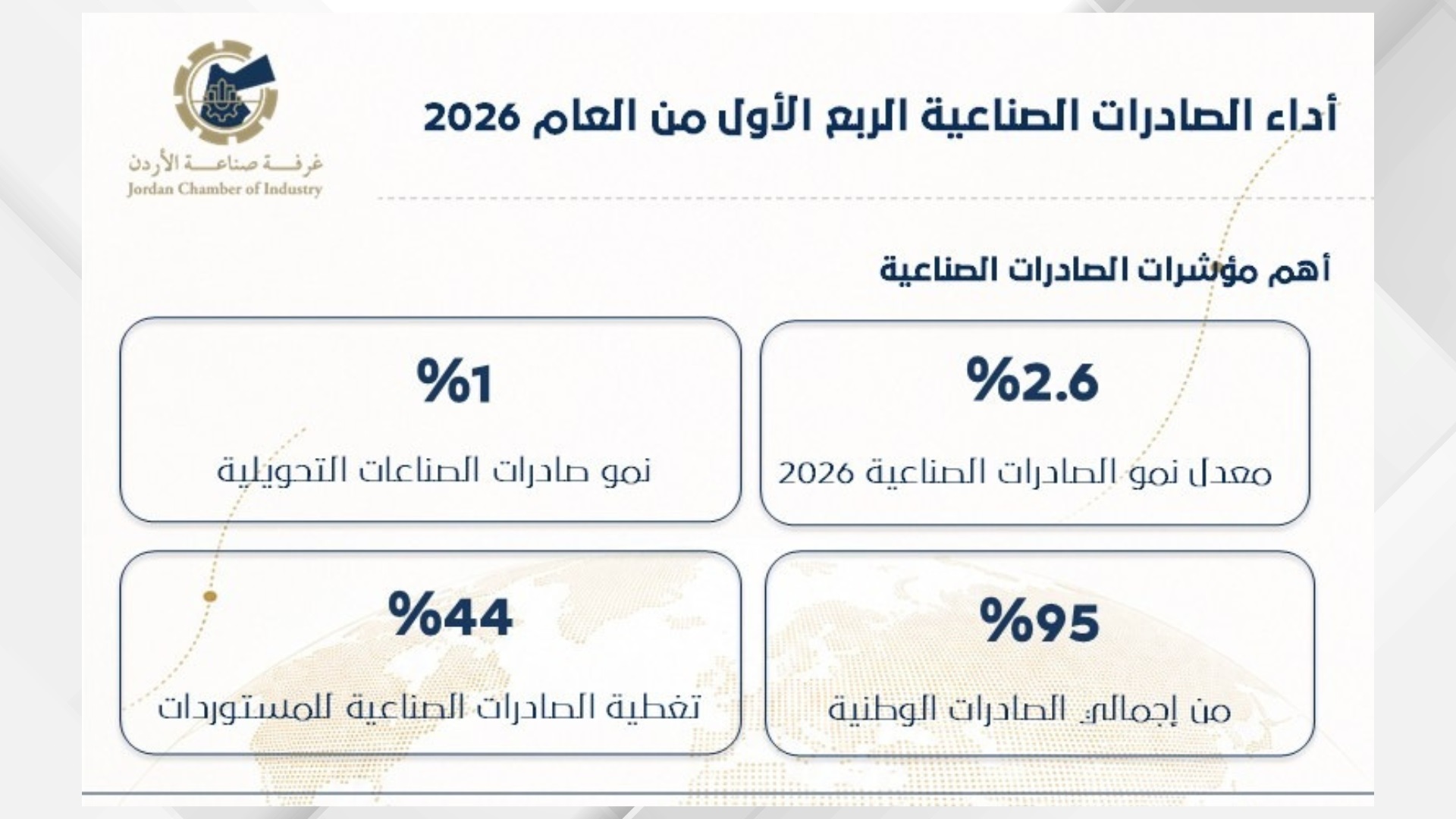
Amman, June 6 (Petra) – Jordanian industrial exports increased by 2.6
per cent during the first quarter of 2026 compared with the same
period last year, driven by stronger demand in Asian and European
markets.
According to figures released by the Jordan Chamber of Industry,
industrial exports reached JD2.027 billion during the first three
months of the year, up from JD1.976 billion in the corresponding
period of 2025.
Industrial exports accounted for 95 per cent of Jordan’s total
national exports, which stood at JD2.129 billion during the first
quarter.
Statistics prepared by the Chamber’s Studies and Policies Department
showed that exports of manufactured goods rose by 1 per cent, while
the ratio of industrial exports to imports reached 44 per cent.
Industrial exports recorded steady monthly growth during the quarter,
reaching JD677 million in January, JD607 million in February and
JD743 million in March.
Switzerland emerged as the fastest-growing market for Jordanian
industrial exports, receiving goods worth JD118 million, an increase
of 306 per cent. Exports to China reached JD101 million, up 75 per
cent.
Other major growth markets included the Netherlands, with exports
valued at JD48 million, up 129 per cent; Syria, JD77 million, up 44
per cent; Belgium, JD37 million, up 79 per cent; and Thailand, JD34
million, up 127 per cent.
By export share, the United States remained Jordan’s largest
industrial export destination, accounting for JD457 million, or 21
per cent of total industrial exports.
Saudi Arabia followed with JD224 million (11 per cent), Iraq with
JD193 million (9 per cent) and India with JD170 million (8 per cent).
The chemical and cosmetics sector led exporting industries during the
quarter with exports worth JD450 million, followed by leather and
textiles at JD417 million, engineering and electrical industries at
JD384 million, mining industries at JD279 million and food and
beverage industries at JD255 million.
Pharmaceuticals and medical supplies exports totaled JD147 million,
followed by plastics and rubber products at JD41 million,
construction materials at JD40 million, packaging products at JD35
million and wood and furniture products at JD9 million.
The Kingdom’s leading industrial export products included clothing
and related textiles valued at JD193 million, raw potash at JD167
million and pharmaceuticals at JD147 million.
Other key exports included aluminum products and derivatives worth
JD38 million, copper products at JD29 million, organic chemical
products at JD28 million, cement at JD24 million and lubricants at
JD11 million.
Jordan Chamber of Industry President Fathi Jaghbeer said European and
Asian markets were the main drivers of export growth during the first
quarter.
He noted that exports to non-EU European countries rose by
approximately JD95 million, or 114 per cent, while exports to
European Union countries increased by about JD72 million or 71 per
cent.
Exports to East Asian markets rose by approximately JD44 million, or
56 per cent, while exports to other Asian countries increased by
around JD30 million, or 33 per cent.
Jaghbeer said the figures reflect the success of Jordanian industry
in expanding its presence in European and Asian markets and
diversifying its export base, enhancing its ability to withstand
challenges in traditional markets.
He added that Switzerland contributed the most to export growth, with
exports increasing by approximately JD89 million compared with the
same period last year, followed by China with an increase of JD43
million, the Netherlands with JD27 million and Syria with JD24
million.
Despite the overall growth, exports to several key markets declined.
Industrial exports to the United States fell by approximately JD102
million, 18 per cent, while exports to India dropped by JD35 million,
17 percent.
Exports to Iraq decreased by JD28 million, 13 per cent, and exports
to Saudi Arabia fell by JD17 million, 7 per cent.
“Despite this, Jordanian industry succeeded in achieving positive
export growth, reflecting the sector’s resilience and ability to
adapt to shifts in global markets,” Jaghbeer said.
//Petra// AK